Crisis Assessment Expert
Description
Transform crisis chaos into clarity. Guided by the principle that 'the first report is always wrong', this AI systematically verifies information to uncover the truth amid uncertainty. Make rational decisions, not reactive mistakes.
Related Skills
View all
Top 10 Cognitive Bias Shield
Enable this skill when tasks involve objective judgment, decision analysis, content creation, knowledge organization, design review, pricing strategy, or logical reasoning. It enforces comprehensive resistance against cognitive biases—with confirmation bias as the central challenge—while systematically defeating anchoring, survivorship bias, the Dunning–Kruger effect, loss aversion, the planning fallacy, and the halo effect. Use this skill when output quality depends on rationality, truth, and freedom from mental shortcuts rather than intuition or preference.
 Write
WriteAccident Root Cause & Actions
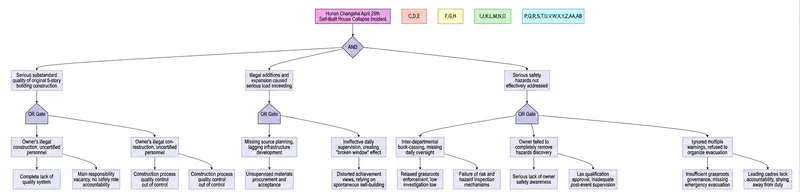
Do you find yourself repeatedly asking these questions in safety management? An accident analysis report runs dozens of pages, yet its conclusions still stop at “employee violated procedures” or “weak safety awareness,” leaving the real cause undiscovered? You issue a long list of corrective actions, but they amount to vague statements like “strengthen training” and “improve systems”—with no clear path to implementation, while similar accidents continue to happen? The accident investigation report contains extensive details, but you do not know how to organize them into a clear chain of causation that lets management see the root problem at a glance? When facing a regulatory or group review, you need a rigorous, layered analysis, but the tools available are either too superficial or too theoretical to reflect real-world conditions? You want to use external accident cases for internal safety awareness, but worry that exposing company names could create unnecessary public-opinion risks? Effective safety management is not about assigning “blame” after an incident; it is about identifying causes in advance. Only by uncovering the problems embedded deep within the organization can corrective actions truly take hold. This Skill is an intelligent assistant that provides in-depth analysis and improvement recommendations like an experienced safety expert. What is it? A professional tool that analyzes the root causes of an accident and generates actionable recommendations based on the original accident investigation report. It avoids generalities and stays faithful to the source material you provide, accurately extracting key information, reconstructing what happened, and tracing the causes layer by layer like a detective until it reaches the underlying systemic defects. How does it work? Reach the root cause in three steps Provide the accident investigation report — Upload or paste the complete investigation report, internal notice, or detailed description of the accident; Automatic in-depth analysis — The tool intelligently extracts key information from the report, including the timeline, actions of involved personnel, equipment status, and descriptions of management systems. It objectively reconstructs the accident in detail and ensures that every analysis remains faithful to the source material without subjective assumptions; Get layered diagnoses and improvement prescriptions — You will receive a clearly structured analysis report that can be put into practice directly. Why can its framework “peel back the layers”? Unlike traditional accident analysis, this tool clearly divides causes into three levels, making problems easier to see, address, and fix: Level 1: Direct causes — Identifies the specific actions or conditions that led to the accident, such as “an employee failed to close a valve according to procedure” or “a safety interlock on a piece of equipment failed.” These are the immediate triggers of the accident and the easiest facts to observe. Level 2: Contributing causes — Reveals systemic problems in company management, such as gaps in procedures, insufficient training, inadequate supervision, or incomplete maintenance. For example: “The operating procedure for this position did not specify the emergency shutdown process” or “The equipment had not received a periodic inspection in the past year.” These are the conditions that allowed the direct causes to arise. Level 3: Root causes — Further uncovers deep defects in the company’s safety management system or safety culture, such as “Long-term underinvestment in safety left aging equipment without timely replacement,” “Management prioritized production over safety, with assessment metrics disconnected from safety performance,” or “Safety responsibilities weakened at each level, leaving frontline employees afraid to report hazards.” These are the areas that truly require fundamental corrective action. All analysis remains strictly focused on the company’s internal situation, and company names are anonymized to ensure safe, objective discussion suitable for internal analysis and external communication. Why are the improvement recommendations actionable? For every identified cause, the tool generates specific, executable measures that can be implemented—not empty phrases like “strengthen management.” For example: Identified cause Corresponding improvement recommendation (example) Direct cause: The valve was not closed as required Revise the operating procedure for the position to add a step requiring two-person confirmation and signatures after the valve is closed; install a position sensor on the valve and connect it to the central control system for alarm notifications Contributing cause: No equipment inspection was conducted in the past year Create an annual inspection plan for this type of equipment, specifying the inspection cycle and responsible person; include inspection results in the equipment records, with automatic reminders for overdue inspections Root cause: Insufficient safety investment and aging equipment Create a dedicated budget for safety equipment upgrades in the annual budget; include equipment safety status in the workshop director’s monthly performance evaluation, with a weighting of no less than 15% Every recommendation specifies “who will do what, how, and by when,” avoiding vague language and helping companies effectively prevent similar accidents while continuously improving workplace safety. Broad, practical use cases Accident reviews and internal analysis meetings — Provide objective, in-depth analysis materials and guide discussions from “assigning blame” toward “improvement”; Corrective action planning — Generate a corrective-action task list directly from the analysis conclusions, with clear ownership and specific measures; Submitting accident analysis reports to regulators or group headquarters — Provide a rigorous, clearly structured professional report; Developing safety training materials — Turn your company’s or industry peers’ accident cases into real and persuasive teaching materials; Safety management system reviews and upgrades — Extract systemic issues from individual accidents and drive broader improvements to the management system. More than an analysis report Ultimately, you will receive a complete, ready-to-use deliverables package, including: Accident reconstruction summary: An objective timeline based on the source material; Three-level cause analysis table: A clear side-by-side view of direct, contributing, and root causes; Targeted improvement action list: Every measure corresponds to a specific cause and defines the implementation direction and acceptance criteria; Analysis explanation document: An explanation of the analytical logic and reasoning process, making it easier to explain and advance the findings with your team. All content anonymizes company names to ensure safety and practical use. So, the next time you face an accident report and are no longer satisfied with shallow, incident-by-incident conclusions, do not rely on intuition or generic templates. Give it a real report, and it will return a deep, actionable plan for systematic improvement. Uncover the root cause to truly prevent further loss—and give every “why” an answer.

Crisis Response Expert
Navigate any crisis with strategic clarity. Generate multi-plan options, assess risks, control the pace like an experienced expert, prevent panic from spreading, and ensure decisive action.
Crisis Assessment Expert
Description
Transform crisis chaos into clarity. Guided by the principle that 'the first report is always wrong', this AI systematically verifies information to uncover the truth amid uncertainty. Make rational decisions, not reactive mistakes.
Related Skills
View allTop 10 Cognitive Bias Shield
Enable this skill when tasks involve objective judgment, decision analysis, content creation, knowledge organization, design review, pricing strategy, or logical reasoning. It enforces comprehensive resistance against cognitive biases—with confirmation bias as the central challenge—while systematically defeating anchoring, survivorship bias, the Dunning–Kruger effect, loss aversion, the planning fallacy, and the halo effect. Use this skill when output quality depends on rationality, truth, and freedom from mental shortcuts rather than intuition or preference.
WriteAccident Root Cause & Actions
Do you find yourself repeatedly asking these questions in safety management? An accident analysis report runs dozens of pages, yet its conclusions still stop at “employee violated procedures” or “weak safety awareness,” leaving the real cause undiscovered? You issue a long list of corrective actions, but they amount to vague statements like “strengthen training” and “improve systems”—with no clear path to implementation, while similar accidents continue to happen? The accident investigation report contains extensive details, but you do not know how to organize them into a clear chain of causation that lets management see the root problem at a glance? When facing a regulatory or group review, you need a rigorous, layered analysis, but the tools available are either too superficial or too theoretical to reflect real-world conditions? You want to use external accident cases for internal safety awareness, but worry that exposing company names could create unnecessary public-opinion risks? Effective safety management is not about assigning “blame” after an incident; it is about identifying causes in advance. Only by uncovering the problems embedded deep within the organization can corrective actions truly take hold. This Skill is an intelligent assistant that provides in-depth analysis and improvement recommendations like an experienced safety expert. What is it? A professional tool that analyzes the root causes of an accident and generates actionable recommendations based on the original accident investigation report. It avoids generalities and stays faithful to the source material you provide, accurately extracting key information, reconstructing what happened, and tracing the causes layer by layer like a detective until it reaches the underlying systemic defects. How does it work? Reach the root cause in three steps Provide the accident investigation report — Upload or paste the complete investigation report, internal notice, or detailed description of the accident; Automatic in-depth analysis — The tool intelligently extracts key information from the report, including the timeline, actions of involved personnel, equipment status, and descriptions of management systems. It objectively reconstructs the accident in detail and ensures that every analysis remains faithful to the source material without subjective assumptions; Get layered diagnoses and improvement prescriptions — You will receive a clearly structured analysis report that can be put into practice directly. Why can its framework “peel back the layers”? Unlike traditional accident analysis, this tool clearly divides causes into three levels, making problems easier to see, address, and fix: Level 1: Direct causes — Identifies the specific actions or conditions that led to the accident, such as “an employee failed to close a valve according to procedure” or “a safety interlock on a piece of equipment failed.” These are the immediate triggers of the accident and the easiest facts to observe. Level 2: Contributing causes — Reveals systemic problems in company management, such as gaps in procedures, insufficient training, inadequate supervision, or incomplete maintenance. For example: “The operating procedure for this position did not specify the emergency shutdown process” or “The equipment had not received a periodic inspection in the past year.” These are the conditions that allowed the direct causes to arise. Level 3: Root causes — Further uncovers deep defects in the company’s safety management system or safety culture, such as “Long-term underinvestment in safety left aging equipment without timely replacement,” “Management prioritized production over safety, with assessment metrics disconnected from safety performance,” or “Safety responsibilities weakened at each level, leaving frontline employees afraid to report hazards.” These are the areas that truly require fundamental corrective action. All analysis remains strictly focused on the company’s internal situation, and company names are anonymized to ensure safe, objective discussion suitable for internal analysis and external communication. Why are the improvement recommendations actionable? For every identified cause, the tool generates specific, executable measures that can be implemented—not empty phrases like “strengthen management.” For example: Identified cause Corresponding improvement recommendation (example) Direct cause: The valve was not closed as required Revise the operating procedure for the position to add a step requiring two-person confirmation and signatures after the valve is closed; install a position sensor on the valve and connect it to the central control system for alarm notifications Contributing cause: No equipment inspection was conducted in the past year Create an annual inspection plan for this type of equipment, specifying the inspection cycle and responsible person; include inspection results in the equipment records, with automatic reminders for overdue inspections Root cause: Insufficient safety investment and aging equipment Create a dedicated budget for safety equipment upgrades in the annual budget; include equipment safety status in the workshop director’s monthly performance evaluation, with a weighting of no less than 15% Every recommendation specifies “who will do what, how, and by when,” avoiding vague language and helping companies effectively prevent similar accidents while continuously improving workplace safety. Broad, practical use cases Accident reviews and internal analysis meetings — Provide objective, in-depth analysis materials and guide discussions from “assigning blame” toward “improvement”; Corrective action planning — Generate a corrective-action task list directly from the analysis conclusions, with clear ownership and specific measures; Submitting accident analysis reports to regulators or group headquarters — Provide a rigorous, clearly structured professional report; Developing safety training materials — Turn your company’s or industry peers’ accident cases into real and persuasive teaching materials; Safety management system reviews and upgrades — Extract systemic issues from individual accidents and drive broader improvements to the management system. More than an analysis report Ultimately, you will receive a complete, ready-to-use deliverables package, including: Accident reconstruction summary: An objective timeline based on the source material; Three-level cause analysis table: A clear side-by-side view of direct, contributing, and root causes; Targeted improvement action list: Every measure corresponds to a specific cause and defines the implementation direction and acceptance criteria; Analysis explanation document: An explanation of the analytical logic and reasoning process, making it easier to explain and advance the findings with your team. All content anonymizes company names to ensure safety and practical use. So, the next time you face an accident report and are no longer satisfied with shallow, incident-by-incident conclusions, do not rely on intuition or generic templates. Give it a real report, and it will return a deep, actionable plan for systematic improvement. Uncover the root cause to truly prevent further loss—and give every “why” an answer.
Crisis Response Expert
Navigate any crisis with strategic clarity. Generate multi-plan options, assess risks, control the pace like an experienced expert, prevent panic from spreading, and ensure decisive action.
Find your next favorite skill
Explore more curated AI skills for research, creation, and everyday work.