Cosmic Insight
Description
Automatically searches multiple platforms for news in finance, tech, or business topics, filters preliminary and core clues, and uncovers related events within 10 years to output a structured topic analysis report. Step 1: Multi-Source Information Collection - Search news from the past 30 days covering WeChat official accounts, Wall Street CN, 36Kr (high weight), Huxiu, Xueqiu, TMTpost (standard weight) - Record title, time, platform, summary, original links - Initially filter duplicates, ads, and low-credibility content Step 2: Information Deduplication and Aggregation - Aggregate the same event by core object, core fact, and time window (within 7 days) - Count how many independent sources mention it - Remove low-value events, output a candidate event list Step 3: Event Analysis and Clue Classification Preliminary clues (any one): abnormal events, high discussion (more than 3 sources), unusual changes, major industry milestones, negative news about large companies Core clues (2 or more): dramatic conflict, room for meaning exploration, more than 3 entities, timeliness (within 14 days) - At least 5 core clues, total 10-25 clues - Each clue includes: event title, summary, deep analysis of writing value, criteria met Step 4: Deep Association Mining - Expand search scope to 10 years - Extract key entities, search: historical nodes of the subject, industry policy evolution, competitor dynamics over the same period, upstream and downstream industry chain changes - Include any association, note association type and year Step 5: Structured Output Output includes: 1. Core clues block; 2. Preliminary clues block; 3. Research suggestions Each clue includes: event overview, criteria met, deep writing value analysis, related events (10-year history), reference links Tools: Web search, long document generation Reference resources: None fixed; user can attach at input.
Related Skills
View all
Research Report Generator
📝 Value in one sentence: Enter a topic or upload materials, and AI handles the entire process from organizing sources to drafting. 🔍 Core features: Smart source integration: Upload multiple documents and AI automatically extracts key viewpoints, critical data, and representative cases, while removing duplicates and flagging conflicts. Automatic outline generation: Based on the topic or source content, it creates a logically clear and well-structured article outline. One-click draft writing: Generates content section by section according to the outline, with every data point and case study source-tagged and traceable. Five writing styles: Supports formal reports, WeChat articles, Xiaohongshu notes, academic papers, and business briefings. Transparent citations: Every figure and viewpoint is marked with its source—no fabrication or invention. Automated content workflow: Source parsing → viewpoint extraction → outline generation → writing in five styles. 🎯 Use cases: 📊 Industry research: Enter "Humanoid Robot Industry 2026" to generate a draft analysis report with data and case studies. 📝 Content creation: Upload 3 related articles to combine into an in-depth WeChat article. 📚 Academic writing: Upload multiple paper abstracts to create a literature review draft. 📋 Competitor analysis: Upload several competitor documents to instantly generate a comparative analysis report. 🧠 Personal learning: Enter a new-domain topic to quickly generate a knowledge overview. 💼 Business decisions: Input business data and background information to produce a decision brief for the CEO. 👩💼 Who it's for: Researchers, analysts, content creators, product managers, students, and consultants—anyone who needs to quickly produce high-quality first drafts.
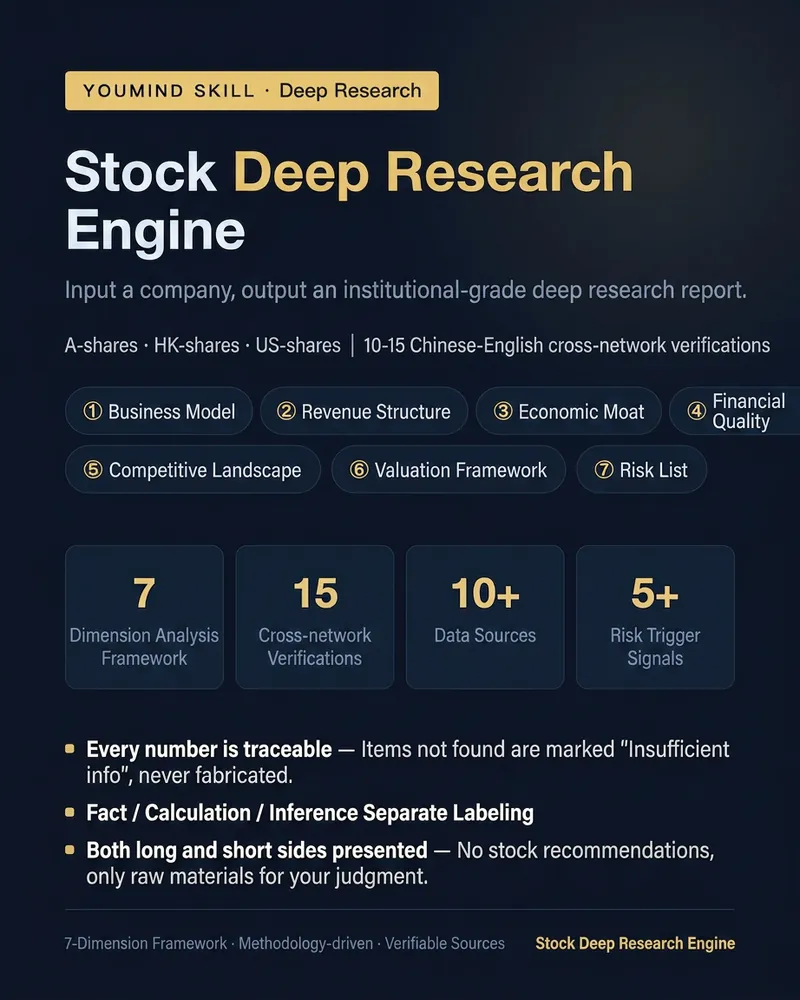
Deep Stock Research Engine
Not a news summary, but an individual stock research report with a methodological framework. Enter a company (A-share/H-share/US stock name or code), and it will perform 10-15 bilingual web searches to produce a report based on a seven-dimension framework: ① Business Model – where money comes from and goes, with a "translated into plain language" version ② Revenue Structure – breakdown by business, growth engines and drags ③ Moat – mandatory answer on widening or narrowing, using market share, gross margin, and pricing power ④ Financial Quality – cash flow vs profit alignment, changes in receivables, inventory, and goodwill ⑤ Competitive Landscape – competitor comparison table and concentration direction ⑥ Valuation Framework – only data and calculation framework, no judgment of over/undervaluation ⑦ Risk List – sorted by impact, each with verifiable trigger signals Each report includes: a one-page bull/bear summary (with substantial evidence on both sides), a next-quarter tracking list, and data sources for each point. Three iron rules: · Each key number is traceable to official filings or authoritative media; if not found, labeled 'insufficient information', never fabricated · Facts, calculations, and inferences are labeled separately · No stock price predictions, no target prices, no buy/sell advice – even for 'should I buy', only bull/bear evidence is given Supports three perspectives: Understand the Business (default), Financial Checkup, and Company Comparison. Suitable for investment researchers, financial content creators, and serious investors who want to systematically understand a company.
 Research
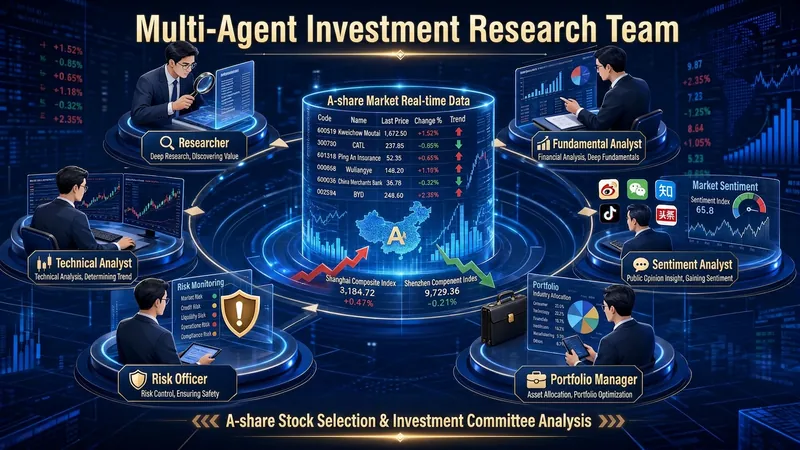
Multi-Agent: A-Share Pick & IC
It's not an AI assistant, but a virtual investment research team. Common AI stock-picking tools suffer from three problems: fabricating financial figures and target prices, giving vague "bullish/bearish" remarks, and offering "buy" recommendations without clear reasoning. The Multi-Agent Investment Research Team tackles these with a three-pronged approach: 6 parallel roles, cross-validation, and mandatory source attribution. It convenes researchers, fundamental analysts, technical analysts, sentiment analysts, risk officers, and investment managers to work in parallel, deliberating like a real investment committee. What you get is not fuzzy opinions, but a professional research document with facts, signals, disagreements, risks, and every number traceable to its source. Two modes covering "researching a single stock" and "screening a batch of stocks" Mode A: Single-Stock Committee Deep Analysis — Just provide a stock (e.g., "Analyze BYD 002594"), and the skill automatically convenes a full investment committee: the researcher aggregates market data, financial reports, research reports, and industry chain positioning, presenting only objective facts; the fundamental analyst issues a financial health scorecard, key changes in the three financial statements, and PEG valuation; the technical analyst evaluates trends, moving averages, MACD, support and resistance levels, and provides a five-point buy signal hit table; the sentiment analyst scans institutional divergence, retail investor sentiment, and potential misinterpretations; the risk officer digs up counter-evidence, systematically refuting optimistic conclusions from other roles; finally, the investment manager, without adding new data, integrates everything to produce committee minutes and a one-page summary. Mode B: Multi-Condition Stock Screening — From a specified universe (e.g., CSI 300, a sector/theme basket, or your own stock pool), apply a three-layer funnel: L1 financial hard screen (three consecutive quarters of growth, ample cash flow, PEG<1 or huge increase in contract liabilities), L2 technical timing (base breakout, moving average golden cross, volume breakout, strong pullback on low volume, MACD crossing above zero line), L3 information validation (research report ratings and industry chain logic, eliminating "pure technical without fundamental basis" picks). After obtaining a candidate list, the top N stocks can automatically proceed to Mode A for deep analysis. What you will get Mode A delivers a fixed "five-piece set": ① Full analysis report integrating all six roles; ② Data source and evidence table, with each key conclusion mapped to "data → source → date"; ③ Meeting-style committee minutes (agenda → each role's view → disagreements → consensus → variables to track); ④ Risk list sorted by high/medium/low severity; ⑤ One-page investment manager summary condensing core logic, key variables, verification points, and confidence level. Mode B delivers: Candidate stock list table (ticker | name | triggered conditions | key data | source | trigger date) plus screening criteria and methodology description, optionally with the full five-piece set for top candidates. All outputs are saved as files with ticker and date in the filename for easy reuse and archiving.
Cosmic Insight
Description
Automatically searches multiple platforms for news in finance, tech, or business topics, filters preliminary and core clues, and uncovers related events within 10 years to output a structured topic analysis report. Step 1: Multi-Source Information Collection - Search news from the past 30 days covering WeChat official accounts, Wall Street CN, 36Kr (high weight), Huxiu, Xueqiu, TMTpost (standard weight) - Record title, time, platform, summary, original links - Initially filter duplicates, ads, and low-credibility content Step 2: Information Deduplication and Aggregation - Aggregate the same event by core object, core fact, and time window (within 7 days) - Count how many independent sources mention it - Remove low-value events, output a candidate event list Step 3: Event Analysis and Clue Classification Preliminary clues (any one): abnormal events, high discussion (more than 3 sources), unusual changes, major industry milestones, negative news about large companies Core clues (2 or more): dramatic conflict, room for meaning exploration, more than 3 entities, timeliness (within 14 days) - At least 5 core clues, total 10-25 clues - Each clue includes: event title, summary, deep analysis of writing value, criteria met Step 4: Deep Association Mining - Expand search scope to 10 years - Extract key entities, search: historical nodes of the subject, industry policy evolution, competitor dynamics over the same period, upstream and downstream industry chain changes - Include any association, note association type and year Step 5: Structured Output Output includes: 1. Core clues block; 2. Preliminary clues block; 3. Research suggestions Each clue includes: event overview, criteria met, deep writing value analysis, related events (10-year history), reference links Tools: Web search, long document generation Reference resources: None fixed; user can attach at input.
Related Skills
View allResearch Report Generator
📝 Value in one sentence: Enter a topic or upload materials, and AI handles the entire process from organizing sources to drafting. 🔍 Core features: Smart source integration: Upload multiple documents and AI automatically extracts key viewpoints, critical data, and representative cases, while removing duplicates and flagging conflicts. Automatic outline generation: Based on the topic or source content, it creates a logically clear and well-structured article outline. One-click draft writing: Generates content section by section according to the outline, with every data point and case study source-tagged and traceable. Five writing styles: Supports formal reports, WeChat articles, Xiaohongshu notes, academic papers, and business briefings. Transparent citations: Every figure and viewpoint is marked with its source—no fabrication or invention. Automated content workflow: Source parsing → viewpoint extraction → outline generation → writing in five styles. 🎯 Use cases: 📊 Industry research: Enter "Humanoid Robot Industry 2026" to generate a draft analysis report with data and case studies. 📝 Content creation: Upload 3 related articles to combine into an in-depth WeChat article. 📚 Academic writing: Upload multiple paper abstracts to create a literature review draft. 📋 Competitor analysis: Upload several competitor documents to instantly generate a comparative analysis report. 🧠 Personal learning: Enter a new-domain topic to quickly generate a knowledge overview. 💼 Business decisions: Input business data and background information to produce a decision brief for the CEO. 👩💼 Who it's for: Researchers, analysts, content creators, product managers, students, and consultants—anyone who needs to quickly produce high-quality first drafts.
Deep Stock Research Engine
Not a news summary, but an individual stock research report with a methodological framework. Enter a company (A-share/H-share/US stock name or code), and it will perform 10-15 bilingual web searches to produce a report based on a seven-dimension framework: ① Business Model – where money comes from and goes, with a "translated into plain language" version ② Revenue Structure – breakdown by business, growth engines and drags ③ Moat – mandatory answer on widening or narrowing, using market share, gross margin, and pricing power ④ Financial Quality – cash flow vs profit alignment, changes in receivables, inventory, and goodwill ⑤ Competitive Landscape – competitor comparison table and concentration direction ⑥ Valuation Framework – only data and calculation framework, no judgment of over/undervaluation ⑦ Risk List – sorted by impact, each with verifiable trigger signals Each report includes: a one-page bull/bear summary (with substantial evidence on both sides), a next-quarter tracking list, and data sources for each point. Three iron rules: · Each key number is traceable to official filings or authoritative media; if not found, labeled 'insufficient information', never fabricated · Facts, calculations, and inferences are labeled separately · No stock price predictions, no target prices, no buy/sell advice – even for 'should I buy', only bull/bear evidence is given Supports three perspectives: Understand the Business (default), Financial Checkup, and Company Comparison. Suitable for investment researchers, financial content creators, and serious investors who want to systematically understand a company.
ResearchMulti-Agent: A-Share Pick & IC
It's not an AI assistant, but a virtual investment research team. Common AI stock-picking tools suffer from three problems: fabricating financial figures and target prices, giving vague "bullish/bearish" remarks, and offering "buy" recommendations without clear reasoning. The Multi-Agent Investment Research Team tackles these with a three-pronged approach: 6 parallel roles, cross-validation, and mandatory source attribution. It convenes researchers, fundamental analysts, technical analysts, sentiment analysts, risk officers, and investment managers to work in parallel, deliberating like a real investment committee. What you get is not fuzzy opinions, but a professional research document with facts, signals, disagreements, risks, and every number traceable to its source. Two modes covering "researching a single stock" and "screening a batch of stocks" Mode A: Single-Stock Committee Deep Analysis — Just provide a stock (e.g., "Analyze BYD 002594"), and the skill automatically convenes a full investment committee: the researcher aggregates market data, financial reports, research reports, and industry chain positioning, presenting only objective facts; the fundamental analyst issues a financial health scorecard, key changes in the three financial statements, and PEG valuation; the technical analyst evaluates trends, moving averages, MACD, support and resistance levels, and provides a five-point buy signal hit table; the sentiment analyst scans institutional divergence, retail investor sentiment, and potential misinterpretations; the risk officer digs up counter-evidence, systematically refuting optimistic conclusions from other roles; finally, the investment manager, without adding new data, integrates everything to produce committee minutes and a one-page summary. Mode B: Multi-Condition Stock Screening — From a specified universe (e.g., CSI 300, a sector/theme basket, or your own stock pool), apply a three-layer funnel: L1 financial hard screen (three consecutive quarters of growth, ample cash flow, PEG<1 or huge increase in contract liabilities), L2 technical timing (base breakout, moving average golden cross, volume breakout, strong pullback on low volume, MACD crossing above zero line), L3 information validation (research report ratings and industry chain logic, eliminating "pure technical without fundamental basis" picks). After obtaining a candidate list, the top N stocks can automatically proceed to Mode A for deep analysis. What you will get Mode A delivers a fixed "five-piece set": ① Full analysis report integrating all six roles; ② Data source and evidence table, with each key conclusion mapped to "data → source → date"; ③ Meeting-style committee minutes (agenda → each role's view → disagreements → consensus → variables to track); ④ Risk list sorted by high/medium/low severity; ⑤ One-page investment manager summary condensing core logic, key variables, verification points, and confidence level. Mode B delivers: Candidate stock list table (ticker | name | triggered conditions | key data | source | trigger date) plus screening criteria and methodology description, optionally with the full five-piece set for top candidates. All outputs are saved as files with ticker and date in the filename for easy reuse and archiving.
Find your next favorite skill
Explore more curated AI skills for research, creation, and everyday work.