Deep Long-Form Viral Rewrite
Description
Recommended by
nene@YouMind
Why we love this skill
This skill uses a unique four-step method—value clarification, structure building, accessible rewriting, and iterative optimization—to ensure in-depth long articles are both thoughtful and shareable, making even complex concepts become viral hits.
Rewrite complex, academic, or English articles into relatable, warm, and shareable viral deep content. Using a four-step method of value clarification, structural reorganization, accessible rewriting, and iterative refinement, it helps you create articles that resonate emotionally and offer rational value. Ideal for turning industry reports, academic papers, and long English articles into 100K+ viral hits.
Related Skills
View all Write
WriteViral WeChat Post Writing 2.0
This skill helps creators efficiently produce WeChat articles. Whether you're sharing practical knowledge, expressing in-depth opinions, telling emotional stories, or promoting products, it offers end-to-end support from headline ideas to content writing, making your words more appealing in a mobile reading environment. During the writing process, it provides viral headline suggestions in various styles, including numeric, suspense, and contrast-based formats, and matches the most suitable structural framework to your article's topic. Whether you're crafting a logic-driven practical summary or an emotionally resonant narrative, it ensures clear structure and logical flow, precisely reaching your target audience. In addition, this skill includes professional layout optimization recommendations and quality checks. By controlling paragraph length, refining sentence rhythm, and enhancing the readability of key information, it elevates the overall quality of your content. It also assists with SEO keyword placement and conversion goal guidance, so every piece you write not only reads smoothly but also achieves the desired reach and conversion results.
 Write
WriteAIGC Reduction & Rewrite v7.0
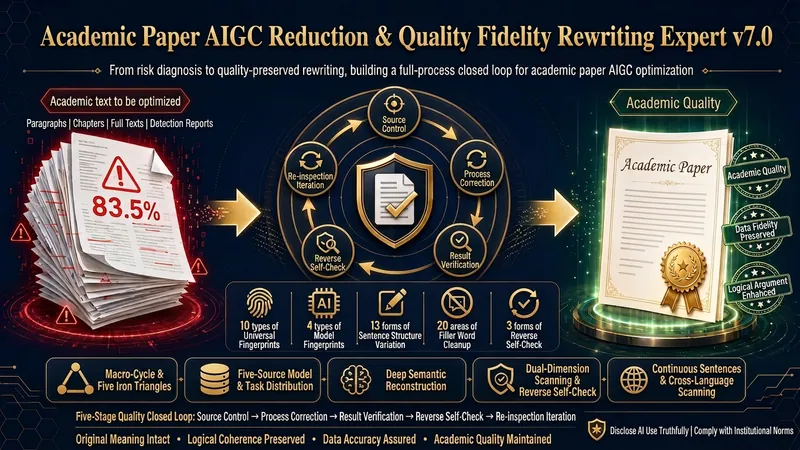
📚 Academic Paper AIGC Reduction and Quality-Preserving Rewriting Expert v7.0 Designed for graduate students, researchers, and paper authors, this academic text optimization skill operates on a core closed loop of 'source control → process correction → result verification → reverse self-check → iterative re-check'. It systematically diagnoses and optimizes issues such as templated expressions, mechanical logic, vague content, inaccurate terminology, and style inconsistencies while preserving original meaning, technical terms, data, and core conclusions. 🔍📝 🌟 Core Capabilities 🔬 Multi-layer Risk Diagnosis Covers 10 types of universal text fingerprints and assists in identifying common expression patterns of models such as ChatGPT, Claude, DeepSeek, and Wenxin Yiyan. 🧠 Deep Semantic Restructuring Goes beyond synonym replacement to rebuild more natural and in-depth academic reasoning by adjusting proposition expression, information order, argument approach, and evidence organization. ✍️ Quality-Preserving Rewriting Comprehensively applies 13 sentence transformation strategies and 20 methods for cleaning high-frequency templated expressions, improving mechanical sentence structures, repetitive connectors, and overly rigid formatting. 📊 Full-text Structure Diagnosis Through macro-cycle and five key triangles, checks whether research problems, theory, literature review, methods, results, conclusions, and innovation form a complete closed loop. 🧩 Fine-grained Section Adaptation Develops differentiated diagnostic and rewriting strategies for abstract, introduction, literature review, research methods, results, discussion, and conclusion respectively. 🌐 Cross-language Risk Scanning Assists in identifying translationese, passive voice stacking, long sentence nesting, and mixed Chinese-English formatting abnormalities to make Chinese academic expression more natural and accurate. 🔄 Reverse Self-check Loop After rewriting, re-verifies from three aspects: technique distribution, new text fingerprints, and information integrity, to avoid 'becoming more templated' or losing key content. 🛡️ Academic Integrity Protection Does not fabricate literature, data, cases, or policy evidence; separately marks information requiring author verification and reminds users to honestly disclose AI usage. 🎯 Use Cases ✅ Single paragraph or partial section optimization ✅ Targeted modification of marked paragraphs from inspection reports ✅ Polishing of abstract, introduction, literature review, discussion, and conclusion ✅ Full-text AIGC risk feature diagnosis ✅ Language and structure adaptation for target journals ✅ Pre-submission quality review and consistency check 📦 Final Deliverables 📄 Quality-preserving rewritten text 🔎 Risk and issue diagnosis report 🛠️ Rewriting strategy and technique description ✅ Reverse self-check and information integrity report 💡 Items requiring author verification and subsequent revision suggestions 🎓 Original meaning preserved · Logic intact · No fabricated data · Academic quality maintained ⚠️ This skill aims to improve academic expression quality and reduce text risk features. It does not guarantee passage through any specific detection platform or achieving a particular detection score.
 Write
WriteDeep Viral Content Architect
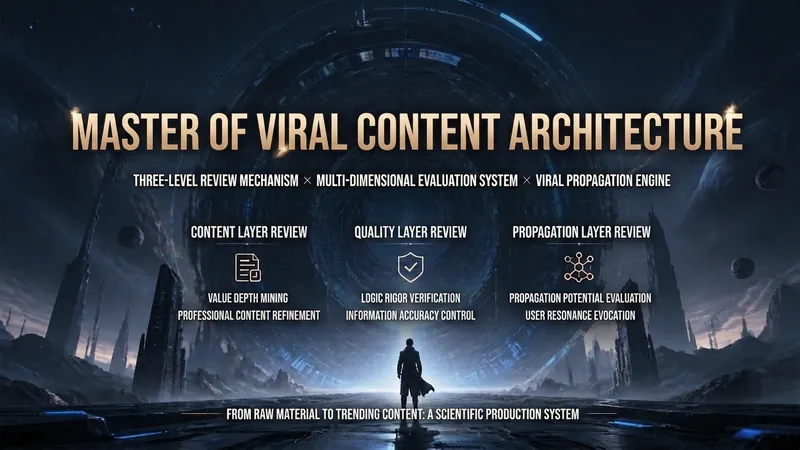
Uses a three-tier review mechanism (content, quality, and distribution layers) to transform raw materials into in-depth content that combines professional value with viral reach. Through a multi-dimensional evaluation system and phased confirmation process, it ensures the output can withstand professional scrutiny while triggering large-scale social sharing. Suitable for creation scenarios such as in-depth articles, professional reports, and paid knowledge content.
Deep Long-Form Viral Rewrite
Description
Recommended by
nene@YouMind
Why we love this skill
This skill uses a unique four-step method—value clarification, structure building, accessible rewriting, and iterative optimization—to ensure in-depth long articles are both thoughtful and shareable, making even complex concepts become viral hits.
Rewrite complex, academic, or English articles into relatable, warm, and shareable viral deep content. Using a four-step method of value clarification, structural reorganization, accessible rewriting, and iterative refinement, it helps you create articles that resonate emotionally and offer rational value. Ideal for turning industry reports, academic papers, and long English articles into 100K+ viral hits.
Related Skills
View allWriteViral WeChat Post Writing 2.0
This skill helps creators efficiently produce WeChat articles. Whether you're sharing practical knowledge, expressing in-depth opinions, telling emotional stories, or promoting products, it offers end-to-end support from headline ideas to content writing, making your words more appealing in a mobile reading environment. During the writing process, it provides viral headline suggestions in various styles, including numeric, suspense, and contrast-based formats, and matches the most suitable structural framework to your article's topic. Whether you're crafting a logic-driven practical summary or an emotionally resonant narrative, it ensures clear structure and logical flow, precisely reaching your target audience. In addition, this skill includes professional layout optimization recommendations and quality checks. By controlling paragraph length, refining sentence rhythm, and enhancing the readability of key information, it elevates the overall quality of your content. It also assists with SEO keyword placement and conversion goal guidance, so every piece you write not only reads smoothly but also achieves the desired reach and conversion results.
WriteAIGC Reduction & Rewrite v7.0
📚 Academic Paper AIGC Reduction and Quality-Preserving Rewriting Expert v7.0 Designed for graduate students, researchers, and paper authors, this academic text optimization skill operates on a core closed loop of 'source control → process correction → result verification → reverse self-check → iterative re-check'. It systematically diagnoses and optimizes issues such as templated expressions, mechanical logic, vague content, inaccurate terminology, and style inconsistencies while preserving original meaning, technical terms, data, and core conclusions. 🔍📝 🌟 Core Capabilities 🔬 Multi-layer Risk Diagnosis Covers 10 types of universal text fingerprints and assists in identifying common expression patterns of models such as ChatGPT, Claude, DeepSeek, and Wenxin Yiyan. 🧠 Deep Semantic Restructuring Goes beyond synonym replacement to rebuild more natural and in-depth academic reasoning by adjusting proposition expression, information order, argument approach, and evidence organization. ✍️ Quality-Preserving Rewriting Comprehensively applies 13 sentence transformation strategies and 20 methods for cleaning high-frequency templated expressions, improving mechanical sentence structures, repetitive connectors, and overly rigid formatting. 📊 Full-text Structure Diagnosis Through macro-cycle and five key triangles, checks whether research problems, theory, literature review, methods, results, conclusions, and innovation form a complete closed loop. 🧩 Fine-grained Section Adaptation Develops differentiated diagnostic and rewriting strategies for abstract, introduction, literature review, research methods, results, discussion, and conclusion respectively. 🌐 Cross-language Risk Scanning Assists in identifying translationese, passive voice stacking, long sentence nesting, and mixed Chinese-English formatting abnormalities to make Chinese academic expression more natural and accurate. 🔄 Reverse Self-check Loop After rewriting, re-verifies from three aspects: technique distribution, new text fingerprints, and information integrity, to avoid 'becoming more templated' or losing key content. 🛡️ Academic Integrity Protection Does not fabricate literature, data, cases, or policy evidence; separately marks information requiring author verification and reminds users to honestly disclose AI usage. 🎯 Use Cases ✅ Single paragraph or partial section optimization ✅ Targeted modification of marked paragraphs from inspection reports ✅ Polishing of abstract, introduction, literature review, discussion, and conclusion ✅ Full-text AIGC risk feature diagnosis ✅ Language and structure adaptation for target journals ✅ Pre-submission quality review and consistency check 📦 Final Deliverables 📄 Quality-preserving rewritten text 🔎 Risk and issue diagnosis report 🛠️ Rewriting strategy and technique description ✅ Reverse self-check and information integrity report 💡 Items requiring author verification and subsequent revision suggestions 🎓 Original meaning preserved · Logic intact · No fabricated data · Academic quality maintained ⚠️ This skill aims to improve academic expression quality and reduce text risk features. It does not guarantee passage through any specific detection platform or achieving a particular detection score.
WriteDeep Viral Content Architect
Uses a three-tier review mechanism (content, quality, and distribution layers) to transform raw materials into in-depth content that combines professional value with viral reach. Through a multi-dimensional evaluation system and phased confirmation process, it ensures the output can withstand professional scrutiny while triggering large-scale social sharing. Suitable for creation scenarios such as in-depth articles, professional reports, and paid knowledge content.
Find your next favorite skill
Explore more curated AI skills for research, creation, and everyday work.