AI Track Panorama Map
Description
Recommended by
nene@YouMind
Why we love this skill
This skill is essential for exploring AI sectors. It provides a panoramic view of the industry chain, player distribution, and customer profiles, and offers tailored entry paths and actionable checklists for both beginners and experts to seize AI opportunities.
Enter any AI track name to automatically generate a panoramic analysis across three dimensions: industry chain, player distribution, and customer profiles. It outputs a complete report document with a beginner's entry guide in Markdown format, including visual charts.
Related Skills
View all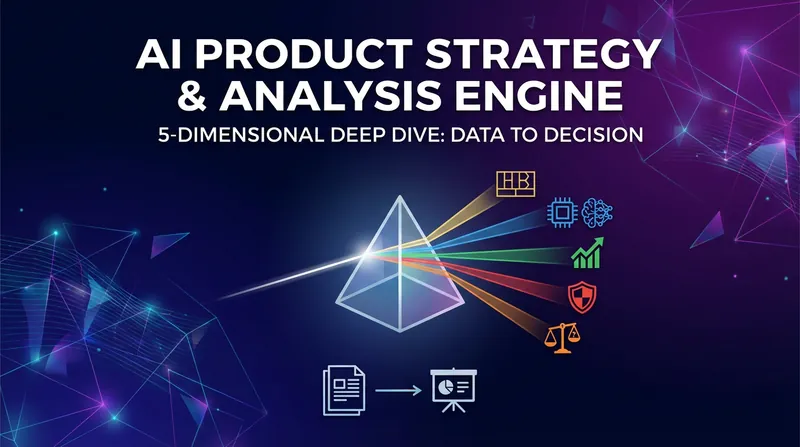
AI Product Teardown Specialist
Enter the name or link of any AI product, and automatically get a McKinsey-level five-dimensional deep teardown covering business model, technical architecture, growth strategy, competitive landscape, and risks & opportunities. Output a structured analysis report + PPT. Ideal for entrepreneurs, product managers, and investors to quickly grasp the core logic of an AI product.
 Research
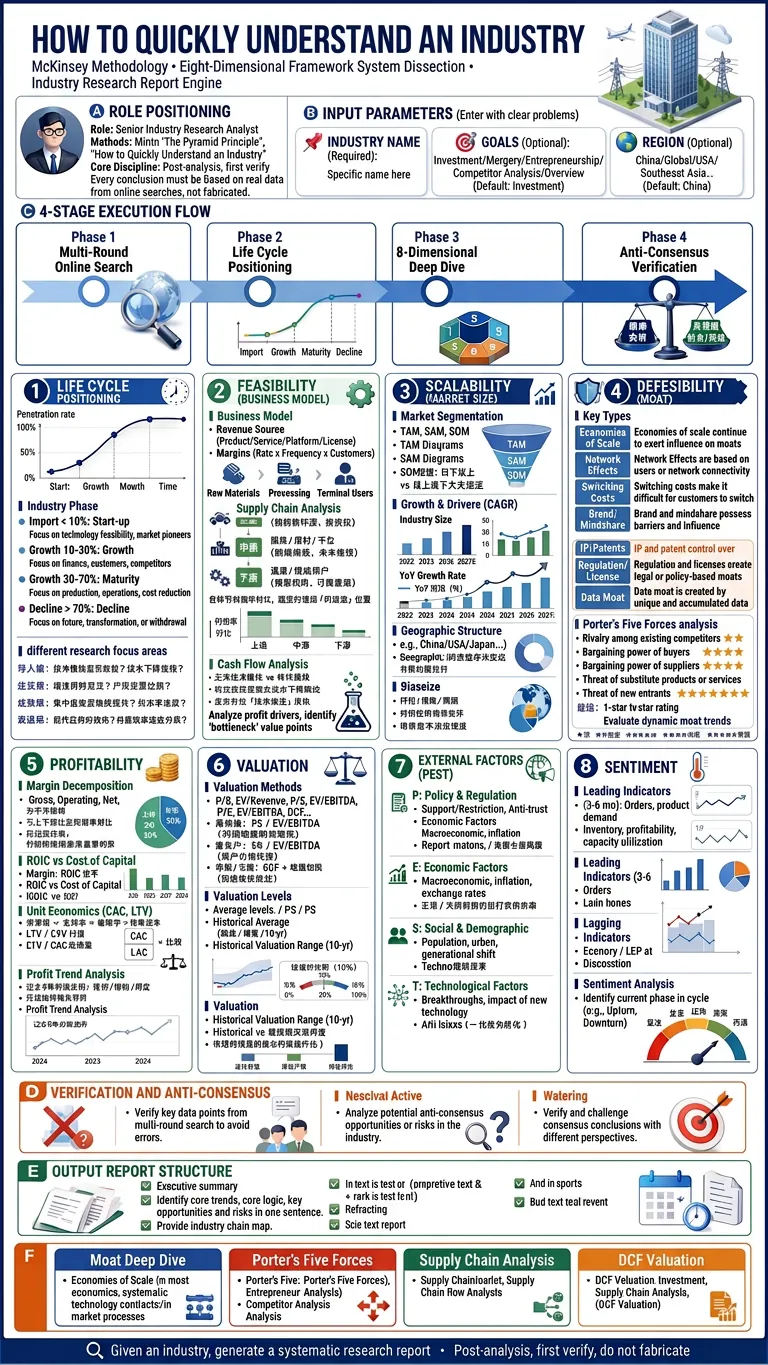
Rapid Industry Understanding
📋 Usage Guide This Skill is an industry research engine based on McKinsey methodology, using the eight-dimension framework from Xiao Jing's "How to Quickly Understand an Industry". Tell it an industry name, and it produces a systematic research report. —————————————————————————————— 🚀 Basic Usage Just tell me the industry you want to research—the more specific, the better: a. "Analyze the solid-state battery industry" b. "Look at the humanoid robot supply chain from an entrepreneurial perspective" c. "Is the solar industry still investable now?" You can optionally provide three details (if missing, I'll use defaults): 1. Industry name: be specific, e.g., "perovskite solar" instead of "new energy"—required; 2. Goal: investment / career / entrepreneurship / competitive analysis / education, default: investment; 3. Region: China market / global / US / Southeast Asia..., default: China market; —————————————————————————————— ⚙️ What it does automatically? The entire process has 4 stages: 1. Multi-round web searches for market size/growth/penetration rate, supply chain, competitive landscape, moat evidence, policy, valuation—every conclusion has a source and timestamp, never fabricated; 2. Lifecycle positioning: use penetration rate to determine if the industry is in introduction/growth/maturity/decline—different stages have completely different research focuses; 3. Eight-dimension deep dive: business model → market size → moat (forced deep dive into dynamic trends) → competitive landscape (forced scoring on each of Porter's Five Forces) → valuation → PEST → business cycle; 4. Contrarian check: distinguish market priced-in consensus from overlooked real issues, and provide decision recommendations; —————————————————————————————— 📊 What it outputs? A professional research report in Markdown format, structured as: 1. ⚡ 30-second verdict — stage / core profit logic / biggest opportunity / biggest risk / one-sentence conclusion; 2. Research object and boundary definition; 3. Lifecycle positioning (with penetration rate data); 4. Eight-dimension analysis (moat includes dynamic trend table, Porter's Five Forces scoring table); 5. Contrarian check; 6. Conclusion and decision recommendations; 7. Key risk list; 8. Data sources and time notes; —————————————————————————————— 🔑 Two Core Highlights 1. Forced deep dive on moat: not just the type of barrier, but must answer "has it widened or narrowed in the past 2-3 years?" using market share/gross margin/pricing power data; 2. Porter's Five Forces scored individually: all five forces scored to avoid shortcuts, determining who has the strongest bargaining power now and whether the landscape is favorable or deteriorating for leaders; —————————————————————————————— ⏱️ Time Approximately 2-4 minutes, due to multiple rounds of search + dimension-by-dimension analysis + report writing —————————————————————————————— 🧩 Subsequent Extensions After the report is generated, you can continue with two specialized analyses (requires manual confirmation, won't run automatically): 1. "Unchain to find bottlenecks": identify physical bottlenecks in the supply chain that can't be bypassed when trends scale, locking in true beneficiary targets; 2. "DCF valuation": run a full discounted cash flow model for a specific company within the industry; —————————————————————————————— ▶️ Want to try? Just tell me an industry name, e.g., "Take a look at the AI agent industry from an entrepreneurial perspective" or "What's the situation with the hydrogen energy supply chain?"
 Research
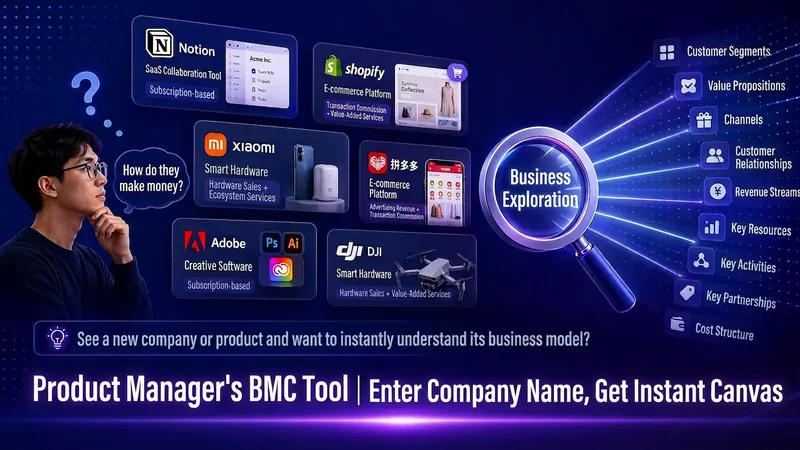
Product People's Business Canvas
Enter a company name and instantly get a business model canvas with 9 grids. Still opening ten tabs to piece together competitor analysis? Enter a company name, and this skill automatically searches online, cross-validates sources, and outputs a structured analysis report based on the 9 BMC modules. 🎯 Smart matching for 5 scenarios: Competitor research, learning about an interesting company, job application reference, investment reference, entrepreneurial inspiration—different purposes, different focus insights. 📊 3 output formats: Text document, canvas table, PPT presentation. 🔍 3 levels of analysis depth auto-adapt: From a quick question to a formal report. ✅ Strict source verification: Each citation is verified via actual access; invalid links are directly discarded, eliminating hallucinations. 🏷️ Information credibility labels: Each piece of info is marked as "Confirmed" or "Inferred", with traceable sources. 🚫 Zero fabrication commitment: If a company is not found, inform directly; do not fabricate or invent. From fragmented information to structured insights, product people instantly understand any company's business logic.
AI Track Panorama Map
Description
Recommended by
nene@YouMind
Why we love this skill
This skill is essential for exploring AI sectors. It provides a panoramic view of the industry chain, player distribution, and customer profiles, and offers tailored entry paths and actionable checklists for both beginners and experts to seize AI opportunities.
Enter any AI track name to automatically generate a panoramic analysis across three dimensions: industry chain, player distribution, and customer profiles. It outputs a complete report document with a beginner's entry guide in Markdown format, including visual charts.
Related Skills
View allAI Product Teardown Specialist
Enter the name or link of any AI product, and automatically get a McKinsey-level five-dimensional deep teardown covering business model, technical architecture, growth strategy, competitive landscape, and risks & opportunities. Output a structured analysis report + PPT. Ideal for entrepreneurs, product managers, and investors to quickly grasp the core logic of an AI product.
ResearchRapid Industry Understanding
📋 Usage Guide This Skill is an industry research engine based on McKinsey methodology, using the eight-dimension framework from Xiao Jing's "How to Quickly Understand an Industry". Tell it an industry name, and it produces a systematic research report. —————————————————————————————— 🚀 Basic Usage Just tell me the industry you want to research—the more specific, the better: a. "Analyze the solid-state battery industry" b. "Look at the humanoid robot supply chain from an entrepreneurial perspective" c. "Is the solar industry still investable now?" You can optionally provide three details (if missing, I'll use defaults): 1. Industry name: be specific, e.g., "perovskite solar" instead of "new energy"—required; 2. Goal: investment / career / entrepreneurship / competitive analysis / education, default: investment; 3. Region: China market / global / US / Southeast Asia..., default: China market; —————————————————————————————— ⚙️ What it does automatically? The entire process has 4 stages: 1. Multi-round web searches for market size/growth/penetration rate, supply chain, competitive landscape, moat evidence, policy, valuation—every conclusion has a source and timestamp, never fabricated; 2. Lifecycle positioning: use penetration rate to determine if the industry is in introduction/growth/maturity/decline—different stages have completely different research focuses; 3. Eight-dimension deep dive: business model → market size → moat (forced deep dive into dynamic trends) → competitive landscape (forced scoring on each of Porter's Five Forces) → valuation → PEST → business cycle; 4. Contrarian check: distinguish market priced-in consensus from overlooked real issues, and provide decision recommendations; —————————————————————————————— 📊 What it outputs? A professional research report in Markdown format, structured as: 1. ⚡ 30-second verdict — stage / core profit logic / biggest opportunity / biggest risk / one-sentence conclusion; 2. Research object and boundary definition; 3. Lifecycle positioning (with penetration rate data); 4. Eight-dimension analysis (moat includes dynamic trend table, Porter's Five Forces scoring table); 5. Contrarian check; 6. Conclusion and decision recommendations; 7. Key risk list; 8. Data sources and time notes; —————————————————————————————— 🔑 Two Core Highlights 1. Forced deep dive on moat: not just the type of barrier, but must answer "has it widened or narrowed in the past 2-3 years?" using market share/gross margin/pricing power data; 2. Porter's Five Forces scored individually: all five forces scored to avoid shortcuts, determining who has the strongest bargaining power now and whether the landscape is favorable or deteriorating for leaders; —————————————————————————————— ⏱️ Time Approximately 2-4 minutes, due to multiple rounds of search + dimension-by-dimension analysis + report writing —————————————————————————————— 🧩 Subsequent Extensions After the report is generated, you can continue with two specialized analyses (requires manual confirmation, won't run automatically): 1. "Unchain to find bottlenecks": identify physical bottlenecks in the supply chain that can't be bypassed when trends scale, locking in true beneficiary targets; 2. "DCF valuation": run a full discounted cash flow model for a specific company within the industry; —————————————————————————————— ▶️ Want to try? Just tell me an industry name, e.g., "Take a look at the AI agent industry from an entrepreneurial perspective" or "What's the situation with the hydrogen energy supply chain?"
ResearchProduct People's Business Canvas
Enter a company name and instantly get a business model canvas with 9 grids. Still opening ten tabs to piece together competitor analysis? Enter a company name, and this skill automatically searches online, cross-validates sources, and outputs a structured analysis report based on the 9 BMC modules. 🎯 Smart matching for 5 scenarios: Competitor research, learning about an interesting company, job application reference, investment reference, entrepreneurial inspiration—different purposes, different focus insights. 📊 3 output formats: Text document, canvas table, PPT presentation. 🔍 3 levels of analysis depth auto-adapt: From a quick question to a formal report. ✅ Strict source verification: Each citation is verified via actual access; invalid links are directly discarded, eliminating hallucinations. 🏷️ Information credibility labels: Each piece of info is marked as "Confirmed" or "Inferred", with traceable sources. 🚫 Zero fabrication commitment: If a company is not found, inform directly; do not fabricate or invent. From fragmented information to structured insights, product people instantly understand any company's business logic.
Find your next favorite skill
Explore more curated AI skills for research, creation, and everyday work.