Bibliometric Search Term Expert
Description
Why we love this skill
This skill is a powerful assistant for bibliometrics research. It deconstructs complex topics into 'concept family trees' and generates finely layered search queries for databases such as Web of Science and CNKI. It satisfies both 'breadth-first' and 'depth-first' retrieval needs, helping you obtain academic literature with precision and efficiency—an indispensable tool for researchers.
Build concept family trees like a bibliometrics expert. Generate high-precision, high-recall professional search queries for WoS and CNKI with one click, ensuring comprehensive and accurate literature research.
Related Skills
View all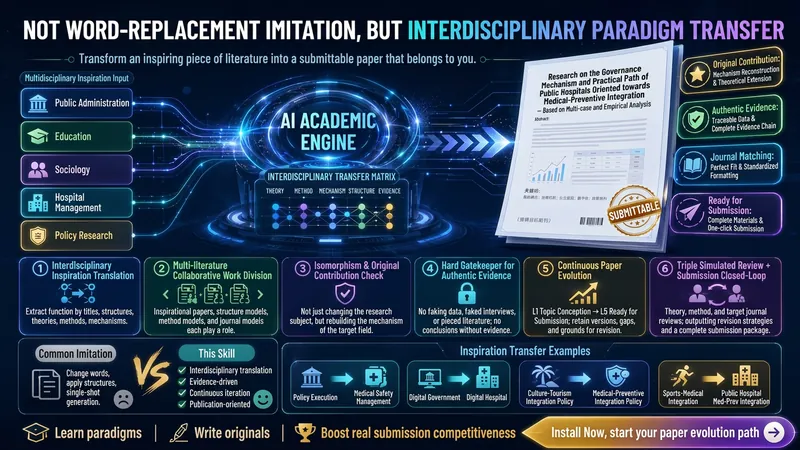
Paper Imitation & Pub. Expert
📚 Paper Imitation & Pub. Expert Develop an inspiring paper into your own high-quality original work step by step. Ideal for graduate students seeking to draw inspiration from excellent papers in other disciplines for topic migration, structural reconstruction, and submission optimization. 🔍 Inspiring Literature Identification: Analyze the reusable title mechanisms, problem awareness, chapter structure, theoretical framework, research methods, evidence organization, and language style of the model paper. 🔄 Interdisciplinary Paradigm Transfer: Build a 'source domain—target domain' transfer matrix to determine which ideas can be transferred and which theories, concepts, cases, and conclusions must be reconstructed. 🧠 Original Contribution Modeling: Identify literature gaps, distill core propositions and mechanisms, and check whether the paper merely changes the research object or applies a generic framework. 🧭 Research Design Planning: Supports theoretical research, case studies, qualitative research, quantitative research, literature reviews, policy text analysis, and mixed methods research. 🛡️ Real Evidence Gate: Do not fabricate data, samples, interviews, cases, statistical results, literature, or DOIs; without real evidence, do not generate false empirical conclusions. ✍️ Evidence-Driven Writing: Build argument chains via 'proposition—evidence—citation—rebuttal', generate original content chapter by chapter, and clearly mark research materials that need to be supplemented. 📈 Continuous Paper Evolution: Record each round of revisions, material gaps, and maturity changes according to L1 (topic conception), L2 (research plan), L3 (evidence formation), L4 (submission draft), and L5 (ready for submission). 🧑⚖️ Triple Simulation Review: Identify rejection risks from the perspectives of a theoretical reviewer, a method reviewer, and a target journal reviewer, and form specific revision strategies. 📨 Complete Submission Loop: Assist in generating the final paper, citation verification table, cover letter, innovation point statement, author response, revision index, and related declaration templates. ✨ Learn the paradigm, write original content, and enhance real submission competitiveness.
 Research
Guided Literature Search
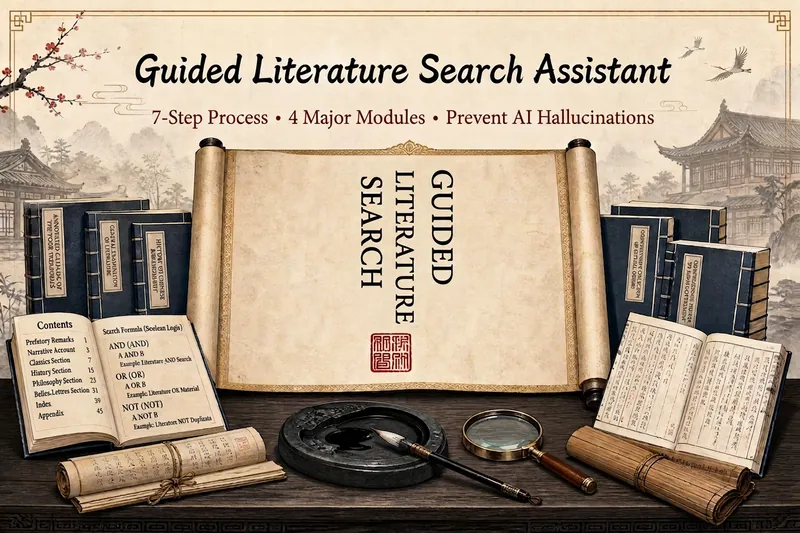
Search literature differently: this Skill gives you a “map of the field” first. It offers five standout capabilities: ① Reviews first, core papers second (a strict rule)—find 3–5 review articles to map the field, then follow their references to locate core literature, so you are not overwhelmed by hundreds of papers from the start; ② Literature authenticity verification (to prevent AI hallucinations)—uses placeholder-pattern checks and real-time verification through CrossRef, DOI, CNKI, and Wanfang, checking each author, journal, DOI, and page number without fabricating a single reference; ③ Automated advanced CSSCI searches on CNKI—when you have VPN or institutional access, automatically extract CSSCI records and abstracts, up to 100 papers at a time, and save them directly to Excel; ④ Direct English OA downloads—download directly from arXiv, MDPI, Frontiers, and other sources at 100%; download approximately 50–70% of Springer and Elsevier OA papers directly; for paywalled papers, receive a DOI link and VPN download instructions; ⑤ Topic selection with the Three-Circle Focus Method—intersect policy trends, your prior experience, and your problem awareness to turn a vague idea into a genuinely worthwhile research topic. The seven-step core workflow is: research topic design → keyword refinement → find reviews first → find core literature → screen and verify → attempt downloads → produce a prioritized reading list. It also includes two enhanced modules: a structured 12-element breakdown in Excel and iterative reflection after reading. Clear boundaries: it does not promise to bypass CNKI’s anti-scraping protections to download Chinese full texts, log in to a VPN on your behalf, or write the main body of your paper. Designed for graduate students, university faculty, and academic researchers who need to conduct systematic literature searches.
Reference Matching Expert
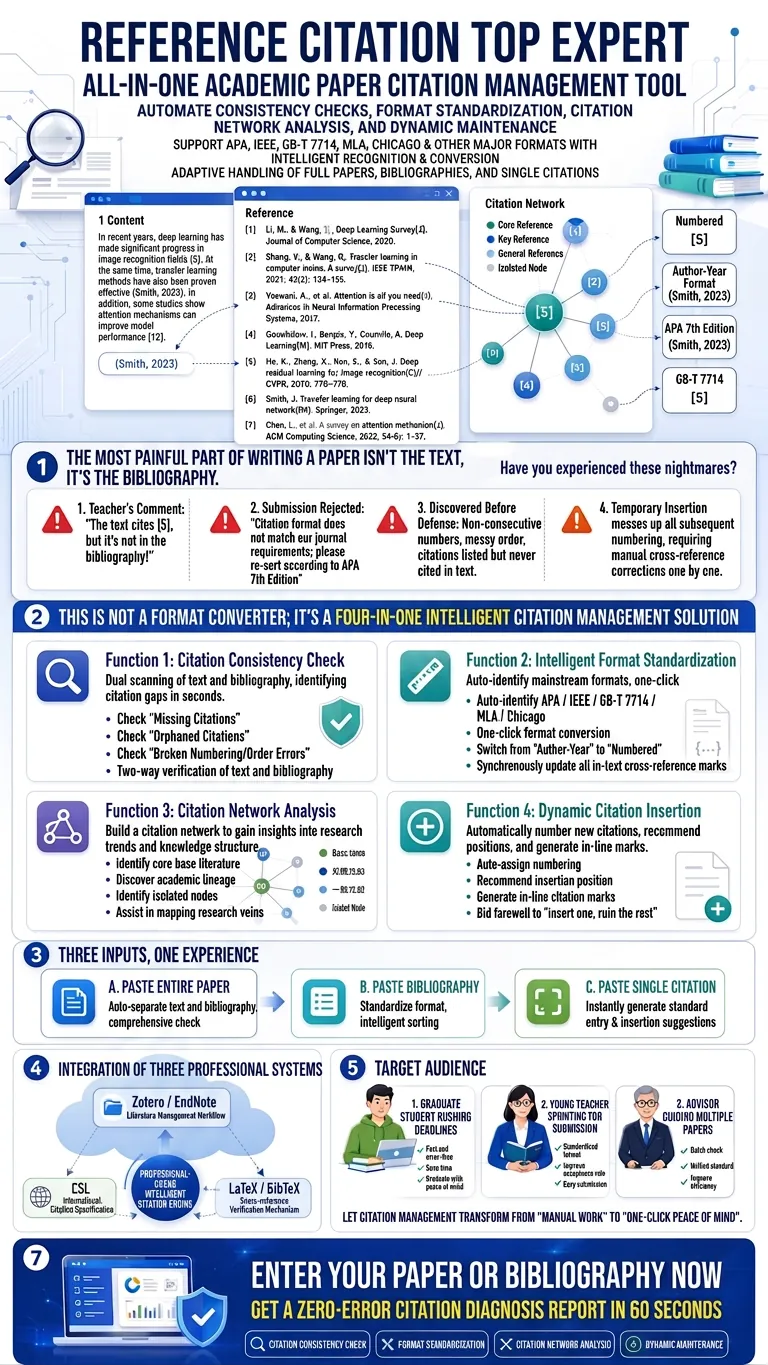
A comprehensive academic paper cross-reference management tool that automates citation consistency checks, format standardization, citation relationship analysis, and dynamic citation maintenance. Supports intelligent recognition and conversion of mainstream citation formats including APA/IEEE/GB-T 7714/MLA/Chicago. Adaptively handles three input forms: full paper, reference list, and single citation. Integrates Zotero/EndNote reference management workflows, Citation Style Language international standards, and LaTeX/BibTeX cross-reference verification mechanisms. "The most painful part of writing a paper isn't the text—it's the references." Have you experienced these nightmares? Advisor's comment: "You cited [5] in the text, but it's not in the reference list!" Rejection: "Citation format does not meet journal requirements. Please reformat according to APA 7th edition." Discovery before the defense: Reference numbers are non-sequential, order is chaotic, and some references are never cited but still in the list. Inserting a new reference mid-paper messes up all subsequent numbers, requiring manual correction of every cross-reference. 【Reference Citation Expert】—— Your academic writing 'citation immune system'. This is not a format converter; it's a four-in-one intelligent citation management solution: 🔍 Feature 1: Citation Consistency Check — Bidirectional scan of text and reference list, instantly locating missing citations, orphan references, and broken numbering. No citation gap can hide. 📐 Feature 2: Smart Formatting — Automatically identifies APA/IEEE/GB-T 7714/MLA/Chicago formats, converts with one click, and updates all cross-reference markers simultaneously. Switch from author-year to numeric style without manual effort. 🕸️ Feature 3: Citation Relationship Analysis — Builds a citation network by connecting to online resources, identifying core foundational papers, academic lineage, and isolated nodes, helping you map research connections. ➕ Feature 4: Dynamic Citation Insertion — New references are automatically numbered, insertion points recommended, and inline citation markers generated. No more 'one insertion wreaks havoc on the whole document.' Three inputs, one experience: Paste entire paper → automatically separate text and reference list, full check Paste reference list → unify format, smart sorting Paste single citation → instantly generate standardized entry and insertion suggestions Integrating three major professional systems: Zotero/EndNote workflows × CSL international citation standards × LaTeX/BibTeX cross-reference verification. Whether you're a graduate student racing a deadline, a young faculty member rushing to submit, or a supervisor guiding multiple papers— Turn citation management from 'manual labor' to 'one-click peace of mind.' Now input your paper or reference list and get a zero-error citation diagnostic report in 60 seconds.
Bibliometric Search Term Expert
Description
Why we love this skill
This skill is a powerful assistant for bibliometrics research. It deconstructs complex topics into 'concept family trees' and generates finely layered search queries for databases such as Web of Science and CNKI. It satisfies both 'breadth-first' and 'depth-first' retrieval needs, helping you obtain academic literature with precision and efficiency—an indispensable tool for researchers.
Build concept family trees like a bibliometrics expert. Generate high-precision, high-recall professional search queries for WoS and CNKI with one click, ensuring comprehensive and accurate literature research.
Related Skills
View allPaper Imitation & Pub. Expert
📚 Paper Imitation & Pub. Expert Develop an inspiring paper into your own high-quality original work step by step. Ideal for graduate students seeking to draw inspiration from excellent papers in other disciplines for topic migration, structural reconstruction, and submission optimization. 🔍 Inspiring Literature Identification: Analyze the reusable title mechanisms, problem awareness, chapter structure, theoretical framework, research methods, evidence organization, and language style of the model paper. 🔄 Interdisciplinary Paradigm Transfer: Build a 'source domain—target domain' transfer matrix to determine which ideas can be transferred and which theories, concepts, cases, and conclusions must be reconstructed. 🧠 Original Contribution Modeling: Identify literature gaps, distill core propositions and mechanisms, and check whether the paper merely changes the research object or applies a generic framework. 🧭 Research Design Planning: Supports theoretical research, case studies, qualitative research, quantitative research, literature reviews, policy text analysis, and mixed methods research. 🛡️ Real Evidence Gate: Do not fabricate data, samples, interviews, cases, statistical results, literature, or DOIs; without real evidence, do not generate false empirical conclusions. ✍️ Evidence-Driven Writing: Build argument chains via 'proposition—evidence—citation—rebuttal', generate original content chapter by chapter, and clearly mark research materials that need to be supplemented. 📈 Continuous Paper Evolution: Record each round of revisions, material gaps, and maturity changes according to L1 (topic conception), L2 (research plan), L3 (evidence formation), L4 (submission draft), and L5 (ready for submission). 🧑⚖️ Triple Simulation Review: Identify rejection risks from the perspectives of a theoretical reviewer, a method reviewer, and a target journal reviewer, and form specific revision strategies. 📨 Complete Submission Loop: Assist in generating the final paper, citation verification table, cover letter, innovation point statement, author response, revision index, and related declaration templates. ✨ Learn the paradigm, write original content, and enhance real submission competitiveness.
ResearchGuided Literature Search
Search literature differently: this Skill gives you a “map of the field” first. It offers five standout capabilities: ① Reviews first, core papers second (a strict rule)—find 3–5 review articles to map the field, then follow their references to locate core literature, so you are not overwhelmed by hundreds of papers from the start; ② Literature authenticity verification (to prevent AI hallucinations)—uses placeholder-pattern checks and real-time verification through CrossRef, DOI, CNKI, and Wanfang, checking each author, journal, DOI, and page number without fabricating a single reference; ③ Automated advanced CSSCI searches on CNKI—when you have VPN or institutional access, automatically extract CSSCI records and abstracts, up to 100 papers at a time, and save them directly to Excel; ④ Direct English OA downloads—download directly from arXiv, MDPI, Frontiers, and other sources at 100%; download approximately 50–70% of Springer and Elsevier OA papers directly; for paywalled papers, receive a DOI link and VPN download instructions; ⑤ Topic selection with the Three-Circle Focus Method—intersect policy trends, your prior experience, and your problem awareness to turn a vague idea into a genuinely worthwhile research topic. The seven-step core workflow is: research topic design → keyword refinement → find reviews first → find core literature → screen and verify → attempt downloads → produce a prioritized reading list. It also includes two enhanced modules: a structured 12-element breakdown in Excel and iterative reflection after reading. Clear boundaries: it does not promise to bypass CNKI’s anti-scraping protections to download Chinese full texts, log in to a VPN on your behalf, or write the main body of your paper. Designed for graduate students, university faculty, and academic researchers who need to conduct systematic literature searches.
Reference Matching Expert
A comprehensive academic paper cross-reference management tool that automates citation consistency checks, format standardization, citation relationship analysis, and dynamic citation maintenance. Supports intelligent recognition and conversion of mainstream citation formats including APA/IEEE/GB-T 7714/MLA/Chicago. Adaptively handles three input forms: full paper, reference list, and single citation. Integrates Zotero/EndNote reference management workflows, Citation Style Language international standards, and LaTeX/BibTeX cross-reference verification mechanisms. "The most painful part of writing a paper isn't the text—it's the references." Have you experienced these nightmares? Advisor's comment: "You cited [5] in the text, but it's not in the reference list!" Rejection: "Citation format does not meet journal requirements. Please reformat according to APA 7th edition." Discovery before the defense: Reference numbers are non-sequential, order is chaotic, and some references are never cited but still in the list. Inserting a new reference mid-paper messes up all subsequent numbers, requiring manual correction of every cross-reference. 【Reference Citation Expert】—— Your academic writing 'citation immune system'. This is not a format converter; it's a four-in-one intelligent citation management solution: 🔍 Feature 1: Citation Consistency Check — Bidirectional scan of text and reference list, instantly locating missing citations, orphan references, and broken numbering. No citation gap can hide. 📐 Feature 2: Smart Formatting — Automatically identifies APA/IEEE/GB-T 7714/MLA/Chicago formats, converts with one click, and updates all cross-reference markers simultaneously. Switch from author-year to numeric style without manual effort. 🕸️ Feature 3: Citation Relationship Analysis — Builds a citation network by connecting to online resources, identifying core foundational papers, academic lineage, and isolated nodes, helping you map research connections. ➕ Feature 4: Dynamic Citation Insertion — New references are automatically numbered, insertion points recommended, and inline citation markers generated. No more 'one insertion wreaks havoc on the whole document.' Three inputs, one experience: Paste entire paper → automatically separate text and reference list, full check Paste reference list → unify format, smart sorting Paste single citation → instantly generate standardized entry and insertion suggestions Integrating three major professional systems: Zotero/EndNote workflows × CSL international citation standards × LaTeX/BibTeX cross-reference verification. Whether you're a graduate student racing a deadline, a young faculty member rushing to submit, or a supervisor guiding multiple papers— Turn citation management from 'manual labor' to 'one-click peace of mind.' Now input your paper or reference list and get a zero-error citation diagnostic report in 60 seconds.
Find your next favorite skill
Explore more curated AI skills for research, creation, and everyday work.