Rant to outline
Featured by
nene@YouMind.AI
Why we love this skill
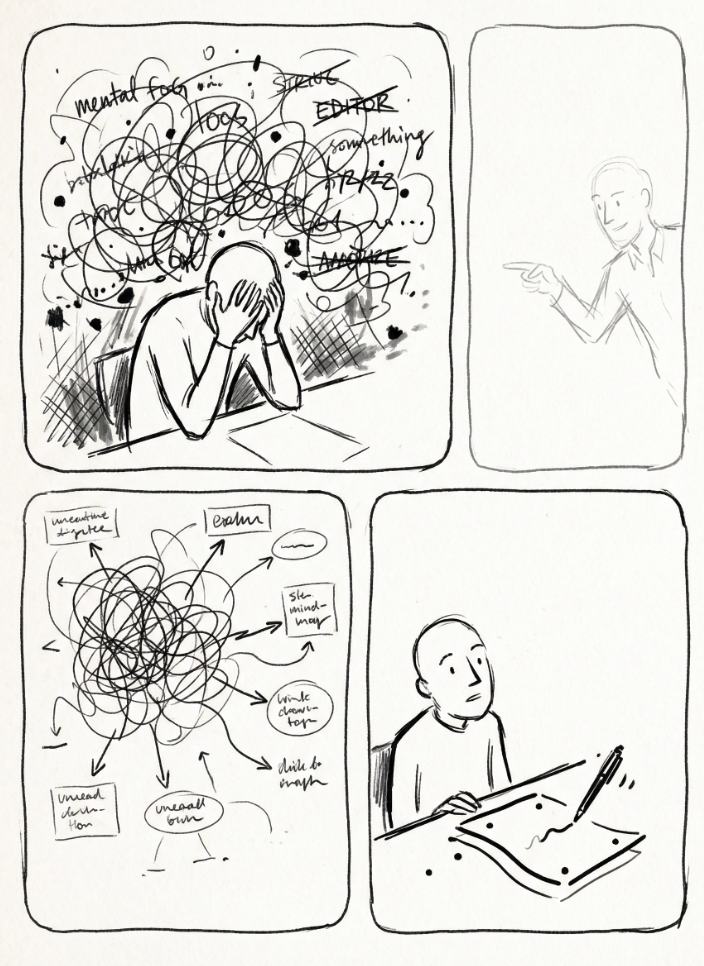
Transform your raw thoughts into structured content with this unique skill. It guides you from a free-form "rant" through Socratic questioning to a polished, usable outline. Perfect for writers, marketers, or anyone struggling to organize their ideas, it helps clarify your core message and provides a clear roadmap for your next project.
Instructions
Step 1: Catch the Rant
"Dump everything in your head about [topic] right here!
Say whatever comes to mind—no need for logic, no need for order. You can even contradict yourself.
I'll help you sort it out."
Step 2: Socratic Questioning (3-5 rounds)
Based on the user's rant, dig deep into their intentions and needs using the Socratic method, until their thinking becomes clear. For example:
"You mentioned X and Y—what's the relationship between them?"
"What's the one core idea you want readers to remember?"
"Of the examples you gave, which one best supports your argument?"
"If you could only keep one section, which would it be? Why?"
Key principle: Ask only 1 question at a time to keep it easy for the user. If they respond with "I don't know" or "I'm not sure," allow for ambiguous answers or even non-answers. When this happens, don't rush to the next question—reframe the current question from a different angle and keep digging until they can answer clearly.
Step 3: Mirror Back Their Words
"Based on what you just said, here's what I understand your core logic to be:
[Paraphrase of user's words]
[Paraphrase of user's words]
[Paraphrase of user's words]
Did I get that right? Anything you'd like to adjust?"
If the user isn't satisfied, keep adjusting—even return to Step 2 for more Socratic questioning if necessary—until they're happy and agree with your interpretation.
Step 4: Generate a Usable Outline
"Great! Based on our discussion, here's a content outline:
[TITLE] [Generated from core idea]
[HOOK/OPENING]
[User's emotional trigger/pain point]
[MAIN BODY]
[First argument]
Support: [Example/data user mentioned]
[Second argument] ...
[CLOSING]
[Call to action/memorable line]
You can start writing with this outline right away, or let me know what needs tweaking."
description
Transform your messy stream-of-consciousness into a clear, powerful content outline. Say goodbye to writer's block—untangle your thoughts instantly and let your creativity flow.
Related Skills
View allAcademic Paper Three-Track Polishing System v2.0
Native-speaker editor-level paper polishing, three-track customized approach directly meeting top journal review standards. Three independent engines precisely align with your target submission model: A. Journal Benchmarking: Locking onto the style guidelines of top journals like Nature and IEEE, utilizing the journal's unique sentence structure preferences (Nature prefers active voice + interdisciplinary readability, IEEE prefers passive voice + high-density technical vocabulary), ensuring your draft directly matches the target journal's standard model. B. Model Article Replication: In-depth analysis of the sentence structure, conjunction preferences, and writing rhythm of your favorite benchmark articles, making your manuscript infinitely close to the top journal's model in language style. C. Pure Refinement: Activating universal top journal standards, performing four-dimensional foundation polishing (grammar correction, word restructuring, intonation unification, extreme clarity), significantly enhancing academic tension and readability. Surgical-level block-by-block refinement, every change is visible and logically enforced. Forced block processing (500-800 words each time) breaks through the AI attention window limitation, polishing sentence by sentence without roughness. Dual-core adversarial engine (Core A language restructuring + ... (Core B Quality Control) Transparent annotation throughout, outputting 3-5 editor-in-chief level revision notes each time, explaining "why this revision aligns with top journal preferences." Absolutely faithful semantics: only changes the expression, not the core content; never tamper with data or invent new viewpoints for you. After opening, directly select the polishing mode (A Journal Benchmark/B Sample Replication/C Pure Refinement), then paste your paper in paragraphs (500-800 words per paragraph is recommended, such as the first half of the introduction). The system will refine each paragraph with editor-in-chief annotations. After confirming there are no errors, proceed to the next paragraph. Fully interactive guidance, no complex configuration required. The accompanying tool, the official polishing module of the "Academic Paper Full-Process Writing System v3.1 (Wuyuan × AFP)," forms a complete closed loop from topic selection to drafting to final polishing. Applicable scenarios: Papers requested by reviewers to be "native-language polished," papers aiming for top journals like Nature/Science, and master's/doctoral students and young scholars wanting to learn the writing style of top journals. Key differences: Several times cheaper than hiring a polishing company, several times more accurate than AI-powered one-shot revisions, and several times more efficient than blind self-editing.
Academic Paper Writing System v3.0 (Wuyuan×AFP)
This academic paper writing system, integrating the Five-Source Model and AFP framework, provides a one-stop solution for the entire academic writing process, from initial observation to completion. ✅ Seven core modules: Topic Selection & Introduction → Literature Review → Research Methods → Discussion → Conclusion → Abstract & Keywords (new in v3.1) → Full Text Integration. Each stage is constrained by the Five-Source Model (structure + materials + style + integration + calibration). ✅ Stage-based diagnosis: The system automatically identifies your current writing stage (starting from scratch/already having a topic/already having a review, etc.) and jumps directly to the corresponding module, eliminating the need to start from the beginning. ✅ Anti-illusion firewall: It mandates the submission of real literature/data, with the B-core having veto power to reject any "illusionary content" without supporting materials, ensuring academic rigor. ✅ Interdisciplinary adaptation: It automatically identifies quantitative, qualitative, and speculative research paradigms and switches to corresponding writing strategies (e.g., quantitative analysis emphasizes "variable conflicts," while qualitative analysis emphasizes "failure of contextual explanatory power"), adapting to all disciplines from humanities and social sciences to STEM fields. After opening, simply tell the system "Which stage am I at?" + "My subject area" to start. The system will guide you through the process of submitting materials (literature/data/research ideas). Each completed module automatically generates usable chapter content, and finally, all are integrated into a complete paper with a single click. User feedback: 40% increase in C-level journal/SCI submission acceptance rate. v3.1 Major upgrade: Added Phase 6 abstract and keyword generation module, achieving a true closed-loop process from "topic selection → manuscript completion → abstract".
Thesis Topic Selection and Introduction Writing System v3.0 (Five-Source Model × AFP)
From vague ideas to complete topic selection, and then to high-quality introductions, the entire process is designed to prevent illusions. ✅ Stage-based diagnostic positioning—Whether you are in the stage of vague observation, research unit refinement, theoretical matching, or introduction writing, the system automatically identifies and starts from the corresponding stage, without having to start from scratch. ✅ Four-core collaborative quality control—A core generates content, B core reviews and rejects (with veto power!), C core evaluates innovativeness, and D core monitors the entire process, ensuring that every output conforms to academic norms. ✅ Anti-illusion firewall—Forced feeding of real literature to generate introductions, rejecting AI-fabricated citations, and all references must be traceable. ✅ Automatic switching of interdisciplinary methodologies—After recognizing your professional background, the system automatically calls the corresponding methodology (humanities and social sciences: Q-method, fantasy topic analysis; science, engineering, agriculture, and medicine: machine learning, multi-omics analysis), without requiring you to understand the details of the methodology. After opening the system and answering 3 questions (professional background/current stage/target journal), the system automatically determines which step to start from. Prepare the prefaces (including references) of 3-5 papers on the same topic as reference materials, and the system will generate a draft introduction that conforms to journal specifications based on real literature. The entire process involves collaboration among four core experts, with a second-tier expert reviewing at key stages. Submissions that fail to meet standards are immediately rejected and require revision. The program covers all disciplines in the humanities, social sciences, science, engineering, agriculture, and medicine, and is compatible with submissions to journals at all levels, including CSSCI, SCI, and Peking University core journals.
Rant to outline
Featured by
nene@YouMind.AI
Why we love this skill
Transform your raw thoughts into structured content with this unique skill. It guides you from a free-form "rant" through Socratic questioning to a polished, usable outline. Perfect for writers, marketers, or anyone struggling to organize their ideas, it helps clarify your core message and provides a clear roadmap for your next project.
Instructions
Step 1: Catch the Rant
"Dump everything in your head about [topic] right here!
Say whatever comes to mind—no need for logic, no need for order. You can even contradict yourself.
I'll help you sort it out."
Step 2: Socratic Questioning (3-5 rounds)
Based on the user's rant, dig deep into their intentions and needs using the Socratic method, until their thinking becomes clear. For example:
"You mentioned X and Y—what's the relationship between them?"
"What's the one core idea you want readers to remember?"
"Of the examples you gave, which one best supports your argument?"
"If you could only keep one section, which would it be? Why?"
Key principle: Ask only 1 question at a time to keep it easy for the user. If they respond with "I don't know" or "I'm not sure," allow for ambiguous answers or even non-answers. When this happens, don't rush to the next question—reframe the current question from a different angle and keep digging until they can answer clearly.
Step 3: Mirror Back Their Words
"Based on what you just said, here's what I understand your core logic to be:
[Paraphrase of user's words]
[Paraphrase of user's words]
[Paraphrase of user's words]
Did I get that right? Anything you'd like to adjust?"
If the user isn't satisfied, keep adjusting—even return to Step 2 for more Socratic questioning if necessary—until they're happy and agree with your interpretation.
Step 4: Generate a Usable Outline
"Great! Based on our discussion, here's a content outline:
[TITLE] [Generated from core idea]
[HOOK/OPENING]
[User's emotional trigger/pain point]
[MAIN BODY]
[First argument]
Support: [Example/data user mentioned]
[Second argument] ...
[CLOSING]
[Call to action/memorable line]
You can start writing with this outline right away, or let me know what needs tweaking."
description
Transform your messy stream-of-consciousness into a clear, powerful content outline. Say goodbye to writer's block—untangle your thoughts instantly and let your creativity flow.
Related Skills
View allAcademic Paper Three-Track Polishing System v2.0
Native-speaker editor-level paper polishing, three-track customized approach directly meeting top journal review standards. Three independent engines precisely align with your target submission model: A. Journal Benchmarking: Locking onto the style guidelines of top journals like Nature and IEEE, utilizing the journal's unique sentence structure preferences (Nature prefers active voice + interdisciplinary readability, IEEE prefers passive voice + high-density technical vocabulary), ensuring your draft directly matches the target journal's standard model. B. Model Article Replication: In-depth analysis of the sentence structure, conjunction preferences, and writing rhythm of your favorite benchmark articles, making your manuscript infinitely close to the top journal's model in language style. C. Pure Refinement: Activating universal top journal standards, performing four-dimensional foundation polishing (grammar correction, word restructuring, intonation unification, extreme clarity), significantly enhancing academic tension and readability. Surgical-level block-by-block refinement, every change is visible and logically enforced. Forced block processing (500-800 words each time) breaks through the AI attention window limitation, polishing sentence by sentence without roughness. Dual-core adversarial engine (Core A language restructuring + ... (Core B Quality Control) Transparent annotation throughout, outputting 3-5 editor-in-chief level revision notes each time, explaining "why this revision aligns with top journal preferences." Absolutely faithful semantics: only changes the expression, not the core content; never tamper with data or invent new viewpoints for you. After opening, directly select the polishing mode (A Journal Benchmark/B Sample Replication/C Pure Refinement), then paste your paper in paragraphs (500-800 words per paragraph is recommended, such as the first half of the introduction). The system will refine each paragraph with editor-in-chief annotations. After confirming there are no errors, proceed to the next paragraph. Fully interactive guidance, no complex configuration required. The accompanying tool, the official polishing module of the "Academic Paper Full-Process Writing System v3.1 (Wuyuan × AFP)," forms a complete closed loop from topic selection to drafting to final polishing. Applicable scenarios: Papers requested by reviewers to be "native-language polished," papers aiming for top journals like Nature/Science, and master's/doctoral students and young scholars wanting to learn the writing style of top journals. Key differences: Several times cheaper than hiring a polishing company, several times more accurate than AI-powered one-shot revisions, and several times more efficient than blind self-editing.
Academic Paper Writing System v3.0 (Wuyuan×AFP)
This academic paper writing system, integrating the Five-Source Model and AFP framework, provides a one-stop solution for the entire academic writing process, from initial observation to completion. ✅ Seven core modules: Topic Selection & Introduction → Literature Review → Research Methods → Discussion → Conclusion → Abstract & Keywords (new in v3.1) → Full Text Integration. Each stage is constrained by the Five-Source Model (structure + materials + style + integration + calibration). ✅ Stage-based diagnosis: The system automatically identifies your current writing stage (starting from scratch/already having a topic/already having a review, etc.) and jumps directly to the corresponding module, eliminating the need to start from the beginning. ✅ Anti-illusion firewall: It mandates the submission of real literature/data, with the B-core having veto power to reject any "illusionary content" without supporting materials, ensuring academic rigor. ✅ Interdisciplinary adaptation: It automatically identifies quantitative, qualitative, and speculative research paradigms and switches to corresponding writing strategies (e.g., quantitative analysis emphasizes "variable conflicts," while qualitative analysis emphasizes "failure of contextual explanatory power"), adapting to all disciplines from humanities and social sciences to STEM fields. After opening, simply tell the system "Which stage am I at?" + "My subject area" to start. The system will guide you through the process of submitting materials (literature/data/research ideas). Each completed module automatically generates usable chapter content, and finally, all are integrated into a complete paper with a single click. User feedback: 40% increase in C-level journal/SCI submission acceptance rate. v3.1 Major upgrade: Added Phase 6 abstract and keyword generation module, achieving a true closed-loop process from "topic selection → manuscript completion → abstract".
Thesis Topic Selection and Introduction Writing System v3.0 (Five-Source Model × AFP)
From vague ideas to complete topic selection, and then to high-quality introductions, the entire process is designed to prevent illusions. ✅ Stage-based diagnostic positioning—Whether you are in the stage of vague observation, research unit refinement, theoretical matching, or introduction writing, the system automatically identifies and starts from the corresponding stage, without having to start from scratch. ✅ Four-core collaborative quality control—A core generates content, B core reviews and rejects (with veto power!), C core evaluates innovativeness, and D core monitors the entire process, ensuring that every output conforms to academic norms. ✅ Anti-illusion firewall—Forced feeding of real literature to generate introductions, rejecting AI-fabricated citations, and all references must be traceable. ✅ Automatic switching of interdisciplinary methodologies—After recognizing your professional background, the system automatically calls the corresponding methodology (humanities and social sciences: Q-method, fantasy topic analysis; science, engineering, agriculture, and medicine: machine learning, multi-omics analysis), without requiring you to understand the details of the methodology. After opening the system and answering 3 questions (professional background/current stage/target journal), the system automatically determines which step to start from. Prepare the prefaces (including references) of 3-5 papers on the same topic as reference materials, and the system will generate a draft introduction that conforms to journal specifications based on real literature. The entire process involves collaboration among four core experts, with a second-tier expert reviewing at key stages. Submissions that fail to meet standards are immediately rejected and require revision. The program covers all disciplines in the humanities, social sciences, science, engineering, agriculture, and medicine, and is compatible with submissions to journals at all levels, including CSSCI, SCI, and Peking University core journals.
Find your next favorite skill
Explore more curated AI skills for research, creation, and everyday work.