
SEO/GEO Keyword Planner v2.0
Keyword & GEO planning for new products
SEO/GEO Keyword Planner v2.0
Keyword & GEO planning for new products
Showcase
Description
SEO/GEO keyword research and content topic planning tool. Enter a topic, product, or seed keyword, and through an 8-stage process (Scope Definition → Discovery → Expansion → Classification → Scoring → GEO Check → Clustering → Delivery) output a complete keyword research report, including priority keyword list, topic clusters, and content calendar. Suitable for new page creation, new content topic selection, SEO optimization, and GEO (AI citation optimization) planning.
Related Skills
View all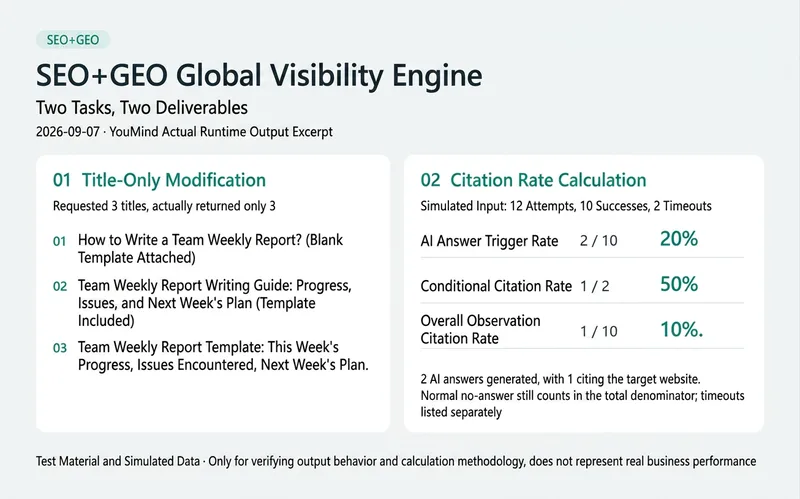
SEO+GEO Visibility Engine
Optimize the search performance and AI citation readiness of your articles, product pages, and landing pages. Quickly identify the issues most worth fixing, or get ready-to-use titles, rewrites, content briefs, technical fix lists, or performance retest plans. Four modes route tasks appropriately: send only a link or body copy for a quick diagnosis by default; request writing to get usable text first; use a full audit to break findings down by target engine and page; or use a performance retest with clearly defined data sources, numerators, denominators, and comparison conditions. Simple tasks do not require a full-length report. Supports platform-specific checks for Google AI Overviews / AI Mode, Bing / Copilot, ChatGPT Search, Perplexity, and Claude. Search, training, and user-triggered visits are assessed separately. For Chinese platforms, checks are adapted to actually available sources and direct observations rather than applying rules from other engines. v8 standardizes scoring and evidence criteria, limits the scope of local blocks, distinguishes answer trigger rate, conditional citation rate, and overall citation rate, and updates Google site-level AI control checks. Use it for your own websites, articles on third-party platforms, and unpublished drafts. Recommendations distinguish what you can change from items that require platform-side validation. Each key finding includes evidence or clearly stated limitations. Scores are provided when needed; data, authors, or citations are never fabricated, and rankings, indexing, or AI citations are not guaranteed. Actual run example (2026-09-07; test material, not business results) Title mode: Given test copy for “How to write a team weekly report” with a request to return only 3 titles, the actual output was: 1. How to Write a Team Weekly Report: Blank Template Included 2. Team Weekly Report Writing Guide: Progress, Issues, and Next Week’s Plan (Template Included) 3. Team Weekly Report Template: This Week’s Progress, Issues, and Next Week’s Plan Calculation mode: Simulated 12 attempts, with 10 successes and 2 timeouts; 2 successful runs generated AI answers, and 1 cited the target website. Actual output: AI answer trigger rate 2/10 = 20%, conditional citation rate 1/2 = 50%, and overall observed citation rate 1/10 = 10%. Normal no-answer cases remain in the overall denominator, while timeouts are listed separately. These figures validate the calculation criteria only and do not represent actual citation performance.
Google Content Quality Checker
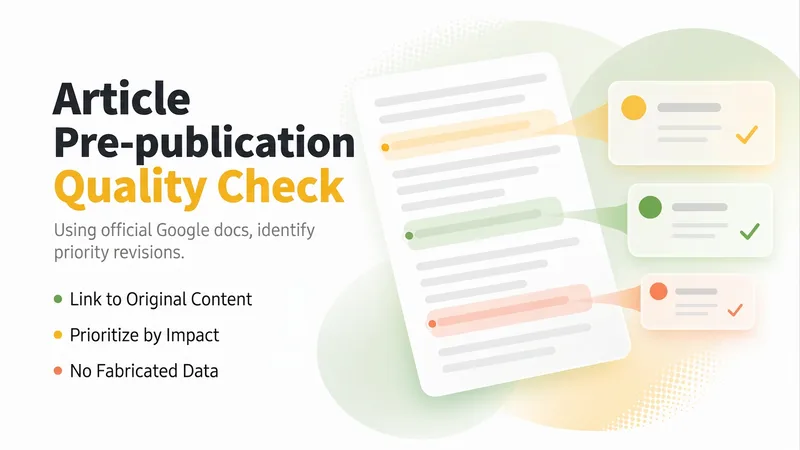
Before you publish, check an SEO article for whether readers can truly use it, which claims don’t hold up, and what might make it seem untrustworthy. It compares the article against Google Search Central’s public content quality guidance, ranks the 3–5 highest-impact fixes, points to the exact location in the original text, and gives specific ways to improve each one. If you want, it can also rewrite the article—but it won’t invent experiences or data that aren’t in the original. Paste the full text or send a link. v2.0 update: Removed hard-coded years and algorithm update names. When specific policies are involved, it checks Google’s official documentation in real time. It no longer scores content using mechanical rules such as word count or keyword frequency. The report is now a prioritized revision checklist instead of a large eight-dimension table. During rewrites, it does not fabricate the author’s experiences, examples, or data.

Viral Topic Finder:100 in 30s🔥
Struggling with what to post every day? This tool helps you dig out 100 viral topic ideas in 30 seconds! ✨ Core Features: • Enter a keyword for your niche and get 20+ topic directions • Combine current trends to find the traffic secrets • Evaluate each topic's viral potential (traffic prediction) • Provide differentiated angles and innovative entry points • Includes title suggestions and content frameworks 🎯 Suitable for: Self-media bloggers, short video creators, WeChat official account operators, brand content teams 💡 Use Cases: Running out of topics? Use it! Want to catch trends? Use it! Batch planning content? Definitely use it! Make your content calendar never run out of topics 📅
Information
- Version
- v7
- Last updated
- Runtime credits
- Usage-based
- Models
- Auto
