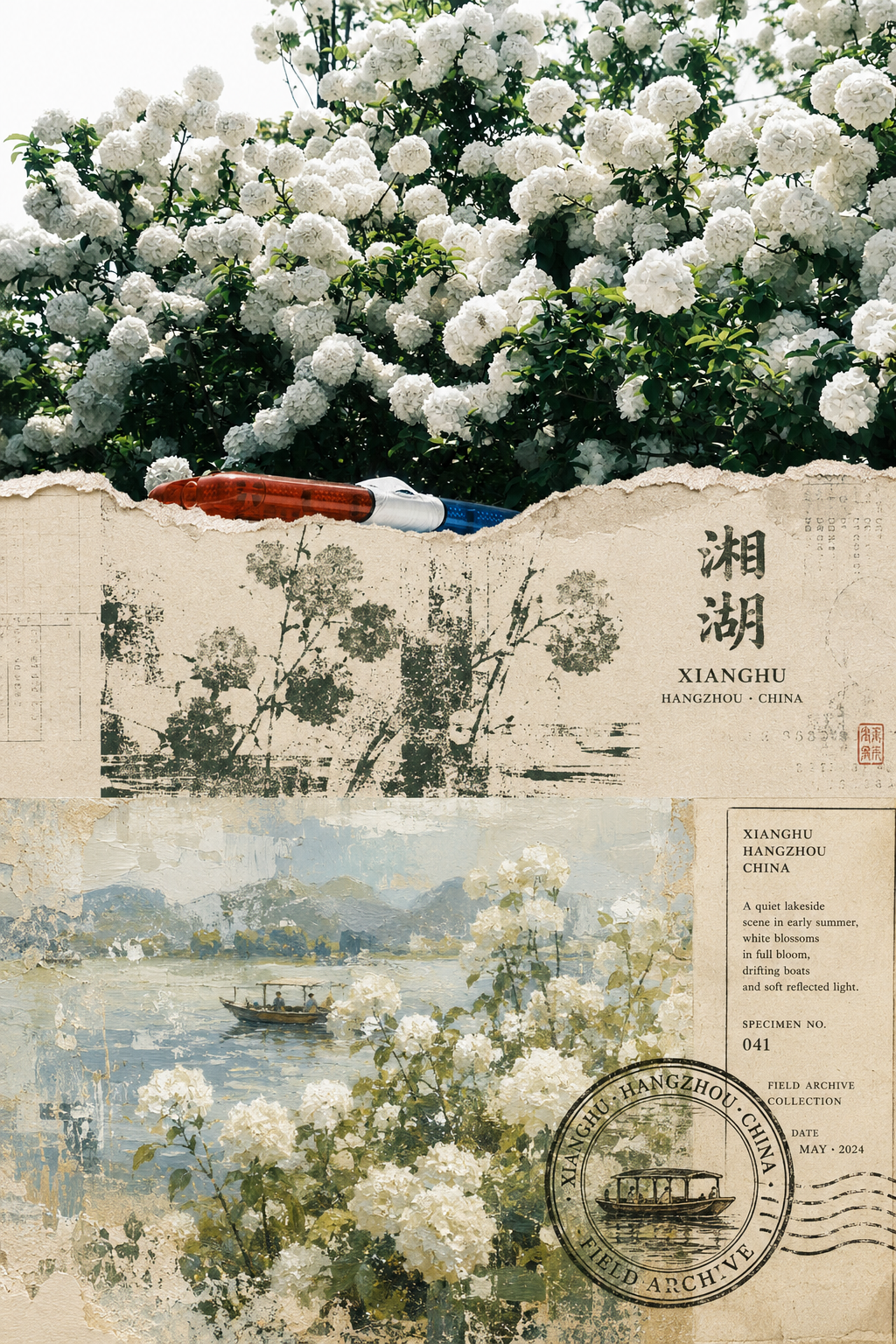
S.004 Starryear Monet Stamp
Turn travel photos into Monet-style stamps!
S.004 Starryear Monet Stamp
Turn travel photos into Monet-style stamps!
Showcase
Description
Turn a travel, landscape, architecture, street, or quiet documentary photo into a collectible-feeling vertical 2:3 “Starryear · Monet Stamp” travel archive artwork. The image preserves the real scene and color evidence from the photo, transforms recognizable subjects, structures, and visual cues into exclusive symbolic marks, and reimagines them as a new memory scene with Monet-inspired light and brushwork. Each photo gains a distinctive sense of place and visual narrative. The finished piece combines photographic evidence, symbolic marks distilled from the source image, and a “Monet memory,” paired with a narrow vintage-paper information panel and a circular postmark generated from the current photo. The location name is based only on what the user provides or what the photo can support, avoiding invented geographic details. The marks, palette, reconstructed composition, and scene identification also change with the original photo rather than applying a generic badge or fixed retro color scheme. Ideal for travel keepsake posters, destination visual archives, personal photography collections, and artistic photo works with a stamp-like feel. Each output is a complete finished piece that preserves the photo’s authenticity while giving it an independent symbolic quality and painterly memory of light and shadow. It is not intended for creating without an original photo, applying an ordinary Monet filter, or making generic decorative designs unrelated to the photo’s content.
Recommended by
Dancang
Why we love this skill
Featured for transforming travel photos into three-part vertical archives—evidence, symbolic marks, and Monet memory—while preserving authenticity and avoiding templated filters or invented locations.
Related Skills
View all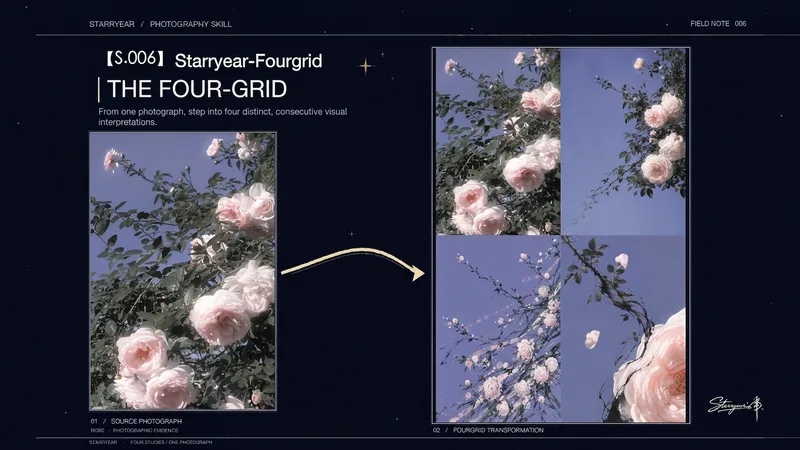 Image
S.006 · Starryear Four-Grid
Turn a single photo into a vertical 2:3 ink four-panel artwork. The original image remains as the top-left panel, while three distinct visual expressions extend from the photo's own colors, compositional relationships, motion paths, and spatial rhythms. The final work is not a standard collage or four filters, but a continuous transformation from photographic evidence to poetic memory, dot-and-line rhythm, and surreal space. The second panel distills the photo's atmosphere in a semi-abstract, moist, and subtly veiled style. The third transforms observable directions, intersections, repetitions, and variations in density into restrained dot-and-line structures, moving beyond the outlines of specific objects. The fourth preserves the original image's spatial grammar and layering, replacing real objects with photo-derived folds, interfaces, passages, or other non-representational forms to create a surreal world whose source remains recognizable. Colors and visual features are extracted anew from each uploaded photo, avoiding fixed themes, palettes, or compositions. Use it to create ink four-panel artworks, one-photo-into-four transformations, source-image abstractions, and editorial-style visual posters. The result is a complete, unified vertical artwork with no text or borders.
 Image
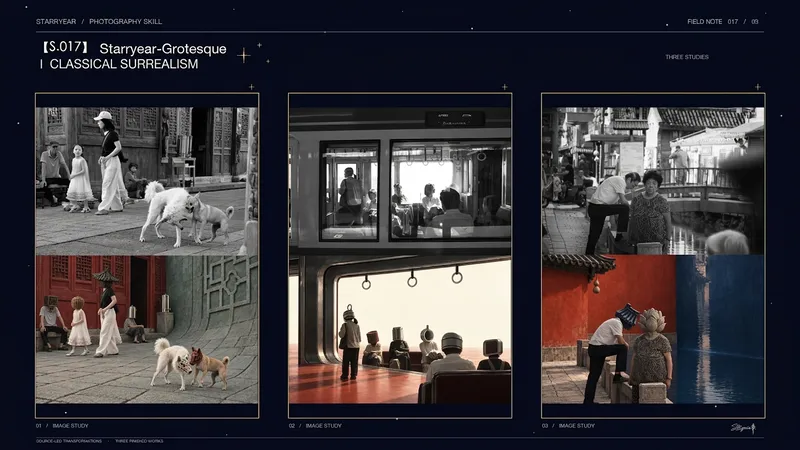
【S.017】Surreal Photo·Starryear
Transform travel, street, cultural event, or portrait photos into vertical classical surrealist diptychs with a documentary feel. The top half preserves the original photo as evidence of reality, while the bottom half reconstructs a visual scene through cinematic spaces, saturated structural colors, monumental scale, bold negative space, and impossible relationships—creating a world that feels both familiar and strange. This Skill is especially suited to creators who want to preserve the context of the original image while exploring conceptual photography and surrealist storytelling. Figures in the image will not show identifiable faces. Instead, based on clothing, gestures, props, and cultural clues from the setting, their heads are replaced with animals, plants, objects, architecture, celestial bodies, or other imagery. The concealment becomes part of the composition and story rather than a standard filter or decorative headpiece. Simply provide a suitable photo to receive a complete diptych that combines the original image with a reconstructed scene. It is suitable for personal photography experiments, travel visual records, street-image re-creations, and noncommercial art research. For personal learning, nonprofit research, and noncommercial creative use only.
 Image
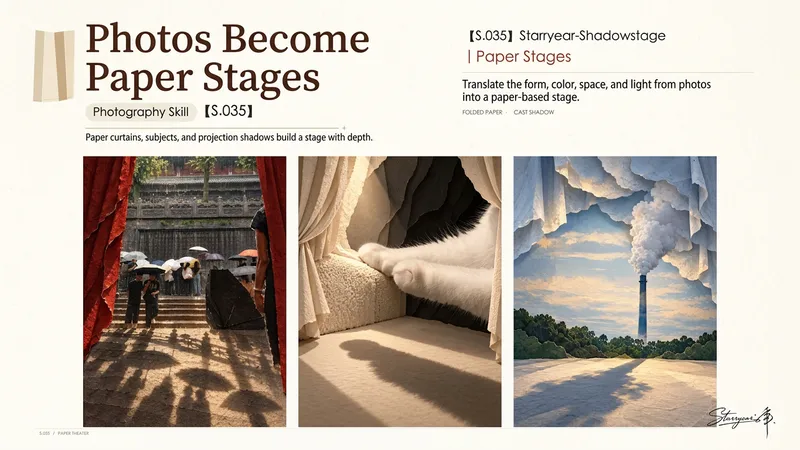
S.035 Year Stage · Starryear
Turn a photograph into a vertical paper-art stage poster with a projection of the subject integrated into the scene. People, plants, buildings, patterns, or other key forms from the photo naturally extend across paper curtains, a paper floor, and layered scenery to create a visually deep world. The work uses the original subject, colors, composition, spatial relationships, and lighting to generate an organically growing paper stage structure, rather than simply applying a photo frame or collage-card layout. The paper curtains, background, and stage floor connect with one another, while the folds, thickness, and occlusion of handmade paper create a convincing sense of depth. The projection derived from the photo becomes a key focal point, using side or backlighting to create dramatic light and shadow. It stretches across the paper floor and scene edges, reinforcing the sense of scale and stage atmosphere. Ideal for transforming documentary photography, travel photos, portraits, nature imagery, or scenes with distinctive textures into photographic posters with a paper-art texture and narrative quality. The default output is one complete vertical 3:4 poster that preserves the original subject’s identity and key visual facts, and typically adds no text, watermark, or decorative elements without a source in the image.
Information
- Version
- v7
- Last updated
- Runtime credits
- Usage-based
- Models
- Auto
