Murat Sakal
 Research
Research Topic & Gap Finder
Suggests original, workable research topics and gaps from your area of interest and literature knowledge; provides a research-question draft and feasibility note for each. Who it's for: graduate students and researchers looking for a thesis or article topic.
 Research
Interview & Focus Group Protocol Writer
Prepares a complete semi-structured interview guide or focus group protocol, from warm-up questions to closing, based on your research question and participant profile. Produces non-leading, open-ended questions and suggests an a priori code list for MAXQDA/NVivo. Who it's for: researchers and graduate students conducting qualitative or mixed-methods research.
 Research
Kaplan-Meier Survival Analysis Writer
Produces a complete Methods + Results text from your Kaplan-Meier survival curve, log-rank test, and Cox regression output. Correctly interprets hazard ratios, explicitly flags a high censoring rate, and reminds you to check the proportional hazards assumption for Cox models. Who it's for: researchers working with clinical/epidemiological survival data.
 Research
Full .mbz Package Generation Engine
Produces the XML skeleton structure and section-to-activity mapping needed for a Moodle-restorable .mbz course backup from your full weekly curriculum content (topic, resource, assignment, quiz); provides a post-installation validation checklist. Who it's for: instructors who want to bulk-package multi-week courses.
 Research
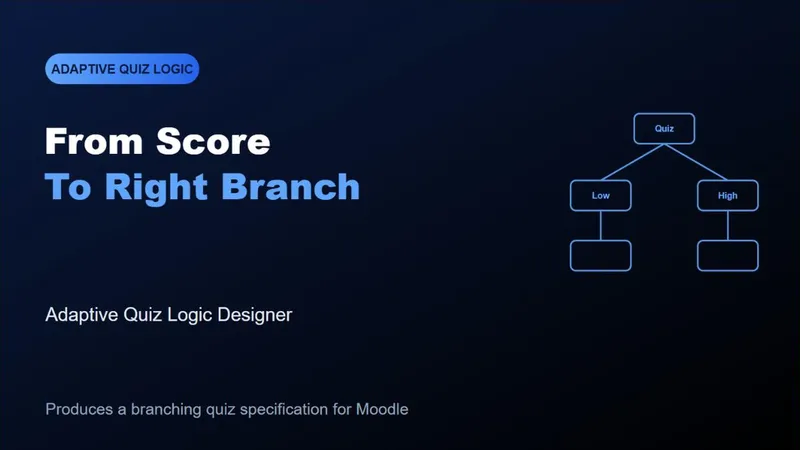
Adaptive Quiz Logic Designer
Produces a written specification for conditional access and adaptive quiz logic (unlocking modules by score range, branching) that can be set up in Moodle from your quiz purpose and question pool, along with implementation steps for the Moodle interface. Who it's for: education technologists designing personalized learning paths.
 Research
Weekly Lesson Plan Writer
Produces a structured weekly lesson plan from your lesson topic and duration, including measurable learning objectives written with Bloom's taxonomy verbs, a time-scheduled lesson flow, and a suggested assessment element. Always matches objectives to activities. Who it's for: university instructors and educators preparing courses or training programs.
 Research
Statistical Report + Reviewer Objection
Produces a complete Results section from your descriptive + inferential statistics outputs (including assumption tests). If it detects a normality or variance homogeneity violation, it recommends the non-parametric alternative test rather than concealing it. It also pre-identifies at least 4 objections journal reviewers commonly raise (e.g., "assumption tests not reported", "effect size not stated", "no multiple comparison correction applied") and provides a defense sentence for each. Who it's for: researchers working with quantitative methods who want statistical reporting rigor before journal submission.
 Research
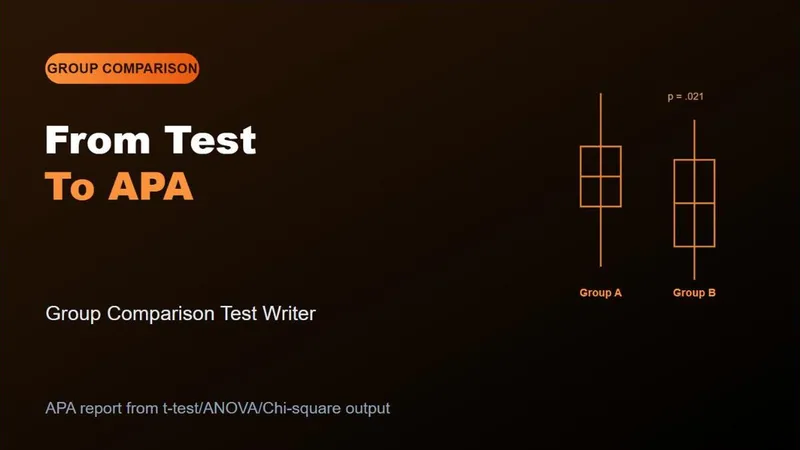
Group Comparison Test Writer
Produces an APA 7-compliant, manuscript-ready Results text from your t-test, ANOVA, or Chi-square test outputs. Uses correct statistical reporting format (t(df)=..., p=..., d=...) and interprets effect size against Cohen's benchmarks. Reminds you to state a multiple comparison correction method when three or more groups are compared. Who it's for: researchers and graduate students running experimental or comparative studies.
 Research
TOPSIS Decision Analysis Writer
Produces a complete manuscript-ready Methods + Results text from your TOPSIS analysis outputs (normalized decision matrix, distances to positive/negative ideal solutions, closeness coefficients). Provides a ranking table and interprets which criteria the best and worst alternatives excelled or lagged in. Suitable for: researchers working on multi-criteria ranking problems such as supplier selection, product/service comparison, or clinical decision support.
 Research
PLS-SEM Report + Objection Engine
Produces a complete Measurement Model + Structural Model report from your PLS-SEM analysis outputs (outer loadings, CR/AVE, HTMT discriminant validity, path coefficients, R²/f²/Q², SRMR). Correctly applies the HTMT threshold and R² interpretation (Cohen/Chin criteria) and avoids causal language. It also pre-identifies at least 4 objections journal reviewers frequently raise (e.g., "why PLS over CB-SEM," "no CMB control reported") and suggests a defense sentence for each. Suitable for: business/social science researchers using PLS-SEM for structural equation modeling who want methodological robustness before journal submission.
 Research
Validity-Reliability Report Writer
Produces a complete manuscript-ready Methods + Results text from your EFA or CFA analysis outputs (KMO, Bartlett's test, factor loadings, fit indices, Cronbach alpha/CR/AVE). Correctly classifies fit index thresholds (CFI/TLI≥.90, RMSEA≤.08, etc.) and reports validity issues like AVE<0.50 without hiding them. Suitable for: academics and graduate students conducting scale development or adaptation studies.
 Research
Cronbach Alpha Reliability Writer
Converts the reliability statistics you enter (Cronbach alpha, item count, subscales) into an academic "Reliability Analysis" paragraph ready to drop straight into your manuscript. Provides an acceptability table by subscale and, if it detects a low alpha (<.60), states this openly rather than hiding it. Suitable for: graduate students and researchers using scales who want to write the method section quickly and correctly.
 Research
PLS-SEM Report & Rebuttal
Generates a complete Measurement Model + Structural Model report from your PLS-SEM analysis outputs (outer loadings, CR/AVE, HTMT discriminant validity, path coefficients, R²/f²/Q², SRMR). Applies the correct HTMT threshold and R² interpretation (Cohen/Chin criteria) and avoids causal language. It also anticipates at least 4 common journal reviewer objections (e.g., “Why was PLS chosen instead of CB-SEM?” and “CMB was not tested”) and provides a defense statement for each. Suitable for business and social science researchers conducting structural equation modeling with PLS-SEM, and for those seeking methodological rigor before submitting to a journal.
 Research
Missing Data Reporting Assistant
When you enter your sample size, missing data proportion/pattern (MCAR/MAR/MNAR), missing data method (listwise deletion, multiple imputation, etc.), and outlier detection method (Z-score, IQR, Mahalanobis), it produces an academic paragraph that can be inserted directly into the "Data Pre-processing" section of your manuscript. If there is a methodological contradiction between your method choice and the missing data pattern (e.g., using listwise deletion under an MNAR pattern), it states this explicitly. Suitable for: graduate students and researchers doing survey/clinical data analysis who want to write the data pre-processing section quickly and correctly.
 Research
Meta-Analysis Full Report Writer
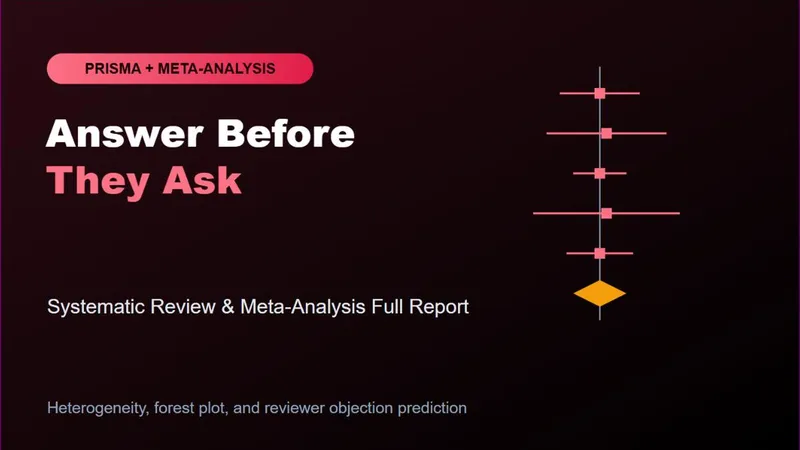
Produces a complete Methods + Results + Limitations text compliant with PRISMA 2020 and the Cochrane Handbook from your meta-analysis statistics (pooled effect size, I², Q, tau², publication bias indicators). Never misinterprets the I² value (including the "percentage of variance" framing); avoids overstated causal language (uses cautious phrasing like "findings are consistent with..." instead of "evidence demonstrates that"). At the end, it also offers at least 3 questions a reviewer might ask along with defense sentences. Suitable for: researchers writing a meta-analysis paper who want to strengthen the methods section before journal submission. What it does not do: it does not perform statistical calculations from raw data (you must already have your R/RevMan/CMA output) — it only converts and interprets your results into academic text.
 Research
Bibliometric Findings Writer
Converts the raw numbers you obtain from VOSviewer or Biblioshiny (Bibliometrix/R) outputs (keyword frequencies, citation network clusters, yearly publication trend, country/institution/journal distribution) into publication-ready, interpreted academic text. Uses an academic tone that narrates where the literature is heading rather than repeating raw numbers; avoids speculative causal claims. Suitable for: researchers writing a thesis/paper who need a bibliometric analysis section but struggle to translate raw data into academic language. Usage: paste your cluster/keyword list from VOSviewer or your Biblioshiny summary table directly; the skill thematically names and interprets the keyword clusters, and evaluates the citation network and country collaboration pattern.
Scale Data Precheck
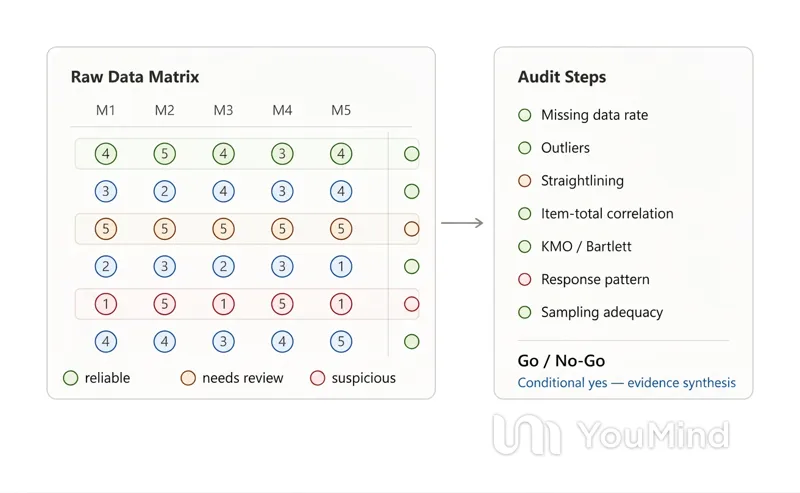
Triggered when raw scale development data (Excel/CSV) collected by a professional survey firm needs to be reviewed for psychometric data quality before proceeding to EFA/CFA or final reliability analyses. It comprehensively evaluates missing data, outliers, careless responding, response bias, item quality, and sample adequacy, then produces a Go/No-Go decision. It does not modify the data; it only provides a diagnostic audit report.