
AI Writing Trace Detector
Identify and eliminate AI traces in text
AI Writing Trace Detector
Identify and eliminate AI traces in text
Showcase
Description
Want your writing to be free of AI traces and read like a product of genuine human thought? This intelligent assistant precisely identifies and eliminates possible AI-generated traces in your text. It deeply analyzes your writing from four core dimensions: structure, language, thought, and rhythm, ensuring your expression is full of judgment, personality, and authentic hesitation, rather than the machine's pursuit of 'correct and comprehensive'. After submitting your text, you will receive a detailed AI trace detection report. The report clearly marks high, medium, and low risk trace types, and provides original text citations and an overall diagnosis, giving you a clear view of the AI feel's source. Whether it's mechanically symmetrical paragraphs, frequently occurring AI high-frequency words, thought patterns lacking personal imprint, or overly uniform sentence rhythms, nothing will escape detection. Going further, it provides specific correction suggestions for each high and medium risk trace. These suggestions not only include correction examples, but also explain the rationale, helping you understand how to break uniformity, replace AI language, add traces of human thought, and create rhythm changes to make your writing radiate 'human touch'. Finally, it can output a fully corrected version and list key changes compared to the original, helping you create truly engaging and personalized content.
Why we love this skill
This skill takes a unique approach, analyzing AI traces from four dimensions: structure, language, thinking, and rhythm, providing an exclusive 'de-AI' correction plan to instantly fill your text with human touch.
Related Skills
View all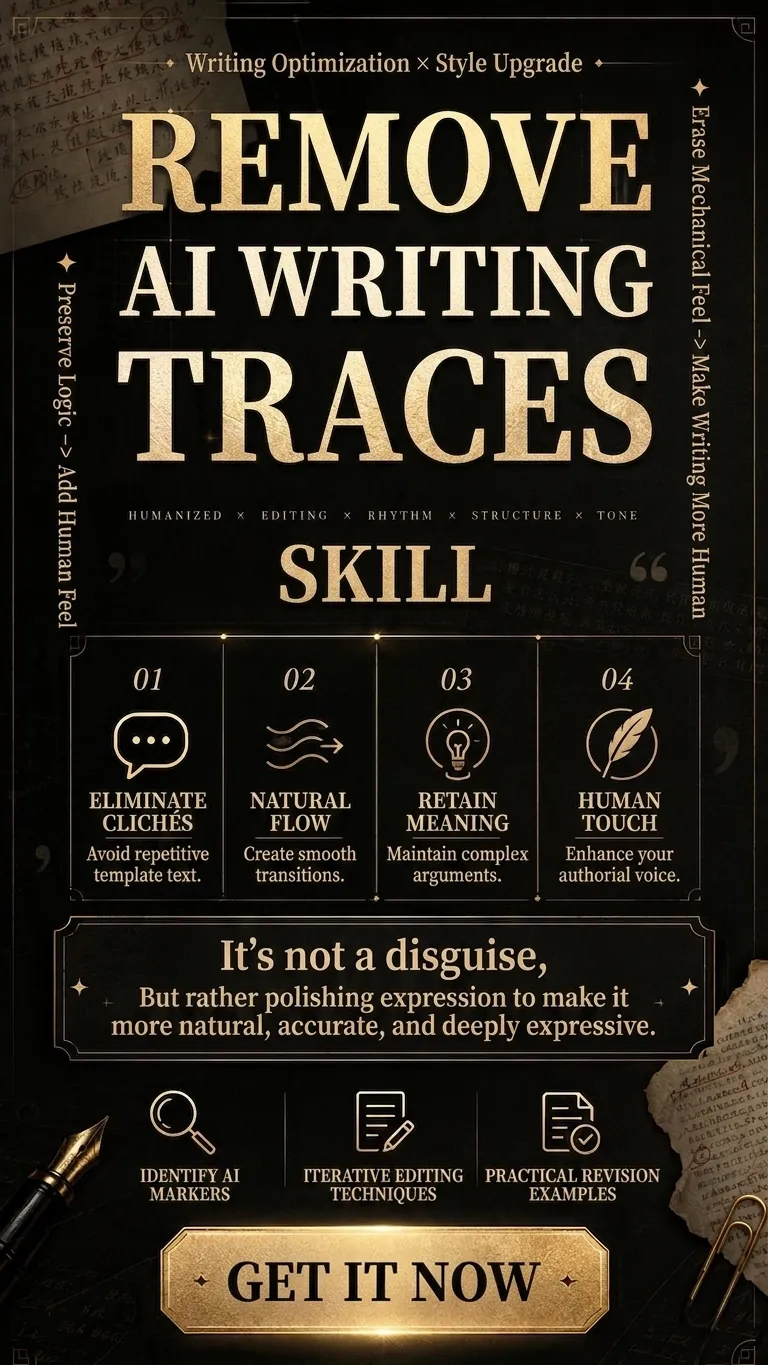 Write
AI Writing Humanizer
Want to eliminate the common 'industrialized' traces in Chinese AI text, giving your writing genuine human warmth and depth? This skill focuses on removing formulaic expressions in AI writing, injecting lively judgment, natural rhythm, unique emphasis, rich details, and authentic tone. It is especially adept at handling in-depth content such as comments, personal essays, historical analysis, political philosophy, social observations, reading notes, and long-form WeChat articles. By identifying and rewriting rigid aspects—from word choice and sentence structure to overall argumentation—this skill helps you transform grand, universally correct narratives into specific, nuanced insights, giving your writing a smooth and natural flow. Without altering the original meaning, it carefully diagnoses AI traces, such as identifying vague clichés, repetitive sentence patterns, and overly balanced tones. It replaces these mechanical elements with more concrete and insightful expressions, infusing your article with the author's personal thoughts and judgments rather than a cold logical construct. Additionally, for issues that mere polishing cannot solve, it points out where facts, examples, or arguments are needed, ensuring both depth and breadth. The result is a Chinese article that is not only clear in viewpoint but also full of human touch and personalized expression. It retains necessary professionalism while removing exaggerated adjectives and stiff connectors, making the text as natural as breathing—powerful yet warm, and far from being 'correct nonsense'.
Mimic CSSCI Expert Writing
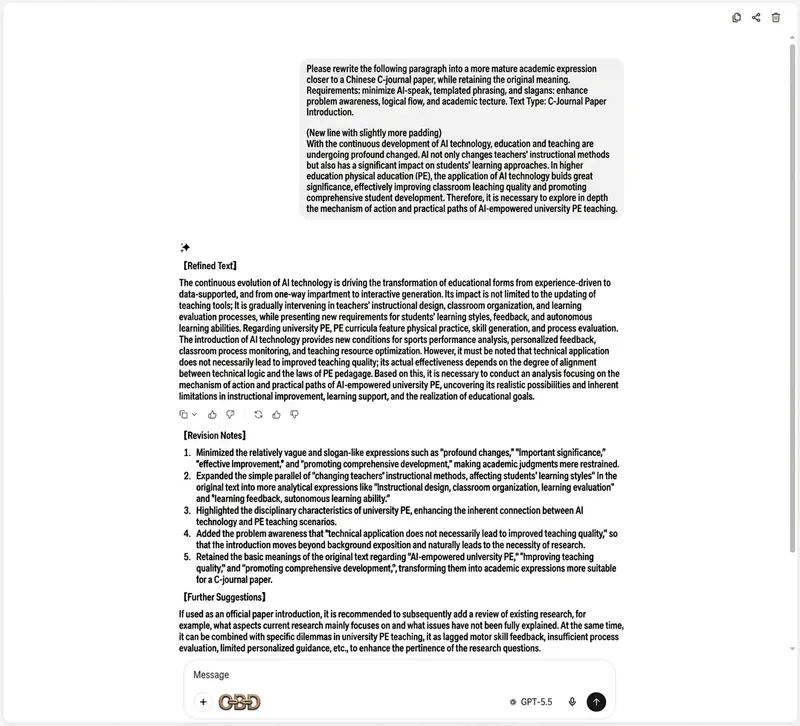
This AI assistant can polish your Chinese academic texts—such as papers, project proposals, or academic reviews—to the mature expression standards of CSSCI and core journals. It focuses on strengthening the text's problem awareness, theoretical rigor, logical coherence, and concise expression, aiming to reduce AI writing traces, avoid empty clichés, mechanical parallelism, and unsupported exaggerated expressions, making your research outputs more academically distinctive and rigorous. Whether you are writing an academic paper, preparing a project proposal, or conducting an academic review, this tool can adjust its polishing style according to the text type. It ensures that core arguments, data, reference numbers, and specialized terms remain unchanged, while optimizing sentence structure and improving conceptual accuracy and judgment restraint, making your expression more aligned with the norms and habits of high-level Chinese academic writing. By refining common and formulaic expressions and transforming them into more profound and insightful academic language, this tool helps your text present stronger professionalism and persuasiveness. It not only enhances the academic quality of the writing but also ensures that your research outcomes are clearer in logic and more refined in expression, enabling them to stand out in academic communication and review.
AI Prompt Optimization Expert
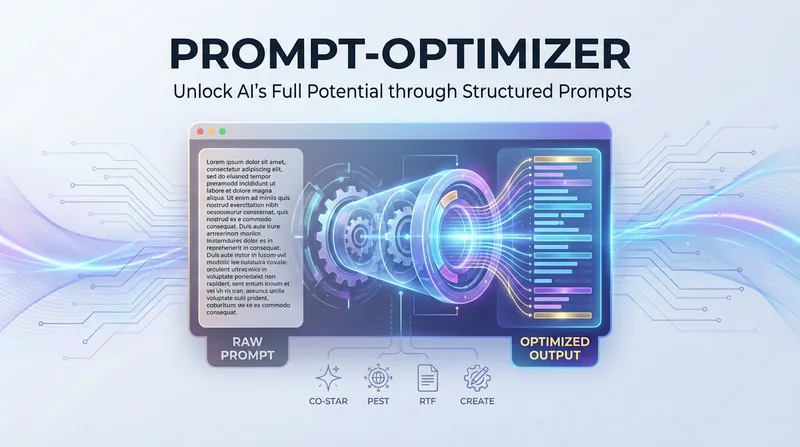
The AI Prompt Optimization Expert focuses on improving prompt quality through a systematic framework, helping you convey your intent precisely and making AI output more stable and predictable. Whether you need to refine existing prompts, build complex task descriptions from scratch, or find professional templates for specific scenarios, this skill provides comprehensive support. It can not only restructure vague requests into structured prompts, but also identify and fix common logical flaws through a diagnostic process. The skill includes a variety of proven optimization frameworks and can flexibly switch strategies based on the nature of the task. For example, for formal documents and professional content, it strengthens the background and audience dimensions; while for code generation or data processing tasks, it focuses more on role definition and specific constraints. In this way, it ensures every prompt has a clear goal, a defined style, and a well-structured output format. In addition, it covers specialized templates for a wide range of high-frequency scenarios, from copywriting and data analysis to technical documentation. You can directly use these proven structures and quickly fill in key details such as core selling points, data descriptions, or reader background. During optimization, the skill also checks against a quality checklist and uses multiple iterations and side-by-side comparisons to help you master essential prompt engineering techniques, significantly reducing communication costs and boosting productivity.
Information
- Version
- v3
- Last updated
- Runtime credits
- Usage-based
- Models
- Auto
