
STEM PhD Topic Designer
Use literature to shape a defensible PhD topic
Description
Designed for PhD students in food science, chemistry, materials science, biology, environmental science, agriculture, and engineering. Through a six-step process—locking down the research object, identifying core variables, scanning titles, calibrating with abstracts, extracting gaps, and building a research-question chain—it turns a vague direction, an advisor-assigned topic, or scattered experiments into a defensible, actionable final PhD topic report. Rather than simply generating batches of topics, it identifies risks such as mixed variables, overcrowded research dimensions, expanding experimental scope, and overstated mechanistic claims. At each key stage, it waits for you to confirm, revise, or reject its suggestions, preserving the judgment that truly belongs to the researcher.
Related Skills
View all
STEM PhD Topic Diagnostician
Already have a PhD dissertation topic but unsure whether it is rigorous, innovative, and feasible? This Skill is designed to diagnose existing topics—not randomly generate topics from scratch or merely polish the wording. It breaks down the research subject, core variables, mechanisms, outcome measures, and research boundaries in your topic. Based on the Chinese and English literature, experimental foundation, samples, methods, equipment, timeline, and budget you provide, it assesses the topic’s rigor, novelty, and feasibility, while identifying risks such as “innovation” based only on changing materials, confounded variables, insufficient evidence for the proposed mechanism, an uncontrolled sample matrix, and chapters that cannot build progressively. The final output is a STEM PhD Topic Health Check Report, which clearly recommends whether to: retain the topic with minor adjustments; retain the research subject while strengthening its dimensions; retain the research problem and reconstruct the subject; or stop patching and redesign the topic. It is intended for STEM PhD students in food science, chemistry, materials science, biology, basic medical sciences, environmental science, agriculture, energy, and engineering. It is especially useful for those preparing a proposal defense, revising a topic at an advisor’s request, who have already defended their proposal but lack a clear central thread, or who have existing experiments but are unsure whether they can support an entire PhD dissertation.

Quantitative Topic Selection
Turn a vague research interest into a testable, feasible quantitative paper topic tailored to your target journal. Whether you plan to submit to a CSSCI or SSCI journal, or are comparing cross-sectional and longitudinal research, this Skill helps clarify your research direction, population, and scope while building a clear variable framework around independent, dependent, mediating, and moderating variables. As your topic takes shape, you can develop research questions, a theoretical framework, formal research hypotheses, measurement instruments, sampling and data collection plans, and statistical analysis approaches aligned with your hypotheses. If you already have a policy project or research keywords, you can use them to identify directions with academic publication potential. If you have not yet settled on a specific angle, you can generate and compare multiple candidate topics. The final output focuses on topic feasibility and publication potential: whether the data can be obtained, whether the variables can be operationalized, whether the theory, hypotheses, and methods form a coherent chain, whether the target journal is a good fit, and where the topic can occupy a distinct niche relative to existing research. You will receive a complete topic finalization plan covering the research direction, variable relationships, theoretical hypotheses, cross-sectional or longitudinal design, data and analysis plan, risk considerations, and feasibility recommendations—ready to share with your advisor or use as the basis for a literature review.
 Write
WriteAcademic Research Question
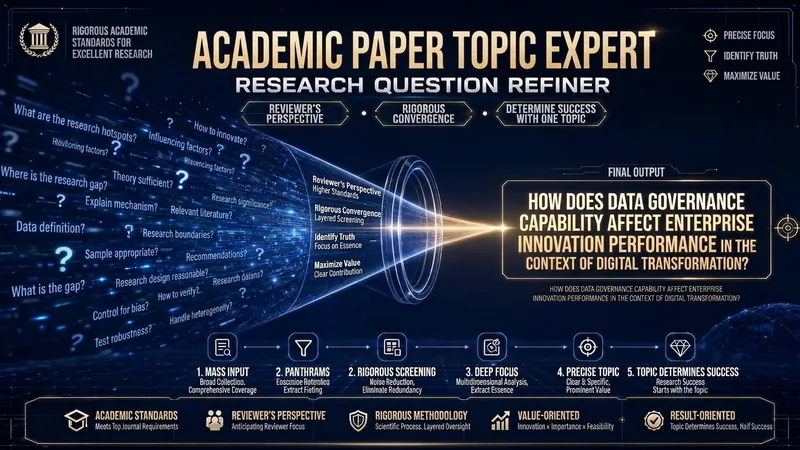
• Diagnose candidate topics: Identify overly broad topics, unclear subjects, uncontrolled boundaries, and false novelty before determining whether the topic is ready to be finalized. • Narrow the research scope: Remove nonessential subjects, variables, and objectives to reduce “trying to study everything” to one central question. • Derive the core question: Identify a single research direction based on subject clarity, question sharpness, scope control, and fit with available materials. • Generate a standardized title: Produce one Chinese title aligned with the research question, with an English title and a specific contribution statement when needed. After opening, say: “I have 3 candidate topics and want to submit to a CSSCI journal. Help me finalize the topic.” It will first check the research subject, core question, scope, and practical constraints, then provide a well-supported final research question. If information is insufficient, it will ask follow-up questions instead of forcing a polished title. Suitable for: Researchers with candidate topics who are struggling to choose one / scholars who need to focus quickly before submission / anyone who does not want to be rejected by a reviewer’s one-line criticism that the research question is unclear. ✅ This version has undergone two months of refinement, testing, and iteration.
STEM PhD Topic Designer
Use literature to shape a defensible PhD topic
Description
Designed for PhD students in food science, chemistry, materials science, biology, environmental science, agriculture, and engineering. Through a six-step process—locking down the research object, identifying core variables, scanning titles, calibrating with abstracts, extracting gaps, and building a research-question chain—it turns a vague direction, an advisor-assigned topic, or scattered experiments into a defensible, actionable final PhD topic report. Rather than simply generating batches of topics, it identifies risks such as mixed variables, overcrowded research dimensions, expanding experimental scope, and overstated mechanistic claims. At each key stage, it waits for you to confirm, revise, or reject its suggestions, preserving the judgment that truly belongs to the researcher.
Related Skills
View allSTEM PhD Topic Diagnostician
Already have a PhD dissertation topic but unsure whether it is rigorous, innovative, and feasible? This Skill is designed to diagnose existing topics—not randomly generate topics from scratch or merely polish the wording. It breaks down the research subject, core variables, mechanisms, outcome measures, and research boundaries in your topic. Based on the Chinese and English literature, experimental foundation, samples, methods, equipment, timeline, and budget you provide, it assesses the topic’s rigor, novelty, and feasibility, while identifying risks such as “innovation” based only on changing materials, confounded variables, insufficient evidence for the proposed mechanism, an uncontrolled sample matrix, and chapters that cannot build progressively. The final output is a STEM PhD Topic Health Check Report, which clearly recommends whether to: retain the topic with minor adjustments; retain the research subject while strengthening its dimensions; retain the research problem and reconstruct the subject; or stop patching and redesign the topic. It is intended for STEM PhD students in food science, chemistry, materials science, biology, basic medical sciences, environmental science, agriculture, energy, and engineering. It is especially useful for those preparing a proposal defense, revising a topic at an advisor’s request, who have already defended their proposal but lack a clear central thread, or who have existing experiments but are unsure whether they can support an entire PhD dissertation.
Quantitative Topic Selection
Turn a vague research interest into a testable, feasible quantitative paper topic tailored to your target journal. Whether you plan to submit to a CSSCI or SSCI journal, or are comparing cross-sectional and longitudinal research, this Skill helps clarify your research direction, population, and scope while building a clear variable framework around independent, dependent, mediating, and moderating variables. As your topic takes shape, you can develop research questions, a theoretical framework, formal research hypotheses, measurement instruments, sampling and data collection plans, and statistical analysis approaches aligned with your hypotheses. If you already have a policy project or research keywords, you can use them to identify directions with academic publication potential. If you have not yet settled on a specific angle, you can generate and compare multiple candidate topics. The final output focuses on topic feasibility and publication potential: whether the data can be obtained, whether the variables can be operationalized, whether the theory, hypotheses, and methods form a coherent chain, whether the target journal is a good fit, and where the topic can occupy a distinct niche relative to existing research. You will receive a complete topic finalization plan covering the research direction, variable relationships, theoretical hypotheses, cross-sectional or longitudinal design, data and analysis plan, risk considerations, and feasibility recommendations—ready to share with your advisor or use as the basis for a literature review.
WriteAcademic Research Question
• Diagnose candidate topics: Identify overly broad topics, unclear subjects, uncontrolled boundaries, and false novelty before determining whether the topic is ready to be finalized. • Narrow the research scope: Remove nonessential subjects, variables, and objectives to reduce “trying to study everything” to one central question. • Derive the core question: Identify a single research direction based on subject clarity, question sharpness, scope control, and fit with available materials. • Generate a standardized title: Produce one Chinese title aligned with the research question, with an English title and a specific contribution statement when needed. After opening, say: “I have 3 candidate topics and want to submit to a CSSCI journal. Help me finalize the topic.” It will first check the research subject, core question, scope, and practical constraints, then provide a well-supported final research question. If information is insufficient, it will ask follow-up questions instead of forcing a polished title. Suitable for: Researchers with candidate topics who are struggling to choose one / scholars who need to focus quickly before submission / anyone who does not want to be rejected by a reviewer’s one-line criticism that the research question is unclear. ✅ This version has undergone two months of refinement, testing, and iteration.
Find your next favorite skill
Explore more curated AI skills for research, creation, and everyday work.