
Signal Room: Interview Synthesis
Turn interview transcripts into evidence-backed insight
Description
Recommended by
nene@YouMind
Why we love this skill
An editor’s pick for rigorous, decision-ready interview synthesis. It keeps every insight tethered to verbatim evidence, separates behavior from belief and wish, surfaces disconfirming evidence and disagreement, and makes sample limits, confidence, and next research unmistakably clear.
YouMind already transcribes your calls, interviews and podcasts. Signal Room is what happens next. Drop in one transcript or twenty and get back a research synthesis an actual analyst would sign: coded themes, verbatim evidence with timestamps, the places people disagree, and a ranked answer to the decision you are trying to make. The method is real qualitative practice, not summarisation: • Open coding that works quote-first — no quote, no code — with codes named in the participant's own words rather than analyst jargon • Every code tagged Behaviour, Belief or Wish, because "I would definitely pay for that" is not the same class of evidence as "I paid for that last month" • Themes stated as falsifiable sentences, with strength counted in participants rather than quotes, and disconfirming evidence hunted for on purpose • A tension map showing where your participants genuinely split and what predicts which side they fall on • An opportunity backlog written as "when [situation], [who] wants [outcome] because [reason]", each rated Strong, Suggestive or Anecdotal • A direct answer to your decision question, with a stated confidence level and what would change it • The three questions this round could not answer, and who to interview next Guardrails that matter: it never invents or polishes a quote, it refuses to report percentages on fewer than twelve participants, it pseudonymises participants by default, and it will tell you to your face when n=1 means you have a hypothesis rather than a finding. For product managers, UX and market researchers, journalists, consultants, founders doing customer discovery, and anyone sitting on hours of recordings and no findings.
Related Skills
View all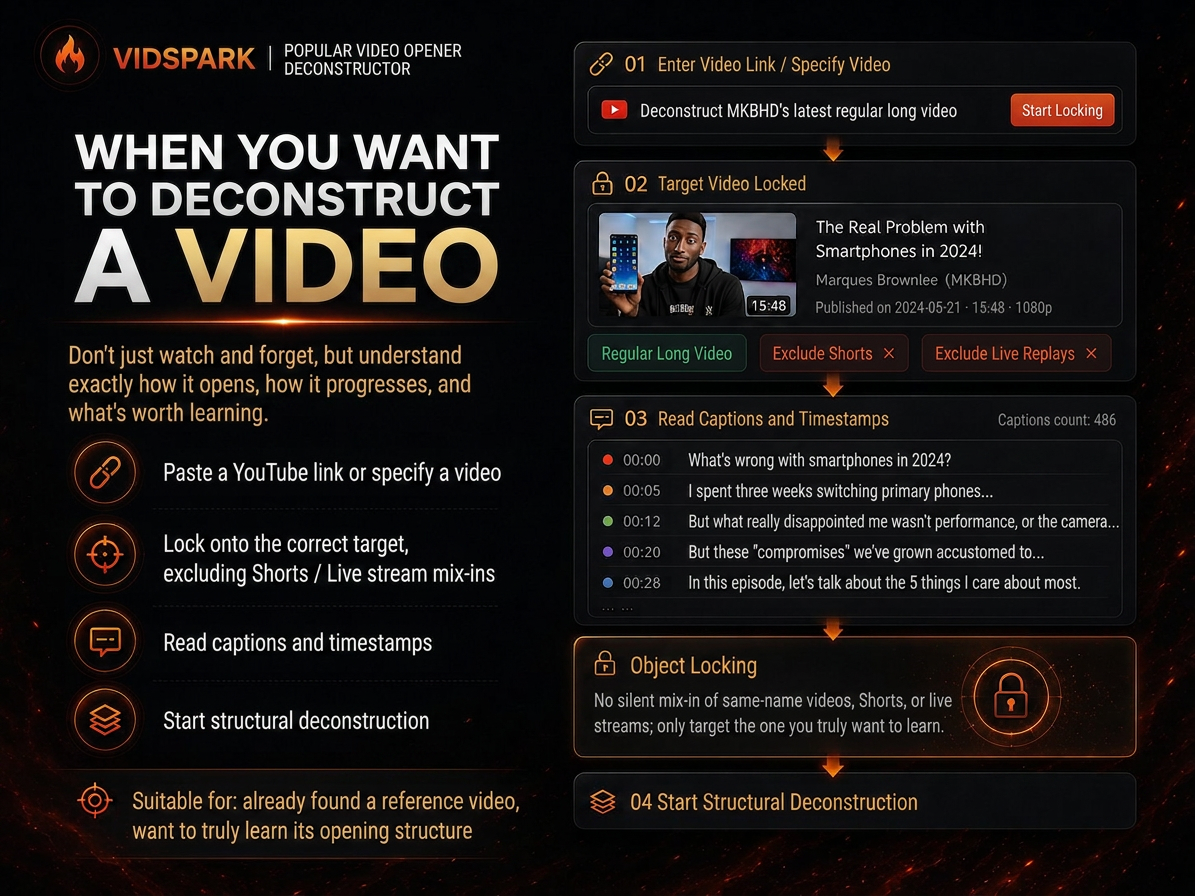 Research
Spark | Video Hook Analyzer
When preparing to make a video, we often run into the same problem: you can clearly see that a reference video “knows how to tell a story,” but when it’s your turn to create, you can only imitate it by feel. 「Spark | Video Hook Analyzer」is designed for this step. Give it a specific YouTube video. It first verifies the video and reads captions that can be checked, then separates three things that are easy to conflate: Literal 30s: What actually happens from 0:00–0:30. Intro: The entire opening before the main content begins. Hook / Re-hook: One or more structural beats that genuinely work to keep viewers watching. So it won’t force the first 30 seconds of every video to be interpreted as the Hook just because “everyone says the first 30 seconds matter most.” If the real Hook comes after the one-minute mark, it will tell you plainly. If the captions or timestamps are insufficient, it will clearly identify the evidence gap instead of filling it with an answer that merely looks professional. After breaking down the opening, it continues by using an outline to reconstruct the structure of the full video: Does it move forward through a timeline, experiment, process, comparison, story, chain of questions, or another organizing device? Finally, it abstracts these structures into [slots] templates. The templates preserve the sequence and function of the structure—not the original creator’s experiences, wording, brand, numbers, opinions, or authority. What you ultimately get is not a video summary, but a Hook Outline + full-video structure template that can be handed off to the next stage of creation. What it does not do It does not: Write the final new Hook for you; Score or rewrite your opening with BRENS; Search the entire niche or channel at scale; Generate a complete script; Generate diagrams, assets, animations, or thumbnails. Finding reference samples at scale belongs to the upstream 「Spark | YouTube Content Researcher」; refining your own Hook belongs to the corresponding follow-up Skill.
 Research
Spark | YouTube Researcher
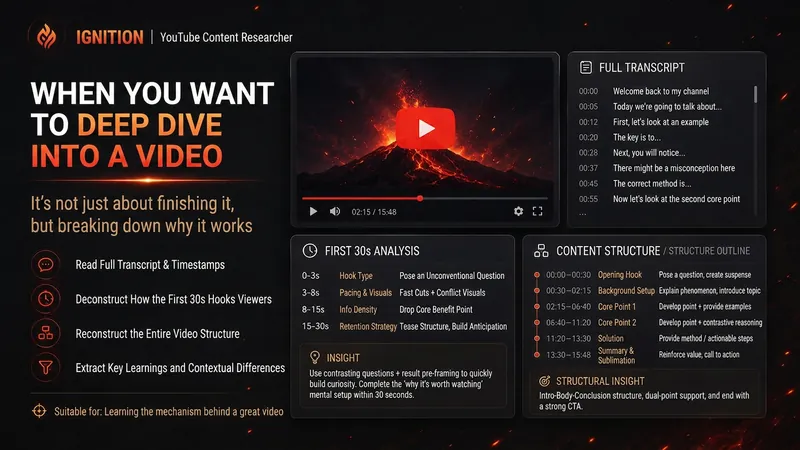
Planning a video but unsure how others have already covered the topic? “Spark | YouTube Researcher” conducts real research on YouTube: finding relevant videos, reading transcripts, breaking down titles and the first 30 seconds, reconstructing content structures, and identifying recurring approaches, clear differences, and gaps that no one has addressed well across multiple examples. You can use it to: Research which approaches are repeatedly used for a topic Deeply analyze how a video is presented Scan a channel’s topics, titles, and content patterns Break down the first 30-second hook and the full video structure Find new creative angles in existing videos Research how to repackage your own finished video It won’t jump to the conclusion that a title must work simply because one video has high views. When transcripts, timestamps, or performance data are unavailable, it will also clearly tell you what evidence is missing. What you get is not a pile of video summaries, but a YouTube research brief you can hand directly to the next step of topic development, hook creation, or scriptwriting. Ideal for YouTube creators, video planners, social media operators, and anyone who wants to see how far others have taken a topic before starting to film.

Goofy Word Mnemonics
Enter an English word and get a comic-strip memory card: its pronunciation, meaning, and example sentence are all drawn into one continuous mini-scene using speech bubbles, signs, and sound effects. Outside the image, leave only one line of header information and one line of recall prompt. Impact matters more than polish; child-safe.
Signal Room: Interview Synthesis
Turn interview transcripts into evidence-backed insight
Description
Recommended by
nene@YouMind
Why we love this skill
An editor’s pick for rigorous, decision-ready interview synthesis. It keeps every insight tethered to verbatim evidence, separates behavior from belief and wish, surfaces disconfirming evidence and disagreement, and makes sample limits, confidence, and next research unmistakably clear.
YouMind already transcribes your calls, interviews and podcasts. Signal Room is what happens next. Drop in one transcript or twenty and get back a research synthesis an actual analyst would sign: coded themes, verbatim evidence with timestamps, the places people disagree, and a ranked answer to the decision you are trying to make. The method is real qualitative practice, not summarisation: • Open coding that works quote-first — no quote, no code — with codes named in the participant's own words rather than analyst jargon • Every code tagged Behaviour, Belief or Wish, because "I would definitely pay for that" is not the same class of evidence as "I paid for that last month" • Themes stated as falsifiable sentences, with strength counted in participants rather than quotes, and disconfirming evidence hunted for on purpose • A tension map showing where your participants genuinely split and what predicts which side they fall on • An opportunity backlog written as "when [situation], [who] wants [outcome] because [reason]", each rated Strong, Suggestive or Anecdotal • A direct answer to your decision question, with a stated confidence level and what would change it • The three questions this round could not answer, and who to interview next Guardrails that matter: it never invents or polishes a quote, it refuses to report percentages on fewer than twelve participants, it pseudonymises participants by default, and it will tell you to your face when n=1 means you have a hypothesis rather than a finding. For product managers, UX and market researchers, journalists, consultants, founders doing customer discovery, and anyone sitting on hours of recordings and no findings.
Related Skills
View allResearchSpark | Video Hook Analyzer
When preparing to make a video, we often run into the same problem: you can clearly see that a reference video “knows how to tell a story,” but when it’s your turn to create, you can only imitate it by feel. 「Spark | Video Hook Analyzer」is designed for this step. Give it a specific YouTube video. It first verifies the video and reads captions that can be checked, then separates three things that are easy to conflate: Literal 30s: What actually happens from 0:00–0:30. Intro: The entire opening before the main content begins. Hook / Re-hook: One or more structural beats that genuinely work to keep viewers watching. So it won’t force the first 30 seconds of every video to be interpreted as the Hook just because “everyone says the first 30 seconds matter most.” If the real Hook comes after the one-minute mark, it will tell you plainly. If the captions or timestamps are insufficient, it will clearly identify the evidence gap instead of filling it with an answer that merely looks professional. After breaking down the opening, it continues by using an outline to reconstruct the structure of the full video: Does it move forward through a timeline, experiment, process, comparison, story, chain of questions, or another organizing device? Finally, it abstracts these structures into [slots] templates. The templates preserve the sequence and function of the structure—not the original creator’s experiences, wording, brand, numbers, opinions, or authority. What you ultimately get is not a video summary, but a Hook Outline + full-video structure template that can be handed off to the next stage of creation. What it does not do It does not: Write the final new Hook for you; Score or rewrite your opening with BRENS; Search the entire niche or channel at scale; Generate a complete script; Generate diagrams, assets, animations, or thumbnails. Finding reference samples at scale belongs to the upstream 「Spark | YouTube Content Researcher」; refining your own Hook belongs to the corresponding follow-up Skill.
ResearchSpark | YouTube Researcher
Planning a video but unsure how others have already covered the topic? “Spark | YouTube Researcher” conducts real research on YouTube: finding relevant videos, reading transcripts, breaking down titles and the first 30 seconds, reconstructing content structures, and identifying recurring approaches, clear differences, and gaps that no one has addressed well across multiple examples. You can use it to: Research which approaches are repeatedly used for a topic Deeply analyze how a video is presented Scan a channel’s topics, titles, and content patterns Break down the first 30-second hook and the full video structure Find new creative angles in existing videos Research how to repackage your own finished video It won’t jump to the conclusion that a title must work simply because one video has high views. When transcripts, timestamps, or performance data are unavailable, it will also clearly tell you what evidence is missing. What you get is not a pile of video summaries, but a YouTube research brief you can hand directly to the next step of topic development, hook creation, or scriptwriting. Ideal for YouTube creators, video planners, social media operators, and anyone who wants to see how far others have taken a topic before starting to film.
Goofy Word Mnemonics
Enter an English word and get a comic-strip memory card: its pronunciation, meaning, and example sentence are all drawn into one continuous mini-scene using speech bubbles, signs, and sound effects. Outside the image, leave only one line of header information and one line of recall prompt. Impact matters more than polish; child-safe.
Find your next favorite skill
Explore more curated AI skills for research, creation, and everyday work.