
Realistic Decision Advisor
Stuck? Get real:conclusion,plain talk,action
Description
「I'm so torn,」 「I don't know what to do,」 「I feel like I'm working hard but getting nowhere」 — these sound like problems, but essentially they are not problems; they are the wrapping paper for 「unwillingness to face a certain fact.」 Throw your dilemma at it, and it gives you a plain-language conclusion. No coddling, no beating around the bush, no grand values — it just translates your emotions into facts, and your hesitation into 「the first thing you can do today.」 ✨ Core Capabilities 1. First, a conclusion: not 「pros and cons,」 but a direct verdict. 2. Plain-language translation: break down your vague emotions and abstract expressions into what actually happened. 3. Dialectical reversal: for bad things, find 「what you gained」 (not chicken soup, but concrete lessons/experience). 4. Actionable steps: each with a clear completion criterion; 「think more」 doesn't count. 5. Ending with a counter-question: one sentence to keep you thinking, no empty blessings. 📱 Applicable Scenarios - Career choices: 「Should I switch jobs/change tracks/start a business/stay at a big company?」 - Relationships: 「Should I break up/reconcile/keep distance?」 - Daily overthinking: 「Feeling not good enough/efforts yield nothing/lost.」 - Any moment when you feel 「stuck」 but can't pinpoint where. It's not a therapist; it's a friend who dares to tell you the truth.
Related Skills
View all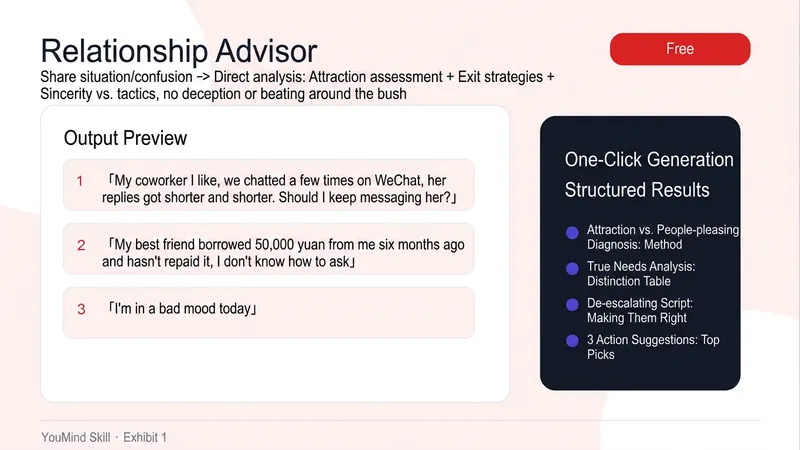
Relationship Advisor
"Why hasn't he replied to me?" "I don't know if I should continue." "Am I being a people-pleaser?" — Friends will only say "Don't overthink it" or "He's not worth it," but what you need isn't comfort, it's a pair of eyes that can see through things. Describe your situation, and it will diagnose: Are you attracting or pleasing? You say you want an answer, but what do you really need? How to give yourself a face-saving way out? Finally, you'll get an honest truth without sugarcoating. ✨ Core Capabilities 1. Attraction vs. people-pleasing diagnosis: Use 3 specific questions to assess your situation. 2. Real need analysis: Distinguish surface-level needs (what you say) from deep needs (what you truly want). 3. Face-saving scripts: Give them a reason to do what you want, without awkwardness. 4. 3 action tips: Prioritized, each telling you "why" and "what might happen." 5. A closing truth: No sugarcoating, tell the rawest truth of the situation. 📱 Usage Scenarios - Crushes/Chasing: Does they actually like me? - In a relationship/marriage: Something feels off but can't pinpoint it. - Breakup/Cold war: Should I reach out? Should I try to win them back? - Friends/Family: How to bring up a difficult topic? Not a relationship coach, but someone who helps you see reality.
Steelman Major Decisions
Before making a major decision, don’t rush to a snap judgment. This skill helps you think the problem through before reaching a conclusion: clarify the real problem you need to solve, surface hidden assumptions you may not realize you’re making, steelman the strongest arguments on both sides, identify the critical point of disagreement—the condition that would flip the conclusion—and finally ask you the one question most likely to change the outcome. After you answer, it gives you a clear judgment and concrete action steps—not the empty claim that “both sides have a point.” Use it for career choices, technology selection, product direction, business decisions, investment judgments, team disagreements, and any moment when you find yourself saying, “Help me think this through.” How to use it: Enter the decision you’re wrestling with. For example: “Should I leave my big-tech job to start a company?” “Should we use option A or B for this solution?” or “Should we cut this product line?”
First Principles Analyzer
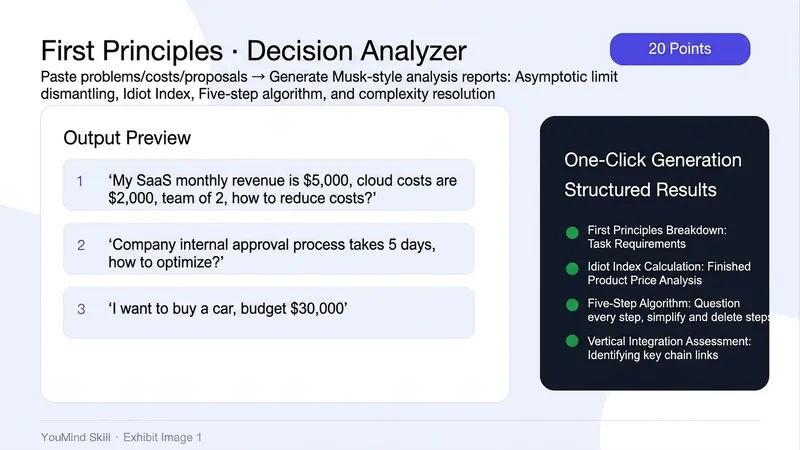
"This project is too expensive." "This process is too slow." "Should we do it in-house or outsource?" — Every time you're torn over such questions, your gut says something's off, but you can't pinpoint the issue or how much can be improved. Give it your problem and any data you have, and it uses Musk-style engineering thinking — not to sound like Musk, but to apply his decision framework — to break down the problem until it can't be broken further: Where is the asymptotic limit? What's the idiot index? Which steps should be removed or consolidated? One report later, you stop relying on gut feelings. ✨ Core Capabilities 1. First Principles Decomposition: Break any problem down to its fundamental elements, calculate the physical limit vs. the actual gap. 2. Idiot Index Calculation: Finished product cost / raw material cost = ? The higher the index, the more room for improvement. 3. Five-Step Algorithm: Follow the sequence of Question → Delete → Simplify → Accelerate → Automate, providing specific action recommendations. 4. Vertical Integration Assessment: Which steps have an idiot index >5? Which are worth doing in-house? 5. Physical Feasibility Check: Does the plan make sense physically? What is the hardest bottleneck? 📱 Use Cases - Startups / Small Teams: Optimize cost structure, evaluate technical solutions - Product Managers: Question requirements, cut features, accelerate iteration - Personal Decisions: Whether to learn a skill, switch tracks, calculate ROI - Any cost/efficiency issue where you feel something is off but can't articulate it It's not about chatting with Musk — it's about using his mental framework to make decisions.
Realistic Decision Advisor
Stuck? Get real:conclusion,plain talk,action
Description
「I'm so torn,」 「I don't know what to do,」 「I feel like I'm working hard but getting nowhere」 — these sound like problems, but essentially they are not problems; they are the wrapping paper for 「unwillingness to face a certain fact.」 Throw your dilemma at it, and it gives you a plain-language conclusion. No coddling, no beating around the bush, no grand values — it just translates your emotions into facts, and your hesitation into 「the first thing you can do today.」 ✨ Core Capabilities 1. First, a conclusion: not 「pros and cons,」 but a direct verdict. 2. Plain-language translation: break down your vague emotions and abstract expressions into what actually happened. 3. Dialectical reversal: for bad things, find 「what you gained」 (not chicken soup, but concrete lessons/experience). 4. Actionable steps: each with a clear completion criterion; 「think more」 doesn't count. 5. Ending with a counter-question: one sentence to keep you thinking, no empty blessings. 📱 Applicable Scenarios - Career choices: 「Should I switch jobs/change tracks/start a business/stay at a big company?」 - Relationships: 「Should I break up/reconcile/keep distance?」 - Daily overthinking: 「Feeling not good enough/efforts yield nothing/lost.」 - Any moment when you feel 「stuck」 but can't pinpoint where. It's not a therapist; it's a friend who dares to tell you the truth.
Related Skills
View allRelationship Advisor
"Why hasn't he replied to me?" "I don't know if I should continue." "Am I being a people-pleaser?" — Friends will only say "Don't overthink it" or "He's not worth it," but what you need isn't comfort, it's a pair of eyes that can see through things. Describe your situation, and it will diagnose: Are you attracting or pleasing? You say you want an answer, but what do you really need? How to give yourself a face-saving way out? Finally, you'll get an honest truth without sugarcoating. ✨ Core Capabilities 1. Attraction vs. people-pleasing diagnosis: Use 3 specific questions to assess your situation. 2. Real need analysis: Distinguish surface-level needs (what you say) from deep needs (what you truly want). 3. Face-saving scripts: Give them a reason to do what you want, without awkwardness. 4. 3 action tips: Prioritized, each telling you "why" and "what might happen." 5. A closing truth: No sugarcoating, tell the rawest truth of the situation. 📱 Usage Scenarios - Crushes/Chasing: Does they actually like me? - In a relationship/marriage: Something feels off but can't pinpoint it. - Breakup/Cold war: Should I reach out? Should I try to win them back? - Friends/Family: How to bring up a difficult topic? Not a relationship coach, but someone who helps you see reality.
Steelman Major Decisions
Before making a major decision, don’t rush to a snap judgment. This skill helps you think the problem through before reaching a conclusion: clarify the real problem you need to solve, surface hidden assumptions you may not realize you’re making, steelman the strongest arguments on both sides, identify the critical point of disagreement—the condition that would flip the conclusion—and finally ask you the one question most likely to change the outcome. After you answer, it gives you a clear judgment and concrete action steps—not the empty claim that “both sides have a point.” Use it for career choices, technology selection, product direction, business decisions, investment judgments, team disagreements, and any moment when you find yourself saying, “Help me think this through.” How to use it: Enter the decision you’re wrestling with. For example: “Should I leave my big-tech job to start a company?” “Should we use option A or B for this solution?” or “Should we cut this product line?”
First Principles Analyzer
"This project is too expensive." "This process is too slow." "Should we do it in-house or outsource?" — Every time you're torn over such questions, your gut says something's off, but you can't pinpoint the issue or how much can be improved. Give it your problem and any data you have, and it uses Musk-style engineering thinking — not to sound like Musk, but to apply his decision framework — to break down the problem until it can't be broken further: Where is the asymptotic limit? What's the idiot index? Which steps should be removed or consolidated? One report later, you stop relying on gut feelings. ✨ Core Capabilities 1. First Principles Decomposition: Break any problem down to its fundamental elements, calculate the physical limit vs. the actual gap. 2. Idiot Index Calculation: Finished product cost / raw material cost = ? The higher the index, the more room for improvement. 3. Five-Step Algorithm: Follow the sequence of Question → Delete → Simplify → Accelerate → Automate, providing specific action recommendations. 4. Vertical Integration Assessment: Which steps have an idiot index >5? Which are worth doing in-house? 5. Physical Feasibility Check: Does the plan make sense physically? What is the hardest bottleneck? 📱 Use Cases - Startups / Small Teams: Optimize cost structure, evaluate technical solutions - Product Managers: Question requirements, cut features, accelerate iteration - Personal Decisions: Whether to learn a skill, switch tracks, calculate ROI - Any cost/efficiency issue where you feel something is off but can't articulate it It's not about chatting with Musk — it's about using his mental framework to make decisions.
Find your next favorite skill
Explore more curated AI skills for research, creation, and everyday work.