
Conversation Podcast: Thinking
Trace thought trajectories in conversations
Description
7/14 Update: Added content extraction and integration sections 1. Key information summary (Module 5) 2. Opinion integration and comparative analysis (Module 6): Groups scattered opinions by topic, distinguishes genuine divergence / surface divergence / consensus, and adds argument strength assessment. 3. Topic area tags (Module 7): Two-tier system of domain tags and concept tags, up to 15 tags, for future retrieval and cross-episode linking. 4. Key questions for further exploration (Module 8): Unresolved threads / logical extensions / assumptions to challenge. ———————————————— Deep analysis of conversational podcasts. This skill helps you capture the most compelling thought trajectories in conversations. It does not merely extract conclusions, but meticulously recreates collisions, generation, divergence, and extension of ideas, allowing you to see how podcast guests build their arguments step by step. You will receive a structurally clear podcast interpretation, including the main thread and unexpected "detour maps," accurately depicting the overall flow of the conversation. The skill presents the reasoning process in segments, from the origin of the topic, intermediate steps of argumentation, to the disagreements between guests and their fascinating chemistry, letting you understand the formation context of each viewpoint. Additionally, this skill highlights "sparkling moments" in the conversation, such as unexpected quotes, brilliant analogies, or 'aha' moments, along with the specific context in which they appear. You can also track the network of clues that are "laid earlier and echoed later," understanding how concepts evolve and how details mentioned early become key to later arguments. Finally, the skill lists unfinished topics and unresolved thoughts, providing inspiration for further exploration.
Related Skills
View all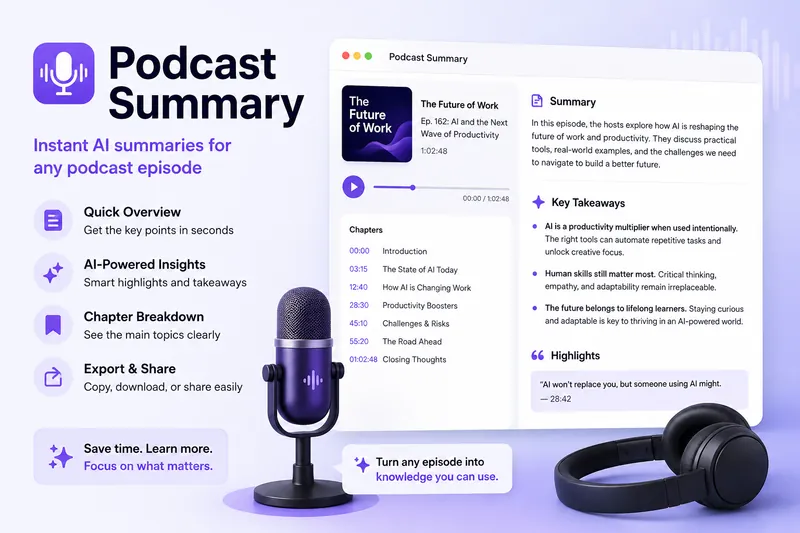
Podcast Summary
This skill provides structured summaries and analysis of podcast content, helping users quickly grasp the core ideas and value of any episode. Whether you're a listener, researcher, or content creator, you can efficiently organize and review podcast episodes using this tool. The skill can extract information from a podcast link (supports major platforms including Xiaoyuzhou, Apple Podcasts, Spotify, YouTube, and Ximalaya) or from user-provided transcripts. It intelligently retrieves metadata such as the episode title, guests, publication date, and show description, and attempts to fetch the full transcript or subtitles. Even if the original page lacks complete information, it will try to supplement content through web searches or cross-platform lookups to ensure comprehensive analysis. After content acquisition, the skill performs an in-depth analysis and generates a detailed note containing an overview, timeline, key quote highlights, and a reasoning progression. The overview summarizes the podcast topic in concise language, the timeline helps you quickly locate key discussions, the key quote highlights distill the guest's unique insights and core viewpoints, and the reasoning progression maps out the podcast's argument logic and thought development. Ultimately, you receive a clean, easy-to-read Markdown-format podcast note that supports direct download.
Dialogue Director Pro | Interview Design Engine
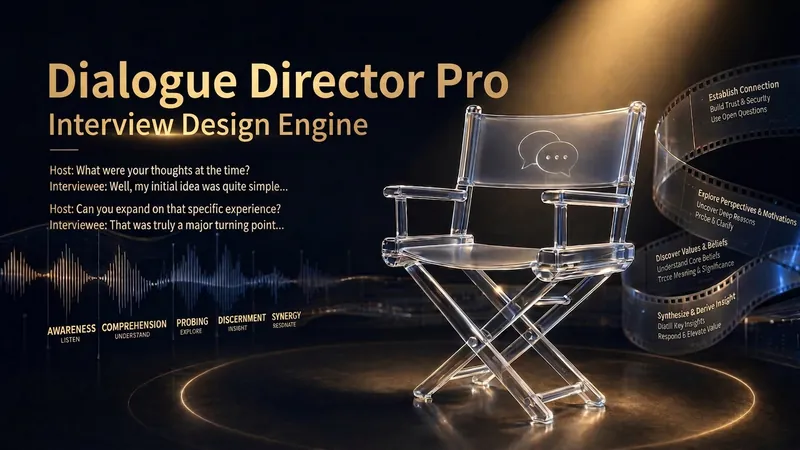
This isn't just a list of questions; it helps you design a memorable conversation. A 7-step process, from guest research to finalized materials: Guest Profile → Narrative Structure → Question Matrix → Process Layout → Interview Rehearsal → Material Conversion → Interview Debriefing 💡 Steps 1-3 form the core design process, delivering a complete interview plan independently; Steps 4-7 enhance the experience and can be used as needed. 🔍 Guest Profile | Online search of publicly available guest information generates a five-dimensional in-depth profile—factual skeleton, story vein, core conflict, communication style, and emotional entry point—telling you which direction to dig. Non-public figures automatically switch to interview-style information gathering. 🌿 Follow-up Question Branching Tree | When generating questions, the system pre-predicts the possible directions of the guest's answers for each key question and designs corresponding follow-up questions. You take this "decision tree" to the event, listen to the guest's answer, and then choose the corresponding branch to ask follow-up questions—no need for on-site AI, no need for real-time text transcription; all plans are designed during the preparation stage. It lets you be a chess player on-site, not an improvisational actor. No similar function exists on the market. 🎬 AI Rehearsal | Before the interview, AI plays the role of a guest, simulating three answering styles (in-depth/superficial/evasive), allowing you to practice follow-up questions and identify blind spots in the process. 📝 Five Outputs | Generates from a single interview: interview article/ podcast script/ oral history transcript/ social media content package/documentary script skeleton. 📊 Interview Debriefing | Plan vs. reality comparison, analysis of gold mines and regrets, five-dimensional capability radar chart, allowing you to grow with every interview. Suitable for: podcast interviews, interviews, student interviews, UX in-depth interviews, executive interviews.
Celebrity Chat Room
In the "Celebrity Chat Room," you can engage in deep conversations with top minds across various fields, whether seeking personal guidance or exploring complex issues. You can discuss first principles with Musk, learn strategic thinking from Mao, get decision-making insights from Munger, or talk about leverage with Naval—gaining multiple perspectives to avoid narrow thinking. This skill supports two core modes: one-on-one private conversations with a single figure to delve into their thought essence, or a roundtable discussion with multiple figures to provoke intellectual debate around your question, providing judgments, evidence, and even pointing out blind spots. Additionally, when you want to introduce new perspectives, the skill can "invite" more figures into the discussion on demand. It quickly extracts the core ideas and unique style of new participants, integrating them into the ongoing conversation to offer richer viewpoints and more comprehensive thinking. Finally, the host will summarize consensus, disagreements, blind spots, and action suggestions to help you clearly understand the issue and make informed decisions.
Conversation Podcast: Thinking
Trace thought trajectories in conversations
Description
7/14 Update: Added content extraction and integration sections 1. Key information summary (Module 5) 2. Opinion integration and comparative analysis (Module 6): Groups scattered opinions by topic, distinguishes genuine divergence / surface divergence / consensus, and adds argument strength assessment. 3. Topic area tags (Module 7): Two-tier system of domain tags and concept tags, up to 15 tags, for future retrieval and cross-episode linking. 4. Key questions for further exploration (Module 8): Unresolved threads / logical extensions / assumptions to challenge. ———————————————— Deep analysis of conversational podcasts. This skill helps you capture the most compelling thought trajectories in conversations. It does not merely extract conclusions, but meticulously recreates collisions, generation, divergence, and extension of ideas, allowing you to see how podcast guests build their arguments step by step. You will receive a structurally clear podcast interpretation, including the main thread and unexpected "detour maps," accurately depicting the overall flow of the conversation. The skill presents the reasoning process in segments, from the origin of the topic, intermediate steps of argumentation, to the disagreements between guests and their fascinating chemistry, letting you understand the formation context of each viewpoint. Additionally, this skill highlights "sparkling moments" in the conversation, such as unexpected quotes, brilliant analogies, or 'aha' moments, along with the specific context in which they appear. You can also track the network of clues that are "laid earlier and echoed later," understanding how concepts evolve and how details mentioned early become key to later arguments. Finally, the skill lists unfinished topics and unresolved thoughts, providing inspiration for further exploration.
Related Skills
View allPodcast Summary
This skill provides structured summaries and analysis of podcast content, helping users quickly grasp the core ideas and value of any episode. Whether you're a listener, researcher, or content creator, you can efficiently organize and review podcast episodes using this tool. The skill can extract information from a podcast link (supports major platforms including Xiaoyuzhou, Apple Podcasts, Spotify, YouTube, and Ximalaya) or from user-provided transcripts. It intelligently retrieves metadata such as the episode title, guests, publication date, and show description, and attempts to fetch the full transcript or subtitles. Even if the original page lacks complete information, it will try to supplement content through web searches or cross-platform lookups to ensure comprehensive analysis. After content acquisition, the skill performs an in-depth analysis and generates a detailed note containing an overview, timeline, key quote highlights, and a reasoning progression. The overview summarizes the podcast topic in concise language, the timeline helps you quickly locate key discussions, the key quote highlights distill the guest's unique insights and core viewpoints, and the reasoning progression maps out the podcast's argument logic and thought development. Ultimately, you receive a clean, easy-to-read Markdown-format podcast note that supports direct download.
Dialogue Director Pro | Interview Design Engine
This isn't just a list of questions; it helps you design a memorable conversation. A 7-step process, from guest research to finalized materials: Guest Profile → Narrative Structure → Question Matrix → Process Layout → Interview Rehearsal → Material Conversion → Interview Debriefing 💡 Steps 1-3 form the core design process, delivering a complete interview plan independently; Steps 4-7 enhance the experience and can be used as needed. 🔍 Guest Profile | Online search of publicly available guest information generates a five-dimensional in-depth profile—factual skeleton, story vein, core conflict, communication style, and emotional entry point—telling you which direction to dig. Non-public figures automatically switch to interview-style information gathering. 🌿 Follow-up Question Branching Tree | When generating questions, the system pre-predicts the possible directions of the guest's answers for each key question and designs corresponding follow-up questions. You take this "decision tree" to the event, listen to the guest's answer, and then choose the corresponding branch to ask follow-up questions—no need for on-site AI, no need for real-time text transcription; all plans are designed during the preparation stage. It lets you be a chess player on-site, not an improvisational actor. No similar function exists on the market. 🎬 AI Rehearsal | Before the interview, AI plays the role of a guest, simulating three answering styles (in-depth/superficial/evasive), allowing you to practice follow-up questions and identify blind spots in the process. 📝 Five Outputs | Generates from a single interview: interview article/ podcast script/ oral history transcript/ social media content package/documentary script skeleton. 📊 Interview Debriefing | Plan vs. reality comparison, analysis of gold mines and regrets, five-dimensional capability radar chart, allowing you to grow with every interview. Suitable for: podcast interviews, interviews, student interviews, UX in-depth interviews, executive interviews.
Celebrity Chat Room
In the "Celebrity Chat Room," you can engage in deep conversations with top minds across various fields, whether seeking personal guidance or exploring complex issues. You can discuss first principles with Musk, learn strategic thinking from Mao, get decision-making insights from Munger, or talk about leverage with Naval—gaining multiple perspectives to avoid narrow thinking. This skill supports two core modes: one-on-one private conversations with a single figure to delve into their thought essence, or a roundtable discussion with multiple figures to provoke intellectual debate around your question, providing judgments, evidence, and even pointing out blind spots. Additionally, when you want to introduce new perspectives, the skill can "invite" more figures into the discussion on demand. It quickly extracts the core ideas and unique style of new participants, integrating them into the ongoing conversation to offer richer viewpoints and more comprehensive thinking. Finally, the host will summarize consensus, disagreements, blind spots, and action suggestions to help you clearly understand the issue and make informed decisions.
Find your next favorite skill
Explore more curated AI skills for research, creation, and everyday work.