
SSCI Submission & Polish
SSCI journal recs, editing, formatting & more
Description
Overview: A full-process Skill for pre-submission preparation of SSCI papers, supporting journal recommendations, native language translation, English editing, target journal adaptation, format checking, reference verification, Cover Letter and submission material organization. Core Capabilities: SSCI journal recommendation and legitimacy verification, aggressive/stable/safe submission strategy, target journal Author Guidelines analysis, sample literature style anchoring, Chinese-to-English academic paper conversion, English editing, Word/LaTeX/journal template format checking, reference and DOI verification, PDF submission file final check, Cover Letter drafting, plagiarism report interpretation, and submission material checklist organization. Keywords: SSCI, academic paper, submission, journal selection, English editing, academic translation, Cover Letter, Author Guidelines, references, Zotero, DOI, Word formatting, LaTeX, PDF final check, plagiarism check and reduction Notes: This Skill does not design research from scratch, rewrite theoretical frameworks, reanalyze data, or fabricate data/literature/reviewers. Its focus is to help users prepare their existing manuscripts into a state more suitable for submission.
Related Skills
View all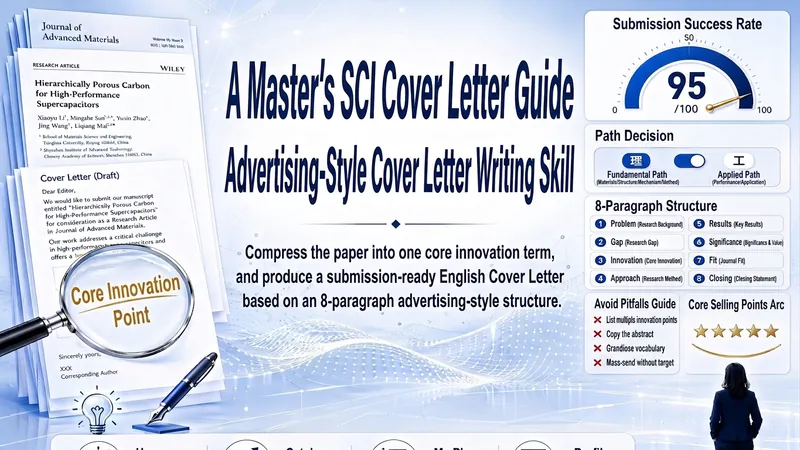
SCI Cover Letter Slow Teacher
This skill treats your journal submission cover letter as an advertisement for your paper. It first forces you to compress your research into a single core innovation point ("one word") and decide whether it follows the "science" route (material/structure/mechanism/method) or "engineering" route (performance/application). Then, it generates an 8-section English cover letter ready for submission: a four-sentence selling arc covering problem, innovation, data, and significance; journal matching information; and standard declarations. It uses the most concise, objective language (rejecting flashy words like "employs" or "shatter the ceiling") and fits within one page. Including a figure is mandatory: for performance types, it provides literature comparison scatter plots or tables; for mechanism/structure types, it actively diagnoses your existing figures (five-point check), gives a redraw list, and directly outputs an SVG draft. It can also critique an existing draft, pointing out common flaws such as listing multiple innovations, lacking data, copying the abstract, or having no journal targeting, and rewrite it. Compatible with universal agents like Claude Code and Codex. Trigger phrases include "help me write a cover letter", "submit to SCI", "is this letter good", and "which figure should I show the editor".
Paper Imitation & Pub. Expert
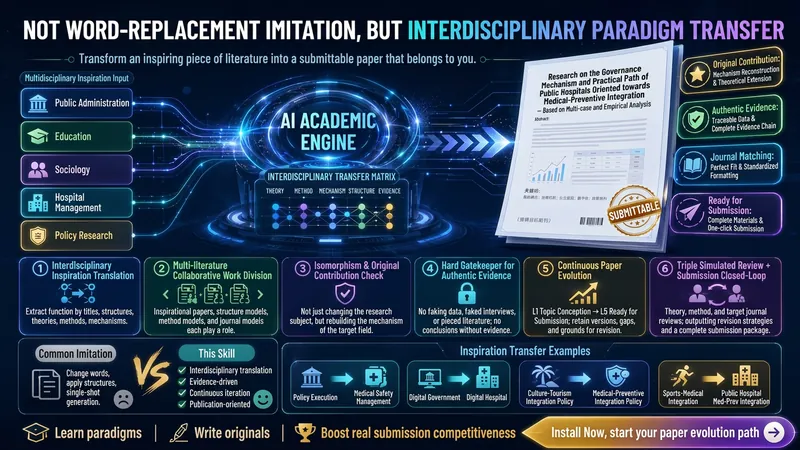
📚 Paper Imitation & Pub. Expert Develop an inspiring paper into your own high-quality original work step by step. Ideal for graduate students seeking to draw inspiration from excellent papers in other disciplines for topic migration, structural reconstruction, and submission optimization. 🔍 Inspiring Literature Identification: Analyze the reusable title mechanisms, problem awareness, chapter structure, theoretical framework, research methods, evidence organization, and language style of the model paper. 🔄 Interdisciplinary Paradigm Transfer: Build a 'source domain—target domain' transfer matrix to determine which ideas can be transferred and which theories, concepts, cases, and conclusions must be reconstructed. 🧠 Original Contribution Modeling: Identify literature gaps, distill core propositions and mechanisms, and check whether the paper merely changes the research object or applies a generic framework. 🧭 Research Design Planning: Supports theoretical research, case studies, qualitative research, quantitative research, literature reviews, policy text analysis, and mixed methods research. 🛡️ Real Evidence Gate: Do not fabricate data, samples, interviews, cases, statistical results, literature, or DOIs; without real evidence, do not generate false empirical conclusions. ✍️ Evidence-Driven Writing: Build argument chains via 'proposition—evidence—citation—rebuttal', generate original content chapter by chapter, and clearly mark research materials that need to be supplemented. 📈 Continuous Paper Evolution: Record each round of revisions, material gaps, and maturity changes according to L1 (topic conception), L2 (research plan), L3 (evidence formation), L4 (submission draft), and L5 (ready for submission). 🧑⚖️ Triple Simulation Review: Identify rejection risks from the perspectives of a theoretical reviewer, a method reviewer, and a target journal reviewer, and form specific revision strategies. 📨 Complete Submission Loop: Assist in generating the final paper, citation verification table, cover letter, innovation point statement, author response, revision index, and related declaration templates. ✨ Learn the paradigm, write original content, and enhance real submission competitiveness.
 Write
WriteAcademic Paper Editor
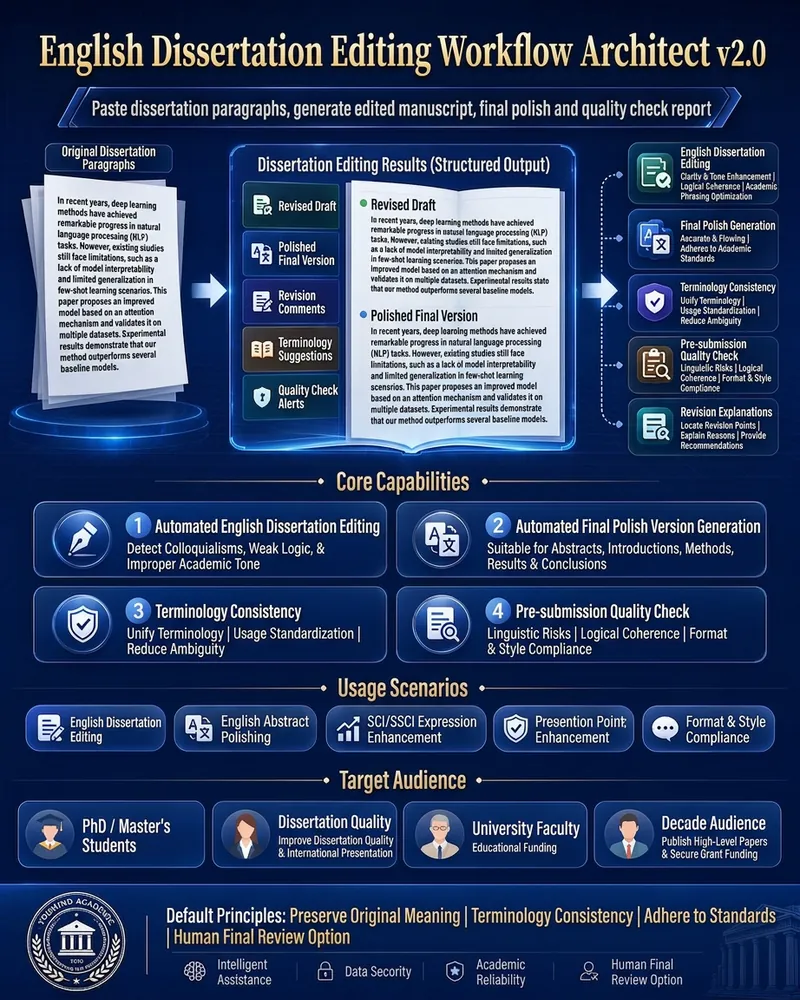
Paste a paper paragraph to generate a polished version, an English translation, and a quality-check report. It can help you: 1. Automatically polish Chinese academic papers Identify conversational wording, loose expression, logical jumps, and insufficiently academic tone, then produce more standardized and clearer academic Chinese. 2. Automatically generate an English translation Translate Chinese paper paragraphs into English that follows academic writing conventions while preserving terminology, logical relationships, and the tone of the research. 3. Automatically perform bilingual quality checks Check terminology consistency, logical flow, semantic deviations, grammar issues, long-sentence risks, and whether the academic phrasing is sound. 4. Automatically explain revisions In addition to providing the results, explain what was changed and why, making it easier to continue revising the full paper. Suitable for: PhD students, master's students, university instructors, researchers, paper submission authors, research group members, and writers of English abstracts and SCI/SSCI papers. How to use: Paste a paper paragraph and say what you want to do: “Please polish this Chinese academic paragraph.” “Please translate it into English.” “Please polish the Chinese first, then translate it into English.” “Please check whether this English paragraph fits academic writing conventions.” If you do not specify a mode, I will default to “Chinese polishing + English translation + quality-check report.”
SSCI Submission & Polish
SSCI journal recs, editing, formatting & more
Description
Overview: A full-process Skill for pre-submission preparation of SSCI papers, supporting journal recommendations, native language translation, English editing, target journal adaptation, format checking, reference verification, Cover Letter and submission material organization. Core Capabilities: SSCI journal recommendation and legitimacy verification, aggressive/stable/safe submission strategy, target journal Author Guidelines analysis, sample literature style anchoring, Chinese-to-English academic paper conversion, English editing, Word/LaTeX/journal template format checking, reference and DOI verification, PDF submission file final check, Cover Letter drafting, plagiarism report interpretation, and submission material checklist organization. Keywords: SSCI, academic paper, submission, journal selection, English editing, academic translation, Cover Letter, Author Guidelines, references, Zotero, DOI, Word formatting, LaTeX, PDF final check, plagiarism check and reduction Notes: This Skill does not design research from scratch, rewrite theoretical frameworks, reanalyze data, or fabricate data/literature/reviewers. Its focus is to help users prepare their existing manuscripts into a state more suitable for submission.
Related Skills
View allSCI Cover Letter Slow Teacher
This skill treats your journal submission cover letter as an advertisement for your paper. It first forces you to compress your research into a single core innovation point ("one word") and decide whether it follows the "science" route (material/structure/mechanism/method) or "engineering" route (performance/application). Then, it generates an 8-section English cover letter ready for submission: a four-sentence selling arc covering problem, innovation, data, and significance; journal matching information; and standard declarations. It uses the most concise, objective language (rejecting flashy words like "employs" or "shatter the ceiling") and fits within one page. Including a figure is mandatory: for performance types, it provides literature comparison scatter plots or tables; for mechanism/structure types, it actively diagnoses your existing figures (five-point check), gives a redraw list, and directly outputs an SVG draft. It can also critique an existing draft, pointing out common flaws such as listing multiple innovations, lacking data, copying the abstract, or having no journal targeting, and rewrite it. Compatible with universal agents like Claude Code and Codex. Trigger phrases include "help me write a cover letter", "submit to SCI", "is this letter good", and "which figure should I show the editor".
Paper Imitation & Pub. Expert
📚 Paper Imitation & Pub. Expert Develop an inspiring paper into your own high-quality original work step by step. Ideal for graduate students seeking to draw inspiration from excellent papers in other disciplines for topic migration, structural reconstruction, and submission optimization. 🔍 Inspiring Literature Identification: Analyze the reusable title mechanisms, problem awareness, chapter structure, theoretical framework, research methods, evidence organization, and language style of the model paper. 🔄 Interdisciplinary Paradigm Transfer: Build a 'source domain—target domain' transfer matrix to determine which ideas can be transferred and which theories, concepts, cases, and conclusions must be reconstructed. 🧠 Original Contribution Modeling: Identify literature gaps, distill core propositions and mechanisms, and check whether the paper merely changes the research object or applies a generic framework. 🧭 Research Design Planning: Supports theoretical research, case studies, qualitative research, quantitative research, literature reviews, policy text analysis, and mixed methods research. 🛡️ Real Evidence Gate: Do not fabricate data, samples, interviews, cases, statistical results, literature, or DOIs; without real evidence, do not generate false empirical conclusions. ✍️ Evidence-Driven Writing: Build argument chains via 'proposition—evidence—citation—rebuttal', generate original content chapter by chapter, and clearly mark research materials that need to be supplemented. 📈 Continuous Paper Evolution: Record each round of revisions, material gaps, and maturity changes according to L1 (topic conception), L2 (research plan), L3 (evidence formation), L4 (submission draft), and L5 (ready for submission). 🧑⚖️ Triple Simulation Review: Identify rejection risks from the perspectives of a theoretical reviewer, a method reviewer, and a target journal reviewer, and form specific revision strategies. 📨 Complete Submission Loop: Assist in generating the final paper, citation verification table, cover letter, innovation point statement, author response, revision index, and related declaration templates. ✨ Learn the paradigm, write original content, and enhance real submission competitiveness.
WriteAcademic Paper Editor
Paste a paper paragraph to generate a polished version, an English translation, and a quality-check report. It can help you: 1. Automatically polish Chinese academic papers Identify conversational wording, loose expression, logical jumps, and insufficiently academic tone, then produce more standardized and clearer academic Chinese. 2. Automatically generate an English translation Translate Chinese paper paragraphs into English that follows academic writing conventions while preserving terminology, logical relationships, and the tone of the research. 3. Automatically perform bilingual quality checks Check terminology consistency, logical flow, semantic deviations, grammar issues, long-sentence risks, and whether the academic phrasing is sound. 4. Automatically explain revisions In addition to providing the results, explain what was changed and why, making it easier to continue revising the full paper. Suitable for: PhD students, master's students, university instructors, researchers, paper submission authors, research group members, and writers of English abstracts and SCI/SSCI papers. How to use: Paste a paper paragraph and say what you want to do: “Please polish this Chinese academic paragraph.” “Please translate it into English.” “Please polish the Chinese first, then translate it into English.” “Please check whether this English paragraph fits academic writing conventions.” If you do not specify a mode, I will default to “Chinese polishing + English translation + quality-check report.”
Find your next favorite skill
Explore more curated AI skills for research, creation, and everyday work.