Podcast Co-creation Editor
Create your own podcast from scratch
Description
Why we love this skill
Instead of ghostwriting your podcast, it uses editorial questioning to distill distinct viewpoints, audience value, and a differentiating angle from scattered material, then builds structure, completes the script, and polishes iteratively. It truly preserves the creator's voice and perspective.
In 5 steps, conversational guidance helps creators turn scattered materials and vague ideas into clear, well-structured podcast scripts with strong viewpoints. Works for all podcast formats, including monologues, dialogues, and interviews.
Related Skills
View all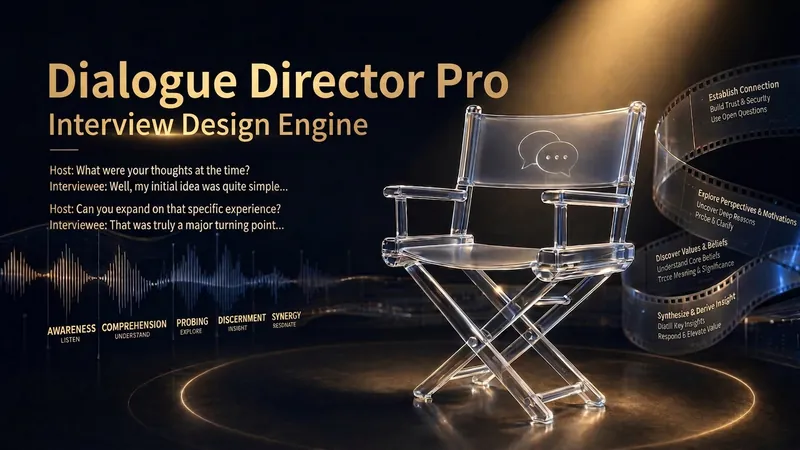
Dialogue Director Pro | Interview Design Engine
This isn't just a list of questions; it helps you design a memorable conversation. A 7-step process, from guest research to finalized materials: Guest Profile → Narrative Structure → Question Matrix → Process Layout → Interview Rehearsal → Material Conversion → Interview Debriefing 💡 Steps 1-3 form the core design process, delivering a complete interview plan independently; Steps 4-7 enhance the experience and can be used as needed. 🔍 Guest Profile | Online search of publicly available guest information generates a five-dimensional in-depth profile—factual skeleton, story vein, core conflict, communication style, and emotional entry point—telling you which direction to dig. Non-public figures automatically switch to interview-style information gathering. 🌿 Follow-up Question Branching Tree | When generating questions, the system pre-predicts the possible directions of the guest's answers for each key question and designs corresponding follow-up questions. You take this "decision tree" to the event, listen to the guest's answer, and then choose the corresponding branch to ask follow-up questions—no need for on-site AI, no need for real-time text transcription; all plans are designed during the preparation stage. It lets you be a chess player on-site, not an improvisational actor. No similar function exists on the market. 🎬 AI Rehearsal | Before the interview, AI plays the role of a guest, simulating three answering styles (in-depth/superficial/evasive), allowing you to practice follow-up questions and identify blind spots in the process. 📝 Five Outputs | Generates from a single interview: interview article/ podcast script/ oral history transcript/ social media content package/documentary script skeleton. 📊 Interview Debriefing | Plan vs. reality comparison, analysis of gold mines and regrets, five-dimensional capability radar chart, allowing you to grow with every interview. Suitable for: podcast interviews, interviews, student interviews, UX in-depth interviews, executive interviews.
Interview-Based Writing@泛函
Through deep one-on-one interviews, this skill helps you clarify your creative ideas, uncover source material, and ultimately produce high-quality articles. Based on tacit knowledge theory and IP expression methodology, it asks only one question at a time to continuously explore, outputs a detailed outline for your confirmation, and then completes the writing.
 Research
Conversation Content Insights
Centered on interview-style podcasts, this skill distills lengthy conversations into structured guides. It deeply analyzes guests' perspectives and methodologies to help you precisely absorb practical wisdom and make smarter decisions.
Podcast Co-creation Editor
Create your own podcast from scratch
Description
Why we love this skill
Instead of ghostwriting your podcast, it uses editorial questioning to distill distinct viewpoints, audience value, and a differentiating angle from scattered material, then builds structure, completes the script, and polishes iteratively. It truly preserves the creator's voice and perspective.
In 5 steps, conversational guidance helps creators turn scattered materials and vague ideas into clear, well-structured podcast scripts with strong viewpoints. Works for all podcast formats, including monologues, dialogues, and interviews.
Related Skills
View allDialogue Director Pro | Interview Design Engine
This isn't just a list of questions; it helps you design a memorable conversation. A 7-step process, from guest research to finalized materials: Guest Profile → Narrative Structure → Question Matrix → Process Layout → Interview Rehearsal → Material Conversion → Interview Debriefing 💡 Steps 1-3 form the core design process, delivering a complete interview plan independently; Steps 4-7 enhance the experience and can be used as needed. 🔍 Guest Profile | Online search of publicly available guest information generates a five-dimensional in-depth profile—factual skeleton, story vein, core conflict, communication style, and emotional entry point—telling you which direction to dig. Non-public figures automatically switch to interview-style information gathering. 🌿 Follow-up Question Branching Tree | When generating questions, the system pre-predicts the possible directions of the guest's answers for each key question and designs corresponding follow-up questions. You take this "decision tree" to the event, listen to the guest's answer, and then choose the corresponding branch to ask follow-up questions—no need for on-site AI, no need for real-time text transcription; all plans are designed during the preparation stage. It lets you be a chess player on-site, not an improvisational actor. No similar function exists on the market. 🎬 AI Rehearsal | Before the interview, AI plays the role of a guest, simulating three answering styles (in-depth/superficial/evasive), allowing you to practice follow-up questions and identify blind spots in the process. 📝 Five Outputs | Generates from a single interview: interview article/ podcast script/ oral history transcript/ social media content package/documentary script skeleton. 📊 Interview Debriefing | Plan vs. reality comparison, analysis of gold mines and regrets, five-dimensional capability radar chart, allowing you to grow with every interview. Suitable for: podcast interviews, interviews, student interviews, UX in-depth interviews, executive interviews.
Interview-Based Writing@泛函
Through deep one-on-one interviews, this skill helps you clarify your creative ideas, uncover source material, and ultimately produce high-quality articles. Based on tacit knowledge theory and IP expression methodology, it asks only one question at a time to continuously explore, outputs a detailed outline for your confirmation, and then completes the writing.
ResearchConversation Content Insights
Centered on interview-style podcasts, this skill distills lengthy conversations into structured guides. It deeply analyzes guests' perspectives and methodologies to help you precisely absorb practical wisdom and make smarter decisions.
Find your next favorite skill
Explore more curated AI skills for research, creation, and everyday work.