
Storytelling Skills Workshop
Improve spoken storytelling, make it vivid
Description
Want to make your stories more engaging and vivid in daily conversations and at work? The "Storytelling Skills Workshop" provides you with a systematic approach to master scientific storytelling techniques, transforming ordinary experiences into captivating stories. Based on narrative transportation theory and cognitive science, this workshop offers a variety of practical storytelling strategies. Whether through the "Five Senses Activation Method" to immerse listeners, or using the "Three-Part Suspense Structure" to create cognitive tension, or leveraging the "Detail Magnifier" and "Dialogue Restoration Method" to enhance the vividness and engagement of stories, you will find ways to improve your expression. We also provide a wealth of scenario-based exercises, including "Elevator Storytelling" during commutes, "Retelling Upgrade" for casual chats, and specific applications for work presentations and family sharing. Through these exercises, you can quickly conceive story hooks, turn data into persuasive narratives, and even make daily trivialities warm and interesting. During the training, you will receive instant feedback to continuously refine your storytelling.
Related Skills
View all Video
VideoStick Figure Silhouette Gen
Want to present engaging stories like fables, historical anecdotes, or brand stories in a unique visual style? This skill helps you easily create landscape, minimalist stick figure silhouette short video clips. Just input a story theme, and it generates a complete production plan to make your story visually compelling. The skill provides a ~270-word, 45-second narration script for a smooth and expressive story delivery. It also designs 9 storyboard prompts for 16:9 landscape images, guiding AI to produce minimalist line art and silhouette styles with plenty of white space and clear visual focus, evoking a modern, minimal storybook illustration feel. Additionally, you get 9 Seedance 2.0 image-to-video prompts that perfectly match the storyboard, achieving line-by-line drawing and smooth fade-in effects like a whiteboard animation. Whether you're making short story videos, minimalist animations, or need storyboard and video prompts for line art, silhouette, or paper-cut styles, this tool has you covered. It transforms complex story themes into simple, expressive visual narratives that reach audiences in a fresh, artistic way—perfect for fables, fairy tales, anecdotes, or brand stories. You'll receive a complete voiceover script, storyboard cards, generated images and videos, plus detailed assembly tips to efficiently create your video.

Fable Story for Concepts
This skill aims to transform abstract concepts into engaging fables, helping users understand complex ideas indirectly and concretely. It is designed for educators, content creators, and anyone with a deep need for conceptual understanding who wish to explain concepts through innovative storytelling. The core capability of this skill is to create a concise short fable based on any concept provided by the user. The story does not directly mention the concept name or technical terms, but subtly implies the deeper meaning through plot, character interactions, and event progression. Users will experience how the story guides readers toward an understanding of the abstract concept through specific scenes and characters, rather than direct instruction. The entire process includes the creation of a fable, a detailed analysis of the concept, and the generation of two check questions. First, the skill generates a fable that adheres to strict narrative norms, ensuring its independence and artistry. Then, it precisely analyzes the correspondence between each element in the story and the original concept, clarifying how the story maps the structure and mechanism of the concept. Finally, the skill poses two specific questions: one to test the user's understanding of the concept's core, and another to encourage the user to transfer and apply the concept to other fields, thereby deepening and consolidating learning.
Weissman Course Writer
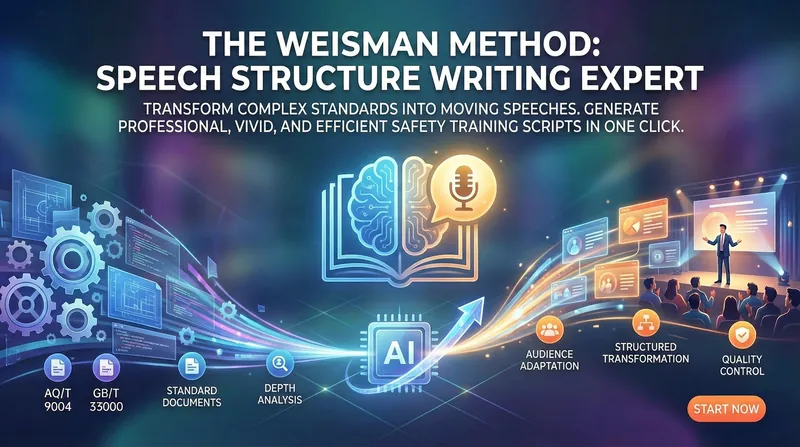
This skill is specifically designed for corporate safety training. It turns dry, abstract safety production standards into engaging, practical training courses. By deeply analyzing various safety standard documents, it precisely extracts core frameworks and mandatory requirements, and adjusts the tone and depth of examples for different audiences, such as executives, managers, or frontline workers. Whether interpreting complex industry regulations or crafting daily work guides, it ensures the output is both professionally rigorous and easy to read for adult learners. When building content, this skill strictly follows structured instructional logic. Each lesson includes a cognitive-conflict opening, easy-to-understand conceptual metaphors, vivid comparisons of positive and negative examples, and impactful summary phrases. It not only provides a clear course outline, but also generates detailed text with specific calls to action, helping learners grasp immediately actionable tasks while understanding professional terms. In addition, the system automatically weaves in group interaction segments and hazard-warning design, keeping the training highly interactive. You can adjust the course direction at any time based on actual needs—for example, adding class hours, strengthening hands-on steps, introducing more scenario simulations, or designing post-course quizzes. It consistently maintains a positive language orientation, emphasizing “how to do it” rather than simply “don’t do it,” helping companies build a more effective safety-training culture so safety standards truly reach employees and translate into action.
Storytelling Skills Workshop
Improve spoken storytelling, make it vivid
Description
Want to make your stories more engaging and vivid in daily conversations and at work? The "Storytelling Skills Workshop" provides you with a systematic approach to master scientific storytelling techniques, transforming ordinary experiences into captivating stories. Based on narrative transportation theory and cognitive science, this workshop offers a variety of practical storytelling strategies. Whether through the "Five Senses Activation Method" to immerse listeners, or using the "Three-Part Suspense Structure" to create cognitive tension, or leveraging the "Detail Magnifier" and "Dialogue Restoration Method" to enhance the vividness and engagement of stories, you will find ways to improve your expression. We also provide a wealth of scenario-based exercises, including "Elevator Storytelling" during commutes, "Retelling Upgrade" for casual chats, and specific applications for work presentations and family sharing. Through these exercises, you can quickly conceive story hooks, turn data into persuasive narratives, and even make daily trivialities warm and interesting. During the training, you will receive instant feedback to continuously refine your storytelling.
Related Skills
View allVideoStick Figure Silhouette Gen
Want to present engaging stories like fables, historical anecdotes, or brand stories in a unique visual style? This skill helps you easily create landscape, minimalist stick figure silhouette short video clips. Just input a story theme, and it generates a complete production plan to make your story visually compelling. The skill provides a ~270-word, 45-second narration script for a smooth and expressive story delivery. It also designs 9 storyboard prompts for 16:9 landscape images, guiding AI to produce minimalist line art and silhouette styles with plenty of white space and clear visual focus, evoking a modern, minimal storybook illustration feel. Additionally, you get 9 Seedance 2.0 image-to-video prompts that perfectly match the storyboard, achieving line-by-line drawing and smooth fade-in effects like a whiteboard animation. Whether you're making short story videos, minimalist animations, or need storyboard and video prompts for line art, silhouette, or paper-cut styles, this tool has you covered. It transforms complex story themes into simple, expressive visual narratives that reach audiences in a fresh, artistic way—perfect for fables, fairy tales, anecdotes, or brand stories. You'll receive a complete voiceover script, storyboard cards, generated images and videos, plus detailed assembly tips to efficiently create your video.
Fable Story for Concepts
This skill aims to transform abstract concepts into engaging fables, helping users understand complex ideas indirectly and concretely. It is designed for educators, content creators, and anyone with a deep need for conceptual understanding who wish to explain concepts through innovative storytelling. The core capability of this skill is to create a concise short fable based on any concept provided by the user. The story does not directly mention the concept name or technical terms, but subtly implies the deeper meaning through plot, character interactions, and event progression. Users will experience how the story guides readers toward an understanding of the abstract concept through specific scenes and characters, rather than direct instruction. The entire process includes the creation of a fable, a detailed analysis of the concept, and the generation of two check questions. First, the skill generates a fable that adheres to strict narrative norms, ensuring its independence and artistry. Then, it precisely analyzes the correspondence between each element in the story and the original concept, clarifying how the story maps the structure and mechanism of the concept. Finally, the skill poses two specific questions: one to test the user's understanding of the concept's core, and another to encourage the user to transfer and apply the concept to other fields, thereby deepening and consolidating learning.
Weissman Course Writer
This skill is specifically designed for corporate safety training. It turns dry, abstract safety production standards into engaging, practical training courses. By deeply analyzing various safety standard documents, it precisely extracts core frameworks and mandatory requirements, and adjusts the tone and depth of examples for different audiences, such as executives, managers, or frontline workers. Whether interpreting complex industry regulations or crafting daily work guides, it ensures the output is both professionally rigorous and easy to read for adult learners. When building content, this skill strictly follows structured instructional logic. Each lesson includes a cognitive-conflict opening, easy-to-understand conceptual metaphors, vivid comparisons of positive and negative examples, and impactful summary phrases. It not only provides a clear course outline, but also generates detailed text with specific calls to action, helping learners grasp immediately actionable tasks while understanding professional terms. In addition, the system automatically weaves in group interaction segments and hazard-warning design, keeping the training highly interactive. You can adjust the course direction at any time based on actual needs—for example, adding class hours, strengthening hands-on steps, introducing more scenario simulations, or designing post-course quizzes. It consistently maintains a positive language orientation, emphasizing “how to do it” rather than simply “don’t do it,” helping companies build a more effective safety-training culture so safety standards truly reach employees and translate into action.
Find your next favorite skill
Explore more curated AI skills for research, creation, and everyday work.