
Emotion Engine: Child Meltdowns
Description
Child having a tantrum, talking back, crying, or easily triggered? The problem isn't that the child is difficult—it's that their emotional skills haven't caught up. Describe the situation in one sentence and get: ⚡ 30-Second Overview — emotion type + age group + one phrase to use today 📋 Complete Plan — not just soothing, but emotional containment + empathy scripts + environmental adjustments Includes: empathy formulas you can use today, how to change the physical environment, how to structure time with white space, a 7-day action checklist (printable for the fridge) 🔮 Learn for Next Time — if this is a tantrum, next time you'll know what to do for separation anxiety or social fear --- Applicable for ages 0-18, with strategies by age group | Not just for tantrums—works for anxiety, fear, withdrawal, and more 📚 Backed by classic psychological theory + brain science research + real-world cases 🙋 Refined over time from the triple perspective of mother, researcher, and teacher --- 💡 Suggested Companion Skills: - When your child is having emotional outbursts → Use this Skill - When your child is unmotivated and uninterested → Use "Motivation Engine: What to Do When Your Child Is Not Proactive" - When you know what to do but can't find the words → Use "One Strategy Per Situation: Custom Parenting Conversation"
Related Skills
View all
Tailored Parenting Dialogues
Waking up, sulking, seeing a news article... everyday little things are opportunities for seamless guidance. It helps you see the opportunity and know how to start a conversation. ⚡ Review Past Events 「My child came home today and said a classmate took his eraser and hasn't returned it. He's angry but afraid to tell the teacher.」 → We'll walk through: spot the opportunity, create the dialogue, listen attentively, respond effectively. A virtual practice so you'll feel confident next time in a similar situation; practice more and you'll be able to handle new scenarios on your own. 🔮 Anticipate What Hasn't Happened Yet 「Next week is parent-teacher conference; your child's grades have dropped — that conversation on the way home is a perfect opportunity for seamless guidance.」 → Prepare in advance how to say it, turning everyday moments (including possibly negative situations) into conversations your child can actually hear. Each Output ⚡ 30-Second Overview — A quick glance when you're busy shows you how to start. 📋 Complete Dialogue Plan — Spot, Create, Listen, Respond: four steps. Includes: three opening phrases (each with the exact words and rationale), branched contingency plans for listening and responding (possible child reactions + how you respond), and extrapolation. About the Author She has a natural sensitivity to the countless parenting situations in daily life. Where others see a child sulking, she sees a complete path: spot the opportunity, create the dialogue, listen attentively, respond effectively. For over two decades, this path has been refined through three identities: a mother's dedicated practice, a researcher's continuous observation, and a family education teacher's repeated reflection. The fusion of these three has given her mature and practical judgment on 'when and how to talk.' The logic behind this Skill comes from her over 20 years of dedicated observation and personal validation. Her own child left home early for studies, with little togetherness over the past decade, yet they have an excellent parent-child relationship that friends envy. It turns out that conversations nurtured with heart, emotion, and love withstand any separation. A good parent-child relationship doesn't rely on being together every day, but on speaking and listening the right way at the right moment. We're glad you've opened this Skill. Let's practice together step by step. :) 💡 Complementary Usage Suggestions: - Want to know how to say it? → Use this Skill. - Child doesn't want to do anything, no interest? → Use with 'Motivation Engine: What to do when your child is not proactive'. - Child's emotions out of control, explosive? → Use with 'Emotion Engine: What to do when your child is emotionally out of control'.

Motivation: Unmotivated Child?
Your child won't do homework, is addicted to their phone, says "I can't learn it," seems self-motivated but stops whenever you stop pushing… The problem isn't laziness—it's that their motivation system is stuck. Describe the situation in one sentence and get: ⚡ A 30-second overview — which gear is missing (autonomy/mastery/purpose/high-compliance) + one action to take today 📋 A complete solution — not just conversation, but also environmental adjustments, habit design, and non-verbal strategies Includes: scripts you can use today, how to change the physical environment, how to leave gaps in the schedule, a 7-day action checklist (printable to put on the fridge) 🔮 Learn from one instance to others — this time it's homework, next time it's piano practice or chores, you'll know what to do --- Suitable for ages 3–18, with different approaches for different ages | Address what's missing, not just academics—also applies to life habits and interest cultivation --- 💡 Recommended pairing: - To know "what to say": use 「一事一策·育儿情境对话定制」 - To solve "motivation problems": use 「内驱力引擎」 - Use both together for double the effect
 Research
Coaching Parenting Assistant
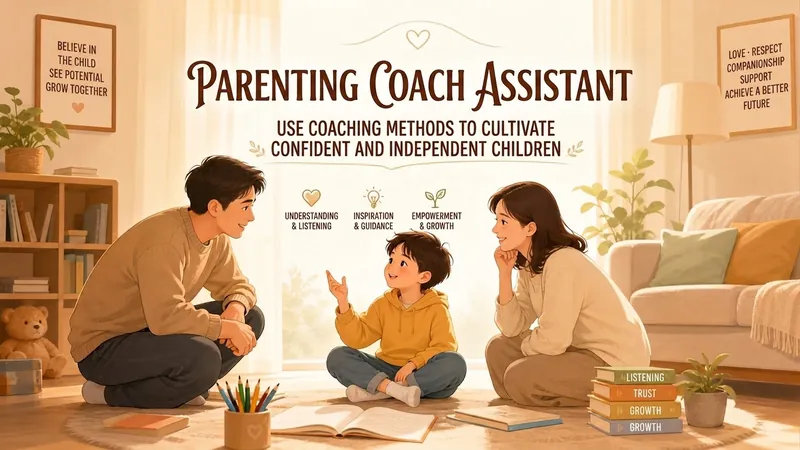
[闭嘴] Between you and your child, all it takes is the right way to speak. [汗] You've tried: Reasoning with him — he shuts the door. Losing your temper — you feel guiltier. Biting your tongue — nothing changes. Your family doesn't lack love, it lacks a set of coaching communication methods. Not coaxing, not preaching, not 'I'm doing this for your own good.' It's about letting the child say 'I want to do it,' not 'You want me to do it.' [玫瑰] This isn't empty inspiration. It's the core methodology of a 3980-yuan coaching parenting course — the **See → Be Curious → Inspire → Co-create** four-step dialogue framework. - Kid addicted to phone? Not confiscation, it's setting boundaries together. - Anxious and slacking off before exams? Not saying 'You can do it,' but asking 'What do you need?' - You say ten words and he talks back? Change how you ask so he speaks up himself. [咖啡] This skill solves the everyday communication chaos in your home. And along the way, it lights up your child's inner drive.
Emotion Engine: Child Meltdowns
Description
Child having a tantrum, talking back, crying, or easily triggered? The problem isn't that the child is difficult—it's that their emotional skills haven't caught up. Describe the situation in one sentence and get: ⚡ 30-Second Overview — emotion type + age group + one phrase to use today 📋 Complete Plan — not just soothing, but emotional containment + empathy scripts + environmental adjustments Includes: empathy formulas you can use today, how to change the physical environment, how to structure time with white space, a 7-day action checklist (printable for the fridge) 🔮 Learn for Next Time — if this is a tantrum, next time you'll know what to do for separation anxiety or social fear --- Applicable for ages 0-18, with strategies by age group | Not just for tantrums—works for anxiety, fear, withdrawal, and more 📚 Backed by classic psychological theory + brain science research + real-world cases 🙋 Refined over time from the triple perspective of mother, researcher, and teacher --- 💡 Suggested Companion Skills: - When your child is having emotional outbursts → Use this Skill - When your child is unmotivated and uninterested → Use "Motivation Engine: What to Do When Your Child Is Not Proactive" - When you know what to do but can't find the words → Use "One Strategy Per Situation: Custom Parenting Conversation"
Related Skills
View allTailored Parenting Dialogues
Waking up, sulking, seeing a news article... everyday little things are opportunities for seamless guidance. It helps you see the opportunity and know how to start a conversation. ⚡ Review Past Events 「My child came home today and said a classmate took his eraser and hasn't returned it. He's angry but afraid to tell the teacher.」 → We'll walk through: spot the opportunity, create the dialogue, listen attentively, respond effectively. A virtual practice so you'll feel confident next time in a similar situation; practice more and you'll be able to handle new scenarios on your own. 🔮 Anticipate What Hasn't Happened Yet 「Next week is parent-teacher conference; your child's grades have dropped — that conversation on the way home is a perfect opportunity for seamless guidance.」 → Prepare in advance how to say it, turning everyday moments (including possibly negative situations) into conversations your child can actually hear. Each Output ⚡ 30-Second Overview — A quick glance when you're busy shows you how to start. 📋 Complete Dialogue Plan — Spot, Create, Listen, Respond: four steps. Includes: three opening phrases (each with the exact words and rationale), branched contingency plans for listening and responding (possible child reactions + how you respond), and extrapolation. About the Author She has a natural sensitivity to the countless parenting situations in daily life. Where others see a child sulking, she sees a complete path: spot the opportunity, create the dialogue, listen attentively, respond effectively. For over two decades, this path has been refined through three identities: a mother's dedicated practice, a researcher's continuous observation, and a family education teacher's repeated reflection. The fusion of these three has given her mature and practical judgment on 'when and how to talk.' The logic behind this Skill comes from her over 20 years of dedicated observation and personal validation. Her own child left home early for studies, with little togetherness over the past decade, yet they have an excellent parent-child relationship that friends envy. It turns out that conversations nurtured with heart, emotion, and love withstand any separation. A good parent-child relationship doesn't rely on being together every day, but on speaking and listening the right way at the right moment. We're glad you've opened this Skill. Let's practice together step by step. :) 💡 Complementary Usage Suggestions: - Want to know how to say it? → Use this Skill. - Child doesn't want to do anything, no interest? → Use with 'Motivation Engine: What to do when your child is not proactive'. - Child's emotions out of control, explosive? → Use with 'Emotion Engine: What to do when your child is emotionally out of control'.
Motivation: Unmotivated Child?
Your child won't do homework, is addicted to their phone, says "I can't learn it," seems self-motivated but stops whenever you stop pushing… The problem isn't laziness—it's that their motivation system is stuck. Describe the situation in one sentence and get: ⚡ A 30-second overview — which gear is missing (autonomy/mastery/purpose/high-compliance) + one action to take today 📋 A complete solution — not just conversation, but also environmental adjustments, habit design, and non-verbal strategies Includes: scripts you can use today, how to change the physical environment, how to leave gaps in the schedule, a 7-day action checklist (printable to put on the fridge) 🔮 Learn from one instance to others — this time it's homework, next time it's piano practice or chores, you'll know what to do --- Suitable for ages 3–18, with different approaches for different ages | Address what's missing, not just academics—also applies to life habits and interest cultivation --- 💡 Recommended pairing: - To know "what to say": use 「一事一策·育儿情境对话定制」 - To solve "motivation problems": use 「内驱力引擎」 - Use both together for double the effect
ResearchCoaching Parenting Assistant
[闭嘴] Between you and your child, all it takes is the right way to speak. [汗] You've tried: Reasoning with him — he shuts the door. Losing your temper — you feel guiltier. Biting your tongue — nothing changes. Your family doesn't lack love, it lacks a set of coaching communication methods. Not coaxing, not preaching, not 'I'm doing this for your own good.' It's about letting the child say 'I want to do it,' not 'You want me to do it.' [玫瑰] This isn't empty inspiration. It's the core methodology of a 3980-yuan coaching parenting course — the **See → Be Curious → Inspire → Co-create** four-step dialogue framework. - Kid addicted to phone? Not confiscation, it's setting boundaries together. - Anxious and slacking off before exams? Not saying 'You can do it,' but asking 'What do you need?' - You say ten words and he talks back? Change how you ask so he speaks up himself. [咖啡] This skill solves the everyday communication chaos in your home. And along the way, it lights up your child's inner drive.
Find your next favorite skill
Explore more curated AI skills for research, creation, and everyday work.