High-Growth Stock Hunter
🔍 Triple-filter A-share picks via chain scan.
Description
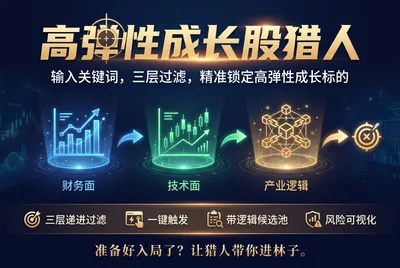
In a bull market, the most expensive thing isn't stocks—it's not knowing what to buy. This isn't fearmongering. It's the lesson the A-share market taught every retail investor in the first half of 2026. Chips are up 50% while you're holding cash. Energy storage has rallied three times while you're still flipping through Xueqiu posts. Stocks in the CXMT supply chain have already doubled, and you can't even name the upstream material companies. It's not that you lack courage—you lack a framework. Buy on tips, sell on feelings, pick stocks based on 'I heard XX is doing well.' That strategy might work in a range-bound market, but in a structural bull market, you're watching others feast while you can't even get a sip of soup. What is the High-Growth Stock Hunter? It's a stock-picking Skill that takes a sector keyword and automatically screens for high-growth A-share candidates. The core is a three-layer filter: Layer 1: Financials Eliminates pure hype. Only stocks that pass hard metrics—revenue growth rate, gross margin, R&D investment—move to the next round. No pump-and-dump stocks, no junk stocks, no pie-in-the-sky stories. Layer 2: Technicals Looks only at price-volume structure. Keep stocks that break out on volume from the bottom, discard those with high-volume bearish candles. Don't be the sucker buying at the top. Layer 3: Industry Logic This is the toughest layer. Candidates must be at key nodes in the supply chain—either upstream selling shovels or midstream bottlenecks. No downstream assemblers, no pure distributors, no story-driven turnarounds. After all three layers, what comes out isn't 'stock recommendations'—it's a candidate pool with selection logic. For every selected stock, you can see: why it's here, the logic behind it, and where the risks lie. Who needs this? If you fit any of the following: * You know a sector is about to take off but don't know which stocks to pick * You read three research reports and ended up more confused because each one recommends different stocks * You've bought chips, new energy, and innovative drugs—but bought each wave at the peak * Your portfolio is full of 'friend's tips' and 'influencer picks,' none of which you selected yourself * You believe there are still opportunities in A-shares, but you need a logic you can understand and reuse, not the next code someone feeds you Then this Skill is for you. Why the price tag? 1,999 credits—not cheap. But do the math: one impulsive chase-the-top trade will cost you more than that. Missing one high-conviction opportunity will lose you more than that. Spending three hours reading all the reports will cost you more than that in time. This Skill doesn't give you a single stock—it gives you a reusable hunting framework. Use it once and you're breakeven. Use it ten times and you start to build judgment. One final truth: The bull market won't wait for you. But it doesn't reward impulsiveness either. It rewards those who pick the right direction, the right stocks, and the right timing. The High-Growth Stock Hunter doesn't guarantee you win every time—nothing can. But it guarantees that next time you make a move, you'll have a map in hand, logic in your eyes, and calm in your heart. Ready to enter the game? Let the hunter take you into the woods.
Related Skills
View all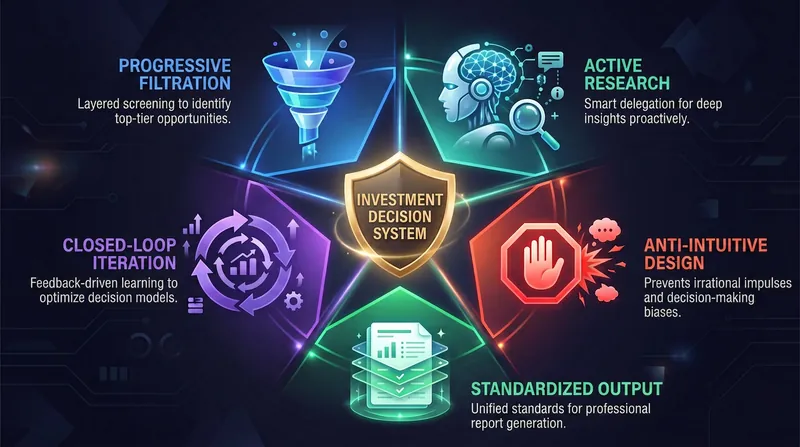
Stock Picking Decision Engine
Every investor has experienced these moments: • 📝 Impulse buying that ends in regret — you see a stock rise for three days, your hand itches, you place an order, and end up buying at the top. • 🤔 Deciding without enough research — you read one analysis article and think you 'get it,' but you can't even explain how the company makes money. • 💸 Not knowing when to sell — you won't sell when you're winning, you can't accept selling at a loss, and in the end you get hurt on both sides. • 🎭 Being swept up by market sentiment — you panic when others panic, get greedy when others get greedy, and forever chase rallies and dump stocks on declines. • 🔄 Repeating the same mistakes — with no review system, every trade starts from scratch. The investment decision system was created to solve these problems. It is not a tool that helps you find reasons to buy; it is a decision brake system that helps you identify the moments when you 'shouldn't buy.' There is only one core principle: a good company ≠ a good stock.
 Research
Multi-Agent: A-Share Pick & IC
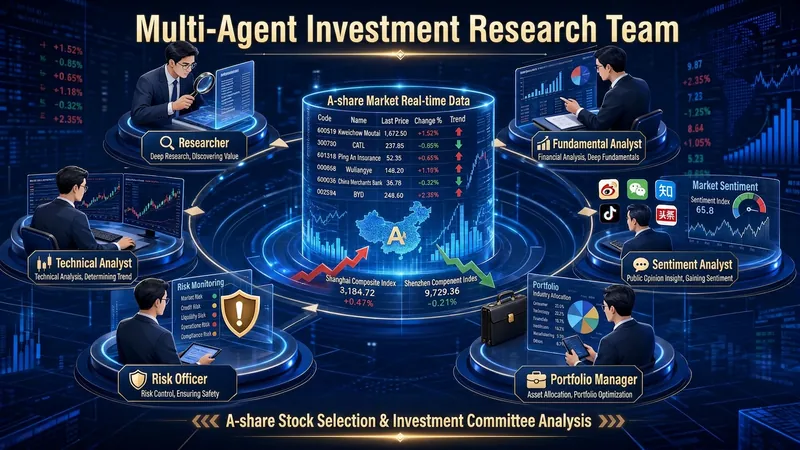
It's not an AI assistant, but a virtual investment research team. Common AI stock-picking tools suffer from three problems: fabricating financial figures and target prices, giving vague "bullish/bearish" remarks, and offering "buy" recommendations without clear reasoning. The Multi-Agent Investment Research Team tackles these with a three-pronged approach: 6 parallel roles, cross-validation, and mandatory source attribution. It convenes researchers, fundamental analysts, technical analysts, sentiment analysts, risk officers, and investment managers to work in parallel, deliberating like a real investment committee. What you get is not fuzzy opinions, but a professional research document with facts, signals, disagreements, risks, and every number traceable to its source. Two modes covering "researching a single stock" and "screening a batch of stocks" Mode A: Single-Stock Committee Deep Analysis — Just provide a stock (e.g., "Analyze BYD 002594"), and the skill automatically convenes a full investment committee: the researcher aggregates market data, financial reports, research reports, and industry chain positioning, presenting only objective facts; the fundamental analyst issues a financial health scorecard, key changes in the three financial statements, and PEG valuation; the technical analyst evaluates trends, moving averages, MACD, support and resistance levels, and provides a five-point buy signal hit table; the sentiment analyst scans institutional divergence, retail investor sentiment, and potential misinterpretations; the risk officer digs up counter-evidence, systematically refuting optimistic conclusions from other roles; finally, the investment manager, without adding new data, integrates everything to produce committee minutes and a one-page summary. Mode B: Multi-Condition Stock Screening — From a specified universe (e.g., CSI 300, a sector/theme basket, or your own stock pool), apply a three-layer funnel: L1 financial hard screen (three consecutive quarters of growth, ample cash flow, PEG<1 or huge increase in contract liabilities), L2 technical timing (base breakout, moving average golden cross, volume breakout, strong pullback on low volume, MACD crossing above zero line), L3 information validation (research report ratings and industry chain logic, eliminating "pure technical without fundamental basis" picks). After obtaining a candidate list, the top N stocks can automatically proceed to Mode A for deep analysis. What you will get Mode A delivers a fixed "five-piece set": ① Full analysis report integrating all six roles; ② Data source and evidence table, with each key conclusion mapped to "data → source → date"; ③ Meeting-style committee minutes (agenda → each role's view → disagreements → consensus → variables to track); ④ Risk list sorted by high/medium/low severity; ⑤ One-page investment manager summary condensing core logic, key variables, verification points, and confidence level. Mode B delivers: Candidate stock list table (ticker | name | triggered conditions | key data | source | trigger date) plus screening criteria and methodology description, optionally with the full five-piece set for top candidates. All outputs are saved as files with ticker and date in the filename for easy reuse and archiving.
Stock Valuation Analysis
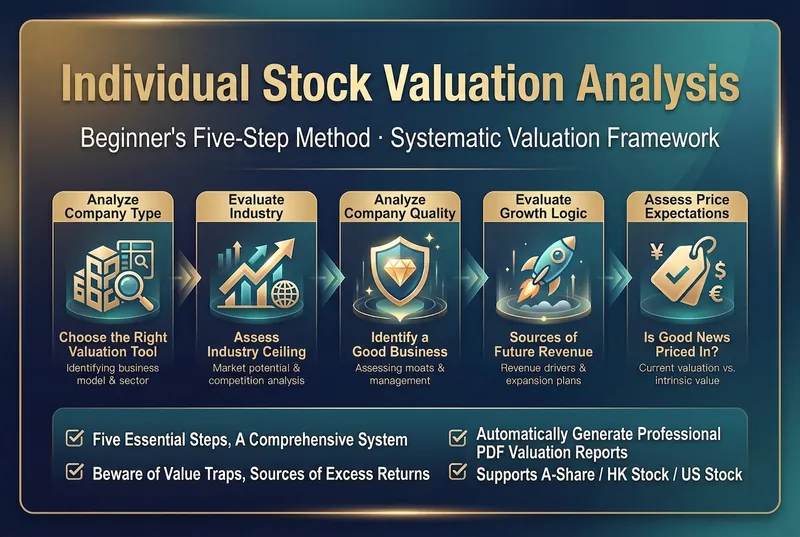
The two biggest fears in stock investing are buying a bad company and overpaying for a good one. Many investors, when they get a stock, first check its PE and PB ratios, compare them with peers, and draw conclusions—this is the biggest misconception in valuation. • 📝 Focusing only on numbers, not the company: Is a low PE always cheap? A low PE for a cyclical stock at the peak of its cycle can actually be a trap; for a growth stock, a high PE isn't necessarily expensive. With the wrong yardstick, you can't measure correctly. • 🤔 Discussing valuation without considering the industry: A contract manufacturer and a tech platform may both have a PE of 20, but their meanings are vastly different. Without first understanding the industry ceiling and business model, any valuation number is a castle in the air. • 📉 Ignoring value traps: A low valuation could be a sign of fundamental deterioration, not an investment opportunity. If the company quality is poor, no matter how 'cheap' it looks, it could still be a trap. • 🎯 Overlooking expectation gaps: Stock price movements don't depend on the absolute level of performance, but on the relative difference between performance and market expectations. If profits rise 30% but the market expected 50%, the stock can still fall. • 📊 Being too precise in valuation can itself be a mistake: Valuation is a range, not an exact number. Better to be roughly right than precisely wrong. This skill is designed to solve these problems. It is based on the 'Five-Step Valuation Method' framework and uses a systematic five-step process that cannot be skipped. It guides you from company type, industry ceiling, company quality, growth logic, and price expectations, progressing step by step to complete a full, professional individual stock valuation analysis. Finally, it outputs a structured valuation report and a downloadable PDF file. It applies to A-shares, Hong Kong stocks, and U.S. stocks.
High-Growth Stock Hunter
🔍 Triple-filter A-share picks via chain scan.
Description
In a bull market, the most expensive thing isn't stocks—it's not knowing what to buy. This isn't fearmongering. It's the lesson the A-share market taught every retail investor in the first half of 2026. Chips are up 50% while you're holding cash. Energy storage has rallied three times while you're still flipping through Xueqiu posts. Stocks in the CXMT supply chain have already doubled, and you can't even name the upstream material companies. It's not that you lack courage—you lack a framework. Buy on tips, sell on feelings, pick stocks based on 'I heard XX is doing well.' That strategy might work in a range-bound market, but in a structural bull market, you're watching others feast while you can't even get a sip of soup. What is the High-Growth Stock Hunter? It's a stock-picking Skill that takes a sector keyword and automatically screens for high-growth A-share candidates. The core is a three-layer filter: Layer 1: Financials Eliminates pure hype. Only stocks that pass hard metrics—revenue growth rate, gross margin, R&D investment—move to the next round. No pump-and-dump stocks, no junk stocks, no pie-in-the-sky stories. Layer 2: Technicals Looks only at price-volume structure. Keep stocks that break out on volume from the bottom, discard those with high-volume bearish candles. Don't be the sucker buying at the top. Layer 3: Industry Logic This is the toughest layer. Candidates must be at key nodes in the supply chain—either upstream selling shovels or midstream bottlenecks. No downstream assemblers, no pure distributors, no story-driven turnarounds. After all three layers, what comes out isn't 'stock recommendations'—it's a candidate pool with selection logic. For every selected stock, you can see: why it's here, the logic behind it, and where the risks lie. Who needs this? If you fit any of the following: * You know a sector is about to take off but don't know which stocks to pick * You read three research reports and ended up more confused because each one recommends different stocks * You've bought chips, new energy, and innovative drugs—but bought each wave at the peak * Your portfolio is full of 'friend's tips' and 'influencer picks,' none of which you selected yourself * You believe there are still opportunities in A-shares, but you need a logic you can understand and reuse, not the next code someone feeds you Then this Skill is for you. Why the price tag? 1,999 credits—not cheap. But do the math: one impulsive chase-the-top trade will cost you more than that. Missing one high-conviction opportunity will lose you more than that. Spending three hours reading all the reports will cost you more than that in time. This Skill doesn't give you a single stock—it gives you a reusable hunting framework. Use it once and you're breakeven. Use it ten times and you start to build judgment. One final truth: The bull market won't wait for you. But it doesn't reward impulsiveness either. It rewards those who pick the right direction, the right stocks, and the right timing. The High-Growth Stock Hunter doesn't guarantee you win every time—nothing can. But it guarantees that next time you make a move, you'll have a map in hand, logic in your eyes, and calm in your heart. Ready to enter the game? Let the hunter take you into the woods.
Related Skills
View allStock Picking Decision Engine
Every investor has experienced these moments: • 📝 Impulse buying that ends in regret — you see a stock rise for three days, your hand itches, you place an order, and end up buying at the top. • 🤔 Deciding without enough research — you read one analysis article and think you 'get it,' but you can't even explain how the company makes money. • 💸 Not knowing when to sell — you won't sell when you're winning, you can't accept selling at a loss, and in the end you get hurt on both sides. • 🎭 Being swept up by market sentiment — you panic when others panic, get greedy when others get greedy, and forever chase rallies and dump stocks on declines. • 🔄 Repeating the same mistakes — with no review system, every trade starts from scratch. The investment decision system was created to solve these problems. It is not a tool that helps you find reasons to buy; it is a decision brake system that helps you identify the moments when you 'shouldn't buy.' There is only one core principle: a good company ≠ a good stock.
ResearchMulti-Agent: A-Share Pick & IC
It's not an AI assistant, but a virtual investment research team. Common AI stock-picking tools suffer from three problems: fabricating financial figures and target prices, giving vague "bullish/bearish" remarks, and offering "buy" recommendations without clear reasoning. The Multi-Agent Investment Research Team tackles these with a three-pronged approach: 6 parallel roles, cross-validation, and mandatory source attribution. It convenes researchers, fundamental analysts, technical analysts, sentiment analysts, risk officers, and investment managers to work in parallel, deliberating like a real investment committee. What you get is not fuzzy opinions, but a professional research document with facts, signals, disagreements, risks, and every number traceable to its source. Two modes covering "researching a single stock" and "screening a batch of stocks" Mode A: Single-Stock Committee Deep Analysis — Just provide a stock (e.g., "Analyze BYD 002594"), and the skill automatically convenes a full investment committee: the researcher aggregates market data, financial reports, research reports, and industry chain positioning, presenting only objective facts; the fundamental analyst issues a financial health scorecard, key changes in the three financial statements, and PEG valuation; the technical analyst evaluates trends, moving averages, MACD, support and resistance levels, and provides a five-point buy signal hit table; the sentiment analyst scans institutional divergence, retail investor sentiment, and potential misinterpretations; the risk officer digs up counter-evidence, systematically refuting optimistic conclusions from other roles; finally, the investment manager, without adding new data, integrates everything to produce committee minutes and a one-page summary. Mode B: Multi-Condition Stock Screening — From a specified universe (e.g., CSI 300, a sector/theme basket, or your own stock pool), apply a three-layer funnel: L1 financial hard screen (three consecutive quarters of growth, ample cash flow, PEG<1 or huge increase in contract liabilities), L2 technical timing (base breakout, moving average golden cross, volume breakout, strong pullback on low volume, MACD crossing above zero line), L3 information validation (research report ratings and industry chain logic, eliminating "pure technical without fundamental basis" picks). After obtaining a candidate list, the top N stocks can automatically proceed to Mode A for deep analysis. What you will get Mode A delivers a fixed "five-piece set": ① Full analysis report integrating all six roles; ② Data source and evidence table, with each key conclusion mapped to "data → source → date"; ③ Meeting-style committee minutes (agenda → each role's view → disagreements → consensus → variables to track); ④ Risk list sorted by high/medium/low severity; ⑤ One-page investment manager summary condensing core logic, key variables, verification points, and confidence level. Mode B delivers: Candidate stock list table (ticker | name | triggered conditions | key data | source | trigger date) plus screening criteria and methodology description, optionally with the full five-piece set for top candidates. All outputs are saved as files with ticker and date in the filename for easy reuse and archiving.
Stock Valuation Analysis
The two biggest fears in stock investing are buying a bad company and overpaying for a good one. Many investors, when they get a stock, first check its PE and PB ratios, compare them with peers, and draw conclusions—this is the biggest misconception in valuation. • 📝 Focusing only on numbers, not the company: Is a low PE always cheap? A low PE for a cyclical stock at the peak of its cycle can actually be a trap; for a growth stock, a high PE isn't necessarily expensive. With the wrong yardstick, you can't measure correctly. • 🤔 Discussing valuation without considering the industry: A contract manufacturer and a tech platform may both have a PE of 20, but their meanings are vastly different. Without first understanding the industry ceiling and business model, any valuation number is a castle in the air. • 📉 Ignoring value traps: A low valuation could be a sign of fundamental deterioration, not an investment opportunity. If the company quality is poor, no matter how 'cheap' it looks, it could still be a trap. • 🎯 Overlooking expectation gaps: Stock price movements don't depend on the absolute level of performance, but on the relative difference between performance and market expectations. If profits rise 30% but the market expected 50%, the stock can still fall. • 📊 Being too precise in valuation can itself be a mistake: Valuation is a range, not an exact number. Better to be roughly right than precisely wrong. This skill is designed to solve these problems. It is based on the 'Five-Step Valuation Method' framework and uses a systematic five-step process that cannot be skipped. It guides you from company type, industry ceiling, company quality, growth logic, and price expectations, progressing step by step to complete a full, professional individual stock valuation analysis. Finally, it outputs a structured valuation report and a downloadable PDF file. It applies to A-shares, Hong Kong stocks, and U.S. stocks.
Find your next favorite skill
Explore more curated AI skills for research, creation, and everyday work.