
Teaching to Research Questions
Convert teaching issues to research questions
Description
Helps college faculty without an education background turn everyday teaching challenges into actionable research questions. Through a guided step-by-step dialogue, it helps identify variables, focus on key entry points, and generate research problem statements that meet academic standards, a list of key variables, research method suggestions, and expected outcomes. Suitable for grant applications, writing teaching reform papers, and daily teaching reflection.
Related Skills
View all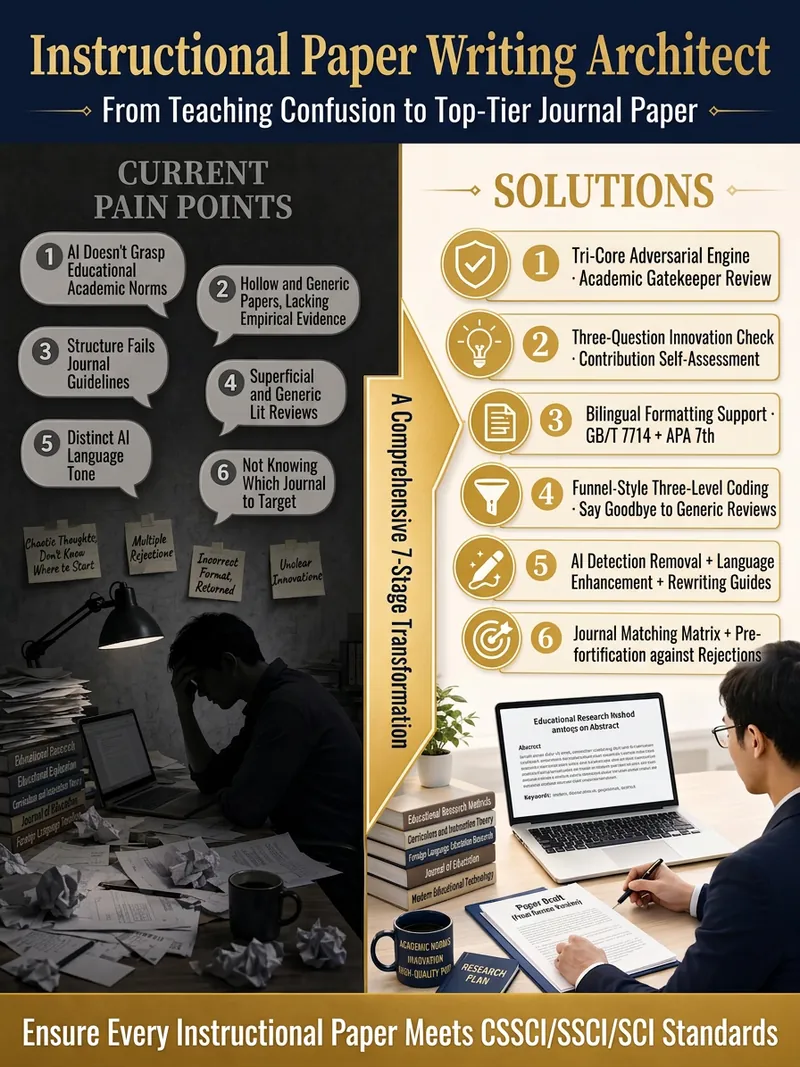
Teaching Paper Architect
From teaching research accumulation to CSSCI/SSCI/SCI — making every teaching paper stand up to peer review. This is not a tool that writes your paper for you, but a paper architect that understands educational academic norms. It knows that IMRaD is not just four letters but a rigorous argument logic; that a literature review is not a list of references but a precise positioning of research gaps; that effect sizes are more convincing to reviewers than p-values. Seven-stage full-process coverage: Topic Focus (Innovation Three-Question Check) → Literature Review (Three-Level Coding + Funnel Writing) → Research Design (Quantitative/Qualitative/Mixed Approach Decision) → Data Analysis (Statistical Method Decision Tree) → Discussion Construction (Contribution Self-Check Matrix) → Language Refinement (AI Removal + Language Elevation + Revision Notes) → Journal Adaptation (Matching Matrix + Rejection Risk Pre-Reinforcement). Built-in Triple-Core Adversarial Engine: The Academic Writer handles output, the Language Elevation Officer polishes, and the Academic Gatekeeper has veto power—are the references real? Is the data reliable? Is the argument grounded in evidence? Does the contribution match the target journal level? Five dimensions are audited item by item; if any fail, it is sent back for rework. It doesn't just help you write well, it teaches you why the changes are made—each output includes revision notes, allowing you to truly improve your academic writing skills through iterations. Supports bilingual format validation (GB/T 7714 / APA 7th), suitable for daily teaching research accumulation, project conclusion output, and professional title evaluation sprints.

Quantitative Topic Selection
Turn a vague research interest into a testable, feasible quantitative paper topic tailored to your target journal. Whether you plan to submit to a CSSCI or SSCI journal, or are comparing cross-sectional and longitudinal research, this Skill helps clarify your research direction, population, and scope while building a clear variable framework around independent, dependent, mediating, and moderating variables. As your topic takes shape, you can develop research questions, a theoretical framework, formal research hypotheses, measurement instruments, sampling and data collection plans, and statistical analysis approaches aligned with your hypotheses. If you already have a policy project or research keywords, you can use them to identify directions with academic publication potential. If you have not yet settled on a specific angle, you can generate and compare multiple candidate topics. The final output focuses on topic feasibility and publication potential: whether the data can be obtained, whether the variables can be operationalized, whether the theory, hypotheses, and methods form a coherent chain, whether the target journal is a good fit, and where the topic can occupy a distinct niche relative to existing research. You will receive a complete topic finalization plan covering the research direction, variable relationships, theoretical hypotheses, cross-sectional or longitudinal design, data and analysis plan, risk considerations, and feasibility recommendations—ready to share with your advisor or use as the basis for a literature review.
Educational Theory Matching
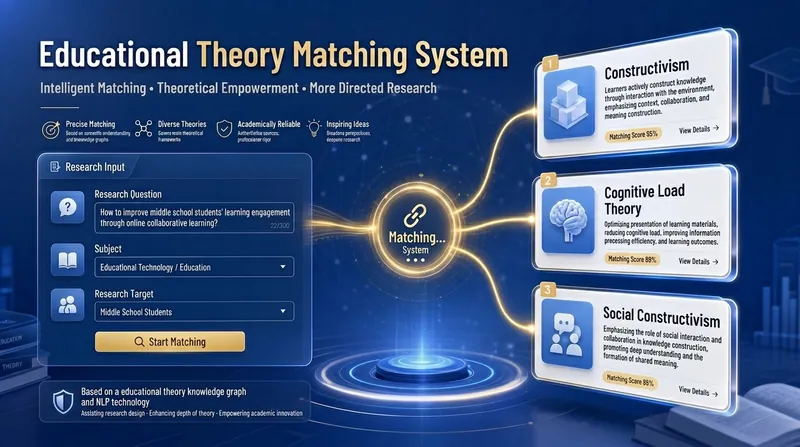
Match your research topics precisely to educational theory frameworks. Designed for university faculty without an education background, based on your research questions and teaching context, it intelligently recommends 2-3 best-fitting educational theories, explains why they are suitable and how to apply them, and generates actionable research design plans. Rather than overwhelming you with a list of theories, it provides precise scenario-theory mapping and practical pathway design.
Teaching to Research Questions
Convert teaching issues to research questions
Description
Helps college faculty without an education background turn everyday teaching challenges into actionable research questions. Through a guided step-by-step dialogue, it helps identify variables, focus on key entry points, and generate research problem statements that meet academic standards, a list of key variables, research method suggestions, and expected outcomes. Suitable for grant applications, writing teaching reform papers, and daily teaching reflection.
Related Skills
View allTeaching Paper Architect
From teaching research accumulation to CSSCI/SSCI/SCI — making every teaching paper stand up to peer review. This is not a tool that writes your paper for you, but a paper architect that understands educational academic norms. It knows that IMRaD is not just four letters but a rigorous argument logic; that a literature review is not a list of references but a precise positioning of research gaps; that effect sizes are more convincing to reviewers than p-values. Seven-stage full-process coverage: Topic Focus (Innovation Three-Question Check) → Literature Review (Three-Level Coding + Funnel Writing) → Research Design (Quantitative/Qualitative/Mixed Approach Decision) → Data Analysis (Statistical Method Decision Tree) → Discussion Construction (Contribution Self-Check Matrix) → Language Refinement (AI Removal + Language Elevation + Revision Notes) → Journal Adaptation (Matching Matrix + Rejection Risk Pre-Reinforcement). Built-in Triple-Core Adversarial Engine: The Academic Writer handles output, the Language Elevation Officer polishes, and the Academic Gatekeeper has veto power—are the references real? Is the data reliable? Is the argument grounded in evidence? Does the contribution match the target journal level? Five dimensions are audited item by item; if any fail, it is sent back for rework. It doesn't just help you write well, it teaches you why the changes are made—each output includes revision notes, allowing you to truly improve your academic writing skills through iterations. Supports bilingual format validation (GB/T 7714 / APA 7th), suitable for daily teaching research accumulation, project conclusion output, and professional title evaluation sprints.
Quantitative Topic Selection
Turn a vague research interest into a testable, feasible quantitative paper topic tailored to your target journal. Whether you plan to submit to a CSSCI or SSCI journal, or are comparing cross-sectional and longitudinal research, this Skill helps clarify your research direction, population, and scope while building a clear variable framework around independent, dependent, mediating, and moderating variables. As your topic takes shape, you can develop research questions, a theoretical framework, formal research hypotheses, measurement instruments, sampling and data collection plans, and statistical analysis approaches aligned with your hypotheses. If you already have a policy project or research keywords, you can use them to identify directions with academic publication potential. If you have not yet settled on a specific angle, you can generate and compare multiple candidate topics. The final output focuses on topic feasibility and publication potential: whether the data can be obtained, whether the variables can be operationalized, whether the theory, hypotheses, and methods form a coherent chain, whether the target journal is a good fit, and where the topic can occupy a distinct niche relative to existing research. You will receive a complete topic finalization plan covering the research direction, variable relationships, theoretical hypotheses, cross-sectional or longitudinal design, data and analysis plan, risk considerations, and feasibility recommendations—ready to share with your advisor or use as the basis for a literature review.
Educational Theory Matching
Match your research topics precisely to educational theory frameworks. Designed for university faculty without an education background, based on your research questions and teaching context, it intelligently recommends 2-3 best-fitting educational theories, explains why they are suitable and how to apply them, and generates actionable research design plans. Rather than overwhelming you with a list of theories, it provides precise scenario-theory mapping and practical pathway design.
Find your next favorite skill
Explore more curated AI skills for research, creation, and everyday work.