Research Gap Identifier
Description
Why we love this skill
This skill is an ideal choice for researchers, systematically identifying research gaps from literature and providing empirically supported, actionable research questions to help you quickly find innovative directions.
Systematic analysis of literature to identify research gaps and provide actionable starting points for academic research. Based on systematic literature review methodology, it proceeds through three stages: literature extraction and clustering, in-depth comprehensive analysis, and research gap identification and explanation.
Related Skills
View all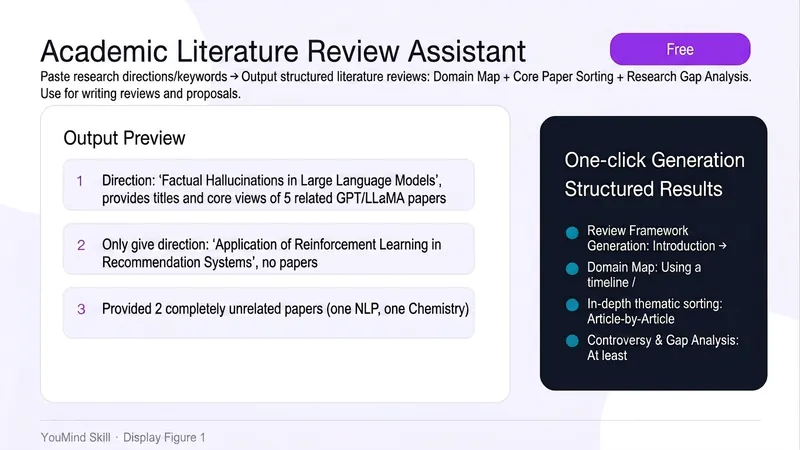
Literature Review Assistant
Writing a literature review is an inevitable challenge for graduate students—but turning information from 50 papers into a logically structured review, rather than a mere summary list, relies on methodology, not brute force. Tell it your research direction and the core papers you've already read. It first builds a framework—field map, thematic sorting, debates and gaps—then, after your confirmation, helps organize the language chapter by chapter. It doesn't write the paper for you, but helps you present the papers you've read with academic logic. ✨ Core Capabilities 1. Review framework generation: Introduction → Field map → Thematic sections → Debates and gaps → Outlook, standard academic structure 2. Field map: Sort domain development by timeline/school of thought, highlight milestone papers 3. In-depth thematic analysis: Individual paper introduction + intra-group comparison + overall contributions and limitations 4. Debate and gap analysis: At least 3 points of debate + 3 research gaps, with specific literature sources 5. Academic writing norms: Citation format, bilingual terminology, critical language rather than mere description 📱 Use Cases - Literature review chapter for graduate thesis/proposal writing - Related Work section of journal papers - Quick literature overview + structured notes when entering a new field - Used in combination with "论文速读笔记" and "论文双模研读" to form a "Read → Analyze → Synthesize" literature workflow ⚠️ Note: This skill does not perform real-time academic search. You need to provide information on papers you have already read (title/author/key points), and it helps you organize and write.

Research Paper Deconstruction
Submit an empirical research paper and receive a deep deconstruction report to help you master the essence of academic writing. This tool is based on the methodology of 'Deconstructing Papers: Understanding Academic Writing through Close Reading,' systematically analyzing the paper from diagnosing the research question, constructing the GAP, connecting theory and materials, to sentence-by-sentence close reading of key paragraphs, layer by layer, revealing the internal logic and writing techniques of the paper. You will receive a structured analysis report that includes an assessment of the specificity and essential nature of the research question, tracking of the GAP logical chain and identification of its strategy type, as well as a detailed examination of the quality of the 'two-way' connection between theory and real-world materials. The report will also specially select the strongest and weakest paragraphs, providing sentence-by-sentence logical function annotations and technique comments, and offering specific revision suggestions for areas that can be improved. This report not only helps you understand the writing secrets of high-level papers but also points out common writing mistakes, allowing you to learn while reading and improve while analyzing. Whether evaluating the depth of the research question, optimizing the narrative of the literature review, or enhancing the rigor of the discussion section, this tool provides powerful guidance to help you write more insightful and persuasive academic works.

Literature Review & Insight
Built with a three-layer analysis engine, this Skill helps you move beyond tedious literature organization and generate in-depth reviews with one click. Precisely extract core arguments, uncover research trends, and stay up to date with the latest developments in your field.
Research Gap Identifier
Description
Why we love this skill
This skill is an ideal choice for researchers, systematically identifying research gaps from literature and providing empirically supported, actionable research questions to help you quickly find innovative directions.
Systematic analysis of literature to identify research gaps and provide actionable starting points for academic research. Based on systematic literature review methodology, it proceeds through three stages: literature extraction and clustering, in-depth comprehensive analysis, and research gap identification and explanation.
Related Skills
View allLiterature Review Assistant
Writing a literature review is an inevitable challenge for graduate students—but turning information from 50 papers into a logically structured review, rather than a mere summary list, relies on methodology, not brute force. Tell it your research direction and the core papers you've already read. It first builds a framework—field map, thematic sorting, debates and gaps—then, after your confirmation, helps organize the language chapter by chapter. It doesn't write the paper for you, but helps you present the papers you've read with academic logic. ✨ Core Capabilities 1. Review framework generation: Introduction → Field map → Thematic sections → Debates and gaps → Outlook, standard academic structure 2. Field map: Sort domain development by timeline/school of thought, highlight milestone papers 3. In-depth thematic analysis: Individual paper introduction + intra-group comparison + overall contributions and limitations 4. Debate and gap analysis: At least 3 points of debate + 3 research gaps, with specific literature sources 5. Academic writing norms: Citation format, bilingual terminology, critical language rather than mere description 📱 Use Cases - Literature review chapter for graduate thesis/proposal writing - Related Work section of journal papers - Quick literature overview + structured notes when entering a new field - Used in combination with "论文速读笔记" and "论文双模研读" to form a "Read → Analyze → Synthesize" literature workflow ⚠️ Note: This skill does not perform real-time academic search. You need to provide information on papers you have already read (title/author/key points), and it helps you organize and write.
Research Paper Deconstruction
Submit an empirical research paper and receive a deep deconstruction report to help you master the essence of academic writing. This tool is based on the methodology of 'Deconstructing Papers: Understanding Academic Writing through Close Reading,' systematically analyzing the paper from diagnosing the research question, constructing the GAP, connecting theory and materials, to sentence-by-sentence close reading of key paragraphs, layer by layer, revealing the internal logic and writing techniques of the paper. You will receive a structured analysis report that includes an assessment of the specificity and essential nature of the research question, tracking of the GAP logical chain and identification of its strategy type, as well as a detailed examination of the quality of the 'two-way' connection between theory and real-world materials. The report will also specially select the strongest and weakest paragraphs, providing sentence-by-sentence logical function annotations and technique comments, and offering specific revision suggestions for areas that can be improved. This report not only helps you understand the writing secrets of high-level papers but also points out common writing mistakes, allowing you to learn while reading and improve while analyzing. Whether evaluating the depth of the research question, optimizing the narrative of the literature review, or enhancing the rigor of the discussion section, this tool provides powerful guidance to help you write more insightful and persuasive academic works.
Literature Review & Insight
Built with a three-layer analysis engine, this Skill helps you move beyond tedious literature organization and generate in-depth reviews with one click. Precisely extract core arguments, uncover research trends, and stay up to date with the latest developments in your field.
Find your next favorite skill
Explore more curated AI skills for research, creation, and everyday work.