慢老师 Review T+D Topic Picks
Description
This is an intelligent tool designed specifically for researchers to choose a topic before writing a review. After you directly provide a research field (e.g., 'Electrochemical Energy Storage', 'Protein Structure Prediction', 'AI for Science', etc.), the skill systematically retrieves high-impact reviews, latest research hotspots, and research gap literature from the past 3-5 years. Strictly based on Professor Man's established T+D innovation paradigm (T = Innovation Themes: methods/structures/materials/mechanisms/systems/performances; D = Innovation Directions: time dimension/summary method/new framework integration), it recommends 3-5 review writing directions with the highest innovative potential.
Related Skills
View all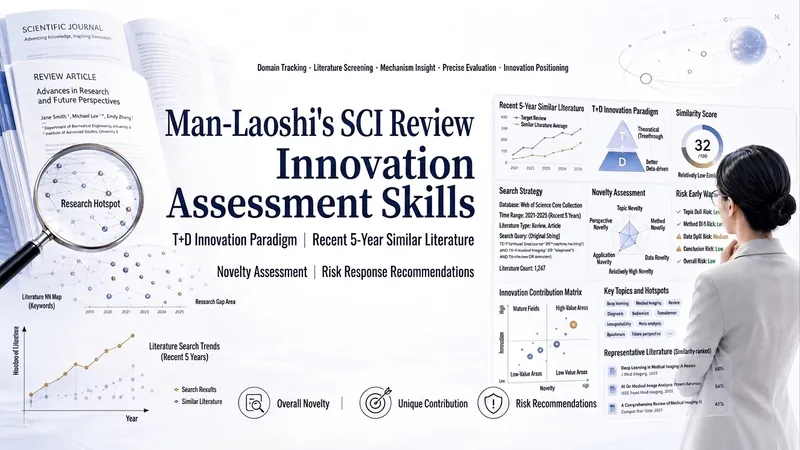
SCI Review Novelty Check – 慢老师
The 慢老师 SCI Review Novelty Check skill is an academic tool specially optimized for depth. It helps researchers systematically and accurately assess whether the innovation points of their own SCI review articles are sufficiently novel and unique, avoiding duplicate publication. The skill strictly follows Professor Slow's T+D Innovation Paradigm through a complete 4-step process: collect 6 core pieces of information from the manuscript, generate multi-dimensional search strategies in Chinese and English, real-time comparison with highly similar literature from the past 5 years, and output a professional report. Ultimately, it produces a complete Chinese report covering three major sections: [Overall Novelty Judgment], [Innovation Points and Unique Contributions], and [Potential Risks and Countermeasure Suggestions].
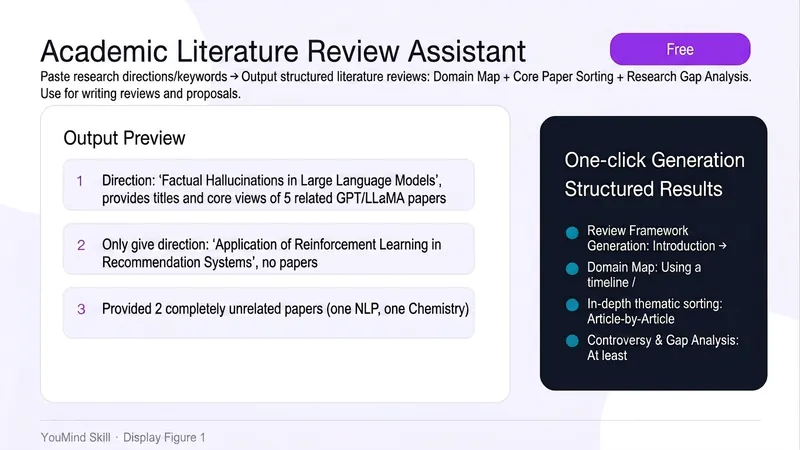
Literature Review Assistant
Writing a literature review is an inevitable challenge for graduate students—but turning information from 50 papers into a logically structured review, rather than a mere summary list, relies on methodology, not brute force. Tell it your research direction and the core papers you've already read. It first builds a framework—field map, thematic sorting, debates and gaps—then, after your confirmation, helps organize the language chapter by chapter. It doesn't write the paper for you, but helps you present the papers you've read with academic logic. ✨ Core Capabilities 1. Review framework generation: Introduction → Field map → Thematic sections → Debates and gaps → Outlook, standard academic structure 2. Field map: Sort domain development by timeline/school of thought, highlight milestone papers 3. In-depth thematic analysis: Individual paper introduction + intra-group comparison + overall contributions and limitations 4. Debate and gap analysis: At least 3 points of debate + 3 research gaps, with specific literature sources 5. Academic writing norms: Citation format, bilingual terminology, critical language rather than mere description 📱 Use Cases - Literature review chapter for graduate thesis/proposal writing - Related Work section of journal papers - Quick literature overview + structured notes when entering a new field - Used in combination with "论文速读笔记" and "论文双模研读" to form a "Read → Analyze → Synthesize" literature workflow ⚠️ Note: This skill does not perform real-time academic search. You need to provide information on papers you have already read (title/author/key points), and it helps you organize and write.
 Write
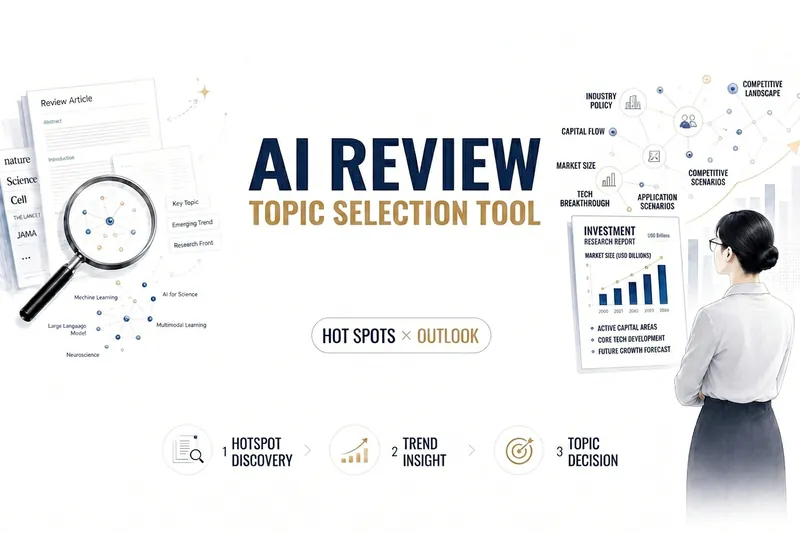
WriteReview Topic AI - Slow Teacher
Want to write a review but can't decide on a topic? This AI tool uses Deep Research (or other search tools) combined with top journal hotspots and investment reports to lock in forward-looking review topics with both trending appeal and financial potential in three steps. A must-have for researchers aiming for top journals. Click to receive high-impact recommendations.
慢老师 Review T+D Topic Picks
Description
This is an intelligent tool designed specifically for researchers to choose a topic before writing a review. After you directly provide a research field (e.g., 'Electrochemical Energy Storage', 'Protein Structure Prediction', 'AI for Science', etc.), the skill systematically retrieves high-impact reviews, latest research hotspots, and research gap literature from the past 3-5 years. Strictly based on Professor Man's established T+D innovation paradigm (T = Innovation Themes: methods/structures/materials/mechanisms/systems/performances; D = Innovation Directions: time dimension/summary method/new framework integration), it recommends 3-5 review writing directions with the highest innovative potential.
Related Skills
View allSCI Review Novelty Check – 慢老师
The 慢老师 SCI Review Novelty Check skill is an academic tool specially optimized for depth. It helps researchers systematically and accurately assess whether the innovation points of their own SCI review articles are sufficiently novel and unique, avoiding duplicate publication. The skill strictly follows Professor Slow's T+D Innovation Paradigm through a complete 4-step process: collect 6 core pieces of information from the manuscript, generate multi-dimensional search strategies in Chinese and English, real-time comparison with highly similar literature from the past 5 years, and output a professional report. Ultimately, it produces a complete Chinese report covering three major sections: [Overall Novelty Judgment], [Innovation Points and Unique Contributions], and [Potential Risks and Countermeasure Suggestions].
Literature Review Assistant
Writing a literature review is an inevitable challenge for graduate students—but turning information from 50 papers into a logically structured review, rather than a mere summary list, relies on methodology, not brute force. Tell it your research direction and the core papers you've already read. It first builds a framework—field map, thematic sorting, debates and gaps—then, after your confirmation, helps organize the language chapter by chapter. It doesn't write the paper for you, but helps you present the papers you've read with academic logic. ✨ Core Capabilities 1. Review framework generation: Introduction → Field map → Thematic sections → Debates and gaps → Outlook, standard academic structure 2. Field map: Sort domain development by timeline/school of thought, highlight milestone papers 3. In-depth thematic analysis: Individual paper introduction + intra-group comparison + overall contributions and limitations 4. Debate and gap analysis: At least 3 points of debate + 3 research gaps, with specific literature sources 5. Academic writing norms: Citation format, bilingual terminology, critical language rather than mere description 📱 Use Cases - Literature review chapter for graduate thesis/proposal writing - Related Work section of journal papers - Quick literature overview + structured notes when entering a new field - Used in combination with "论文速读笔记" and "论文双模研读" to form a "Read → Analyze → Synthesize" literature workflow ⚠️ Note: This skill does not perform real-time academic search. You need to provide information on papers you have already read (title/author/key points), and it helps you organize and write.
WriteReview Topic AI - Slow Teacher
Want to write a review but can't decide on a topic? This AI tool uses Deep Research (or other search tools) combined with top journal hotspots and investment reports to lock in forward-looking review topics with both trending appeal and financial potential in three steps. A must-have for researchers aiming for top journals. Click to receive high-impact recommendations.
Find your next favorite skill
Explore more curated AI skills for research, creation, and everyday work.