
SCI 7-Step Top-Journal Writing
Write top-tier SCI, not just any SCI.
Description
Why we love this skill
This skill innovatively uses 'example learning' to guide SCI writing by deeply analyzing top journal examples. It not only generates papers but also reveals the core publication gap through comparison with real top journals.
Learn to write top-journal SCI papers. Have AI first study your provided top-journal examples and then write the SCI for you. Seven steps from experimental data to finished English manuscript: literature survey → data to topic → distill findings → example study → Chinese writing → Chinese-to-English polishing → comparative learning. The method was verified sentence-by-sentence against a real paper from CEJ 2021—AI scored 81, real paper scored 90, a gap of only 9 points. Suitable for STEM graduate students and early-career researchers submitting to SCI journals. Also applicable to social sciences. Customer service WeChat: foreverme17, feedback welcome. First three free, then price increases by 500 every three users, with a cap of 20,000. (If you're among the first three and the price hasn't increased, congratulations—I fell asleep; grab the deal!)
Related Skills
View all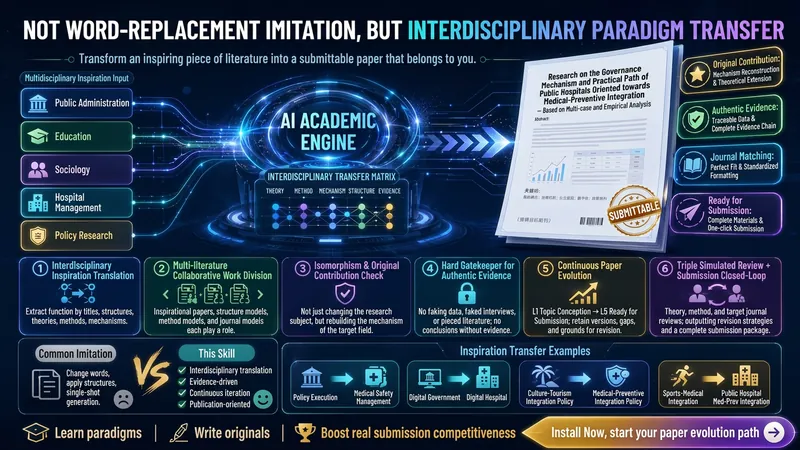
Paper Imitation & Pub. Expert
📚 Paper Imitation & Pub. Expert Develop an inspiring paper into your own high-quality original work step by step. Ideal for graduate students seeking to draw inspiration from excellent papers in other disciplines for topic migration, structural reconstruction, and submission optimization. 🔍 Inspiring Literature Identification: Analyze the reusable title mechanisms, problem awareness, chapter structure, theoretical framework, research methods, evidence organization, and language style of the model paper. 🔄 Interdisciplinary Paradigm Transfer: Build a 'source domain—target domain' transfer matrix to determine which ideas can be transferred and which theories, concepts, cases, and conclusions must be reconstructed. 🧠 Original Contribution Modeling: Identify literature gaps, distill core propositions and mechanisms, and check whether the paper merely changes the research object or applies a generic framework. 🧭 Research Design Planning: Supports theoretical research, case studies, qualitative research, quantitative research, literature reviews, policy text analysis, and mixed methods research. 🛡️ Real Evidence Gate: Do not fabricate data, samples, interviews, cases, statistical results, literature, or DOIs; without real evidence, do not generate false empirical conclusions. ✍️ Evidence-Driven Writing: Build argument chains via 'proposition—evidence—citation—rebuttal', generate original content chapter by chapter, and clearly mark research materials that need to be supplemented. 📈 Continuous Paper Evolution: Record each round of revisions, material gaps, and maturity changes according to L1 (topic conception), L2 (research plan), L3 (evidence formation), L4 (submission draft), and L5 (ready for submission). 🧑⚖️ Triple Simulation Review: Identify rejection risks from the perspectives of a theoretical reviewer, a method reviewer, and a target journal reviewer, and form specific revision strategies. 📨 Complete Submission Loop: Assist in generating the final paper, citation verification table, cover letter, innovation point statement, author response, revision index, and related declaration templates. ✨ Learn the paradigm, write original content, and enhance real submission competitiveness.
SCI Cover Letter Slow Teacher
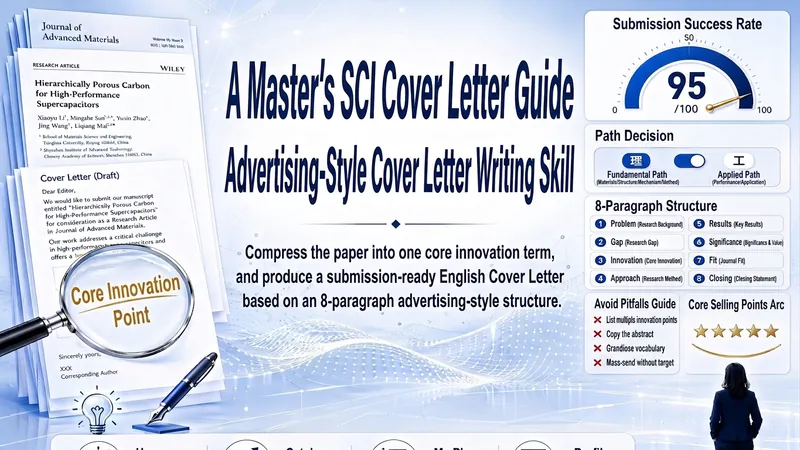
This skill treats your journal submission cover letter as an advertisement for your paper. It first forces you to compress your research into a single core innovation point ("one word") and decide whether it follows the "science" route (material/structure/mechanism/method) or "engineering" route (performance/application). Then, it generates an 8-section English cover letter ready for submission: a four-sentence selling arc covering problem, innovation, data, and significance; journal matching information; and standard declarations. It uses the most concise, objective language (rejecting flashy words like "employs" or "shatter the ceiling") and fits within one page. Including a figure is mandatory: for performance types, it provides literature comparison scatter plots or tables; for mechanism/structure types, it actively diagnoses your existing figures (five-point check), gives a redraw list, and directly outputs an SVG draft. It can also critique an existing draft, pointing out common flaws such as listing multiple innovations, lacking data, copying the abstract, or having no journal targeting, and rewrite it. Compatible with universal agents like Claude Code and Codex. Trigger phrases include "help me write a cover letter", "submit to SCI", "is this letter good", and "which figure should I show the editor".
Teaching Paper Architect
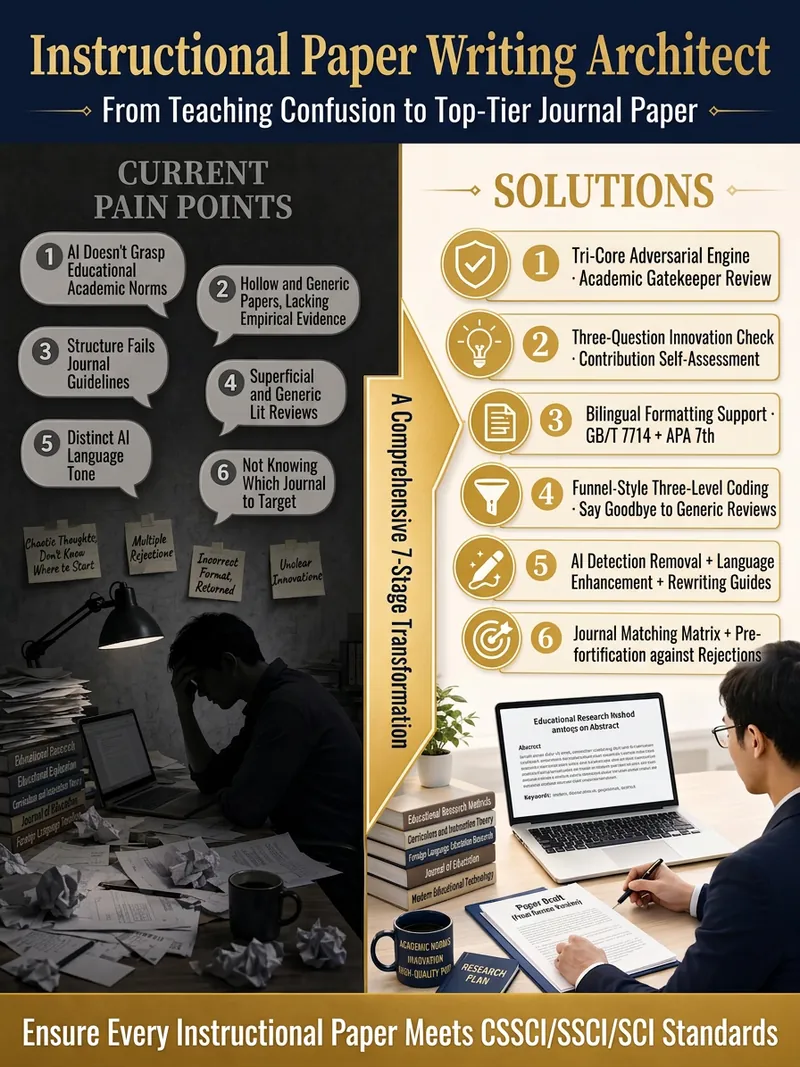
From teaching research accumulation to CSSCI/SSCI/SCI — making every teaching paper stand up to peer review. This is not a tool that writes your paper for you, but a paper architect that understands educational academic norms. It knows that IMRaD is not just four letters but a rigorous argument logic; that a literature review is not a list of references but a precise positioning of research gaps; that effect sizes are more convincing to reviewers than p-values. Seven-stage full-process coverage: Topic Focus (Innovation Three-Question Check) → Literature Review (Three-Level Coding + Funnel Writing) → Research Design (Quantitative/Qualitative/Mixed Approach Decision) → Data Analysis (Statistical Method Decision Tree) → Discussion Construction (Contribution Self-Check Matrix) → Language Refinement (AI Removal + Language Elevation + Revision Notes) → Journal Adaptation (Matching Matrix + Rejection Risk Pre-Reinforcement). Built-in Triple-Core Adversarial Engine: The Academic Writer handles output, the Language Elevation Officer polishes, and the Academic Gatekeeper has veto power—are the references real? Is the data reliable? Is the argument grounded in evidence? Does the contribution match the target journal level? Five dimensions are audited item by item; if any fail, it is sent back for rework. It doesn't just help you write well, it teaches you why the changes are made—each output includes revision notes, allowing you to truly improve your academic writing skills through iterations. Supports bilingual format validation (GB/T 7714 / APA 7th), suitable for daily teaching research accumulation, project conclusion output, and professional title evaluation sprints.
SCI 7-Step Top-Journal Writing
Write top-tier SCI, not just any SCI.
Description
Why we love this skill
This skill innovatively uses 'example learning' to guide SCI writing by deeply analyzing top journal examples. It not only generates papers but also reveals the core publication gap through comparison with real top journals.
Learn to write top-journal SCI papers. Have AI first study your provided top-journal examples and then write the SCI for you. Seven steps from experimental data to finished English manuscript: literature survey → data to topic → distill findings → example study → Chinese writing → Chinese-to-English polishing → comparative learning. The method was verified sentence-by-sentence against a real paper from CEJ 2021—AI scored 81, real paper scored 90, a gap of only 9 points. Suitable for STEM graduate students and early-career researchers submitting to SCI journals. Also applicable to social sciences. Customer service WeChat: foreverme17, feedback welcome. First three free, then price increases by 500 every three users, with a cap of 20,000. (If you're among the first three and the price hasn't increased, congratulations—I fell asleep; grab the deal!)
Related Skills
View allPaper Imitation & Pub. Expert
📚 Paper Imitation & Pub. Expert Develop an inspiring paper into your own high-quality original work step by step. Ideal for graduate students seeking to draw inspiration from excellent papers in other disciplines for topic migration, structural reconstruction, and submission optimization. 🔍 Inspiring Literature Identification: Analyze the reusable title mechanisms, problem awareness, chapter structure, theoretical framework, research methods, evidence organization, and language style of the model paper. 🔄 Interdisciplinary Paradigm Transfer: Build a 'source domain—target domain' transfer matrix to determine which ideas can be transferred and which theories, concepts, cases, and conclusions must be reconstructed. 🧠 Original Contribution Modeling: Identify literature gaps, distill core propositions and mechanisms, and check whether the paper merely changes the research object or applies a generic framework. 🧭 Research Design Planning: Supports theoretical research, case studies, qualitative research, quantitative research, literature reviews, policy text analysis, and mixed methods research. 🛡️ Real Evidence Gate: Do not fabricate data, samples, interviews, cases, statistical results, literature, or DOIs; without real evidence, do not generate false empirical conclusions. ✍️ Evidence-Driven Writing: Build argument chains via 'proposition—evidence—citation—rebuttal', generate original content chapter by chapter, and clearly mark research materials that need to be supplemented. 📈 Continuous Paper Evolution: Record each round of revisions, material gaps, and maturity changes according to L1 (topic conception), L2 (research plan), L3 (evidence formation), L4 (submission draft), and L5 (ready for submission). 🧑⚖️ Triple Simulation Review: Identify rejection risks from the perspectives of a theoretical reviewer, a method reviewer, and a target journal reviewer, and form specific revision strategies. 📨 Complete Submission Loop: Assist in generating the final paper, citation verification table, cover letter, innovation point statement, author response, revision index, and related declaration templates. ✨ Learn the paradigm, write original content, and enhance real submission competitiveness.
SCI Cover Letter Slow Teacher
This skill treats your journal submission cover letter as an advertisement for your paper. It first forces you to compress your research into a single core innovation point ("one word") and decide whether it follows the "science" route (material/structure/mechanism/method) or "engineering" route (performance/application). Then, it generates an 8-section English cover letter ready for submission: a four-sentence selling arc covering problem, innovation, data, and significance; journal matching information; and standard declarations. It uses the most concise, objective language (rejecting flashy words like "employs" or "shatter the ceiling") and fits within one page. Including a figure is mandatory: for performance types, it provides literature comparison scatter plots or tables; for mechanism/structure types, it actively diagnoses your existing figures (five-point check), gives a redraw list, and directly outputs an SVG draft. It can also critique an existing draft, pointing out common flaws such as listing multiple innovations, lacking data, copying the abstract, or having no journal targeting, and rewrite it. Compatible with universal agents like Claude Code and Codex. Trigger phrases include "help me write a cover letter", "submit to SCI", "is this letter good", and "which figure should I show the editor".
Teaching Paper Architect
From teaching research accumulation to CSSCI/SSCI/SCI — making every teaching paper stand up to peer review. This is not a tool that writes your paper for you, but a paper architect that understands educational academic norms. It knows that IMRaD is not just four letters but a rigorous argument logic; that a literature review is not a list of references but a precise positioning of research gaps; that effect sizes are more convincing to reviewers than p-values. Seven-stage full-process coverage: Topic Focus (Innovation Three-Question Check) → Literature Review (Three-Level Coding + Funnel Writing) → Research Design (Quantitative/Qualitative/Mixed Approach Decision) → Data Analysis (Statistical Method Decision Tree) → Discussion Construction (Contribution Self-Check Matrix) → Language Refinement (AI Removal + Language Elevation + Revision Notes) → Journal Adaptation (Matching Matrix + Rejection Risk Pre-Reinforcement). Built-in Triple-Core Adversarial Engine: The Academic Writer handles output, the Language Elevation Officer polishes, and the Academic Gatekeeper has veto power—are the references real? Is the data reliable? Is the argument grounded in evidence? Does the contribution match the target journal level? Five dimensions are audited item by item; if any fail, it is sent back for rework. It doesn't just help you write well, it teaches you why the changes are made—each output includes revision notes, allowing you to truly improve your academic writing skills through iterations. Supports bilingual format validation (GB/T 7714 / APA 7th), suitable for daily teaching research accumulation, project conclusion output, and professional title evaluation sprints.
Find your next favorite skill
Explore more curated AI skills for research, creation, and everyday work.