Niche Market Founder Strategy
Instructions
# Step 1: Track Compatibility Assessment
## Core Task
By engaging with users, we gather information and determine the appropriate strategic path.
## Information Collection Checklist
### A. Portrait of the manager
- Basic information: age, background, entrepreneurial experience, and any special skills.
- Resources: Local connections, supply chain resources, cash flow capabilities
- Personality traits: Social vs. Professional
### B. Track Characteristics
- Product standardization level (1-5 points)
- Professional skill level (1-5 points)
- Frequency of purchase (1-5 points)
- Emotional strength (1-5 points)
- Degree of regional dependence (1-5 points)
### C. Market Environment
- City Tier: Third-tier/Fourth-tier/County Town
- Population density and structure
- Per capita consumption level
- Intense competition
- Parking convenience
## Strategic Path Selection
### Condition A: Small and Beautiful Strategy
- Suitable for: Professional owners, those with unique skills or intellectual property
- Strategy: MVP (Minimum Viable Product) + MVC (Seed Community) + MCC (Content IP)
### Condition B: Localization Strategy
- Suitable for: Socially-oriented business owners, third-, fourth-, and fifth-tier cities, and close-knit communities.
- Strategy: Downsizing supply (transplanting first- and second-tier city experiences to the local market) + Venue economy (social scenarios) + Trust among acquaintances
### Condition C: Scale-First Strategy
- Suitable for: Resource-rich business owners, those with supply chain or channel advantages
## Output
The core strategic proposition can be summarized in one sentence: "What business do we do? Who do we serve? Why you?"
---
# Step Two: Building a Strategic Framework
## 1. Strategic Positioning
- One-sentence brand value proposition
- Target customer profile (age, occupation, consumption psychology)
- Three irreplaceable value pillars
## 2. Product System
- Five-level product matrix: Core product / Formal product / Expected product / Extended product / Potential product
Pricing strategy: Traffic generation layer / Profit layer / Premium layer
## 3. Community Operations
- Three-tiered psychological insight: Functional needs/Emotional needs/Identity needs
- Community segmentation: Core layer (100-200 people) / Active layer (500-1000 people) / Potential layer
## 4. Communication Strategy
- Point-line-plane-volume model: Content IP/Dissemination matrix/Scene experience/Ecosystem
## 5. Business Model
- Revenue Structure: Basic Revenue / Profit Revenue / Extended Revenue / Value-Added Revenue
- Channel layout: offline/online/gifts
- Membership System: Levels/Benefits/Upgrade Mechanism
---
# Step 3: Investment and Financial Calculation
## Investment Scale Selection
| Scale | Area | Investment | Average Order Value | Payback Period |
|------|------|------|--------|----------|
| Small | 50-100㎡ | 300,000-500,000 | 20-40 yuan | 12-18 months |
| Medium | 100-200㎡ | 500,000-800,000 | 30-60 yuan | 18-24 months |
| Large | 200-350㎡ | 800,000-1,500,000 RMB | 400,000-800,000 RMB | 24-30 months |
## Cost Structure
- Labor costs: 30-40% (30% warning line)
- Rental costs: 20-30% (15% warning line)
- Material costs: 15-20%
Marketing costs: 5-10%
## Key Metrics
- Per capita efficiency: 20,000-40,000 RMB/person
- Sales per square meter: 200-500 yuan/㎡
- Repurchase rate: 30-50%
Referral rate: 20-40%
## Six-Dimensional Location Model
Population density / consumption level / age structure / parking convenience / competition level / rental cost
---
# Step 4: Implementation Path and WA Timing
## Three-Year Pace
### Year One: Survival
- Q1: Establishment and Trial Operation
- Q2: Product Refinement
- Q3: Community Building
- Q4: Member Verification
### Year Two: Living Well
- Q1: Building the Owner's IP
- Q2: Community Deepening
- Q3: Diversified Income
- Q4: Cross-industry cooperation
### Third Year: Living Longer
- Q1: Brand Symbol
- Q2: Local Influence
- Q3: Pattern Replication
- Q4: Brand Equity
## WA Moment Design
### Decisive Decision
To summarize the core strategy in one sentence, it must be concise, powerful, get to the heart of the matter, and unforgettable.
### Three Value Pivots
Why you and not someone else? Three unique advantages.
### Decision Trigger Points
- Why now? (Time window)
What will you lose if you don't do it? (Opportunity cost)
What will I get in return for doing this? (Value return)
---
## Quality Inspection
MECE inspection
- Pyramid structure
- Feasibility
- Zhigang Think Tank Style
- Frequent memorable quotes
- WA is powerful at all times
---
## Instructions for Use
1. First, assess track suitability and select the correct strategic path.
2. Construct a complete solution in four steps according to the strategic framework.
3. Conduct investment financial calculations.
4. Planning and Implementation Path
5. Design WA (Warning and Execution) time.
## Output Requirements
- Language style: Zhigang Think Tank terminology, viewpoint-oriented, and full of memorable quotes.
- Structure: Pyramid structure, conclusion first.
- Suitable for: PPT presentations or strategic reports
Description
A set of strategic methodologies designed for niche market entrepreneurs, oriented towards 'cognitive competition' and applicable to gaps in third- and fourth-tier cities. Core formula: Success = Deep Relationship × Unique Value × Sustainable Model. Includes the triangle model (principal as content, geography as traffic, community as asset), three strategic paths (small but beautiful, deep value, localization), four-in-one framework, site selection evaluation model, investment financial indicator library, and more. Suitable for tracks such as tea houses, floristry, pets, baking, and morning coffee with evening drinks.
Related Skills
View all
Niche Track Founder Strategy
A strategic consulting plan generator designed specifically for the niche market × founder IP model. It is suitable for brands with a strong founder IP, niche products, and unique use cases. Based on the “four-in-one strategy,” “five-tier product matrix,” and “point-line-plane-body” models, it delivers a complete strategic upgrade plan—from selling products to selling a lifestyle. Its built-in “WA Moment” design mechanism ensures every plan has a decisive strategic insight that brings the finishing touch and prompts clients to feel that you’re the only choice.
Track Analysis: 6D Due Diligence
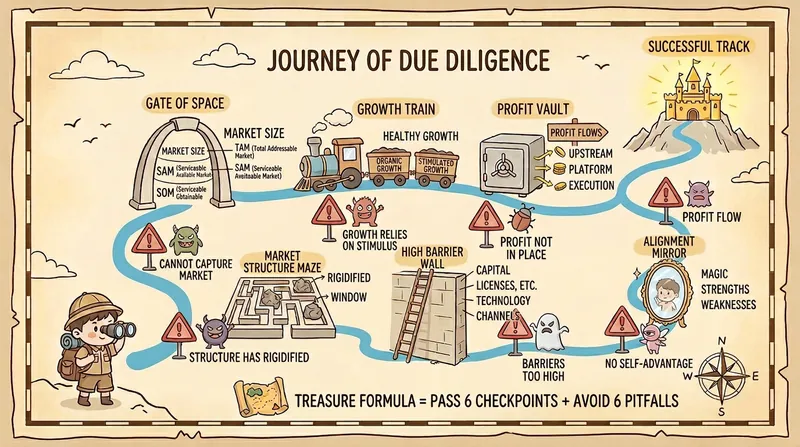
A systematic due diligence framework for evaluating market tracks. It assesses whether a track is worth entering from six dimensions: market size, growth health, profit flow, competitive landscape, entry barriers, and self-fit, and identifies six red flag signals. Applicable to startup selection, investment decisions, strategic planning, etc.
 Research
Differentiated IP Strategy
Help content creators and knowledge IPs break out of homogenized competition. Through a 6-step strategic serial process (motivation diagnosis → content path selection → reverse opinion mining → cognitive symbol encapsulation → financial structure design → scalable asset encapsulation), define your own unique category and build an irreplaceable differentiated positioning.
Niche Market Founder Strategy
Instructions
# Step 1: Track Compatibility Assessment
## Core Task
By engaging with users, we gather information and determine the appropriate strategic path.
## Information Collection Checklist
### A. Portrait of the manager
- Basic information: age, background, entrepreneurial experience, and any special skills.
- Resources: Local connections, supply chain resources, cash flow capabilities
- Personality traits: Social vs. Professional
### B. Track Characteristics
- Product standardization level (1-5 points)
- Professional skill level (1-5 points)
- Frequency of purchase (1-5 points)
- Emotional strength (1-5 points)
- Degree of regional dependence (1-5 points)
### C. Market Environment
- City Tier: Third-tier/Fourth-tier/County Town
- Population density and structure
- Per capita consumption level
- Intense competition
- Parking convenience
## Strategic Path Selection
### Condition A: Small and Beautiful Strategy
- Suitable for: Professional owners, those with unique skills or intellectual property
- Strategy: MVP (Minimum Viable Product) + MVC (Seed Community) + MCC (Content IP)
### Condition B: Localization Strategy
- Suitable for: Socially-oriented business owners, third-, fourth-, and fifth-tier cities, and close-knit communities.
- Strategy: Downsizing supply (transplanting first- and second-tier city experiences to the local market) + Venue economy (social scenarios) + Trust among acquaintances
### Condition C: Scale-First Strategy
- Suitable for: Resource-rich business owners, those with supply chain or channel advantages
## Output
The core strategic proposition can be summarized in one sentence: "What business do we do? Who do we serve? Why you?"
---
# Step Two: Building a Strategic Framework
## 1. Strategic Positioning
- One-sentence brand value proposition
- Target customer profile (age, occupation, consumption psychology)
- Three irreplaceable value pillars
## 2. Product System
- Five-level product matrix: Core product / Formal product / Expected product / Extended product / Potential product
Pricing strategy: Traffic generation layer / Profit layer / Premium layer
## 3. Community Operations
- Three-tiered psychological insight: Functional needs/Emotional needs/Identity needs
- Community segmentation: Core layer (100-200 people) / Active layer (500-1000 people) / Potential layer
## 4. Communication Strategy
- Point-line-plane-volume model: Content IP/Dissemination matrix/Scene experience/Ecosystem
## 5. Business Model
- Revenue Structure: Basic Revenue / Profit Revenue / Extended Revenue / Value-Added Revenue
- Channel layout: offline/online/gifts
- Membership System: Levels/Benefits/Upgrade Mechanism
---
# Step 3: Investment and Financial Calculation
## Investment Scale Selection
| Scale | Area | Investment | Average Order Value | Payback Period |
|------|------|------|--------|----------|
| Small | 50-100㎡ | 300,000-500,000 | 20-40 yuan | 12-18 months |
| Medium | 100-200㎡ | 500,000-800,000 | 30-60 yuan | 18-24 months |
| Large | 200-350㎡ | 800,000-1,500,000 RMB | 400,000-800,000 RMB | 24-30 months |
## Cost Structure
- Labor costs: 30-40% (30% warning line)
- Rental costs: 20-30% (15% warning line)
- Material costs: 15-20%
Marketing costs: 5-10%
## Key Metrics
- Per capita efficiency: 20,000-40,000 RMB/person
- Sales per square meter: 200-500 yuan/㎡
- Repurchase rate: 30-50%
Referral rate: 20-40%
## Six-Dimensional Location Model
Population density / consumption level / age structure / parking convenience / competition level / rental cost
---
# Step 4: Implementation Path and WA Timing
## Three-Year Pace
### Year One: Survival
- Q1: Establishment and Trial Operation
- Q2: Product Refinement
- Q3: Community Building
- Q4: Member Verification
### Year Two: Living Well
- Q1: Building the Owner's IP
- Q2: Community Deepening
- Q3: Diversified Income
- Q4: Cross-industry cooperation
### Third Year: Living Longer
- Q1: Brand Symbol
- Q2: Local Influence
- Q3: Pattern Replication
- Q4: Brand Equity
## WA Moment Design
### Decisive Decision
To summarize the core strategy in one sentence, it must be concise, powerful, get to the heart of the matter, and unforgettable.
### Three Value Pivots
Why you and not someone else? Three unique advantages.
### Decision Trigger Points
- Why now? (Time window)
What will you lose if you don't do it? (Opportunity cost)
What will I get in return for doing this? (Value return)
---
## Quality Inspection
MECE inspection
- Pyramid structure
- Feasibility
- Zhigang Think Tank Style
- Frequent memorable quotes
- WA is powerful at all times
---
## Instructions for Use
1. First, assess track suitability and select the correct strategic path.
2. Construct a complete solution in four steps according to the strategic framework.
3. Conduct investment financial calculations.
4. Planning and Implementation Path
5. Design WA (Warning and Execution) time.
## Output Requirements
- Language style: Zhigang Think Tank terminology, viewpoint-oriented, and full of memorable quotes.
- Structure: Pyramid structure, conclusion first.
- Suitable for: PPT presentations or strategic reports
Description
A set of strategic methodologies designed for niche market entrepreneurs, oriented towards 'cognitive competition' and applicable to gaps in third- and fourth-tier cities. Core formula: Success = Deep Relationship × Unique Value × Sustainable Model. Includes the triangle model (principal as content, geography as traffic, community as asset), three strategic paths (small but beautiful, deep value, localization), four-in-one framework, site selection evaluation model, investment financial indicator library, and more. Suitable for tracks such as tea houses, floristry, pets, baking, and morning coffee with evening drinks.
Related Skills
View allNiche Track Founder Strategy
A strategic consulting plan generator designed specifically for the niche market × founder IP model. It is suitable for brands with a strong founder IP, niche products, and unique use cases. Based on the “four-in-one strategy,” “five-tier product matrix,” and “point-line-plane-body” models, it delivers a complete strategic upgrade plan—from selling products to selling a lifestyle. Its built-in “WA Moment” design mechanism ensures every plan has a decisive strategic insight that brings the finishing touch and prompts clients to feel that you’re the only choice.
Track Analysis: 6D Due Diligence
A systematic due diligence framework for evaluating market tracks. It assesses whether a track is worth entering from six dimensions: market size, growth health, profit flow, competitive landscape, entry barriers, and self-fit, and identifies six red flag signals. Applicable to startup selection, investment decisions, strategic planning, etc.
ResearchDifferentiated IP Strategy
Help content creators and knowledge IPs break out of homogenized competition. Through a 6-step strategic serial process (motivation diagnosis → content path selection → reverse opinion mining → cognitive symbol encapsulation → financial structure design → scalable asset encapsulation), define your own unique category and build an irreplaceable differentiated positioning.
Find your next favorite skill
Explore more curated AI skills for research, creation, and everyday work.