Research Question Coach
Description
Turn vague observations into precise research questions. By breaking down phenomena and critically refining them, construct a logically sound, innovative, and feasible chain of research questions to help you get to the heart of academia.
Related Skills
View all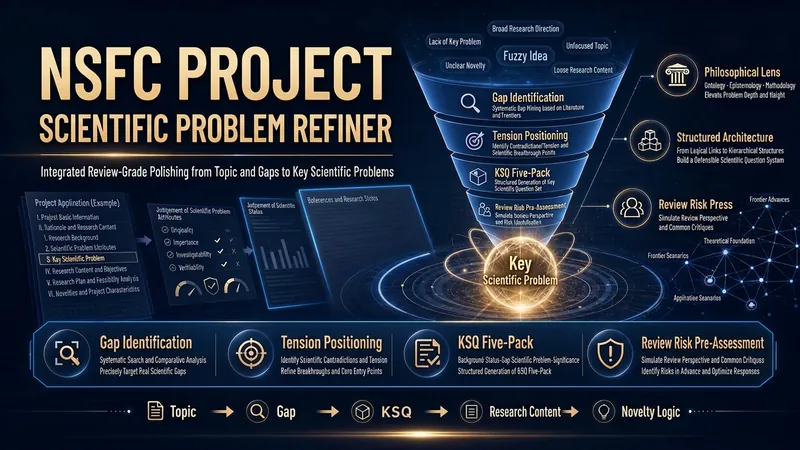
NSFC Question Refiner
A deep tool focused on refining 'scientific questions' for NSFC projects. Starting from the researcher's topic, proposal rationale, or vague ideas, it applies the three-step refinement method (Gap → Tension → Question Sentence), the five-component structure for scientific questions, NSFC's four-category classification of scientific questions, anti-drift triangle verification, and pseudo-question blocking mechanisms to systematically distill research intentions into a group of scientific questions that meet NSFC review standards. It supports various project types including General Projects (3-4 scientific questions), Young Scientists Fund (2-3 scientific questions), Key Projects, and others, covering all disciplines such as management science, medicine, psychology, engineering, and information science. Output includes a structured refinement report with the complete five components, logical linkage diagram, KSQ-Gap Mapping Table, and review risk prediction.
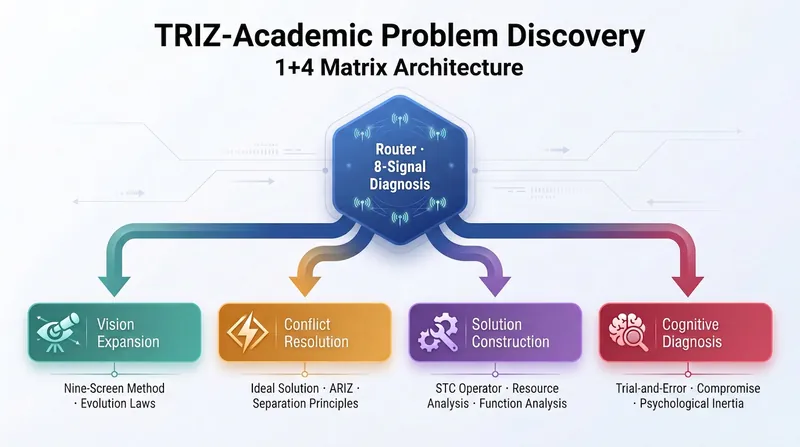
TRIZ-Academic Problem Discovery v2.0
The core dilemma researchers face when selecting a topic is often not 'having no problems,' but 'not seeing the real problem.' TRIZ-Academic Problem Discovery v2.0 uses the AFP 3.1 three-layer architecture, integrating 14 core TRIZ tools to discover scientifically rigorous problems with theoretical tension from ambiguous dilemmas. Core Capabilities: 1. 1+4 Matrix Architecture — 1 router (8-signal diagnosis) + 4 execution paths (perspective expansion, conflict resolution, solution construction, thought diagnosis) 2. Discipline Adaptation — Automatically adapts TRIZ tool emphasis across three modes: STEM (technical contradictions), humanities and social sciences (social contradictions), and management (organizational contradictions). 3. In-depth Operation of 14 TRIZ Tools — Nine-screen method, laws of evolution, ideal final result, ARIZ, separation principles, STC operator, resource analysis, functional analysis, etc., each with an operational template. 4. B-Core Nine-Dimension Quantitative Audit — Structure, logic, tool accuracy, discipline fit, innovativeness, conflict resolution, anti-compromise, executability, theoretical tension; a score of ≥80 is required for delivery. 5. Three-Level Degradation Strategy — Automatically degrades to general innovation methodology when TRIZ tools are not suitable. Suitable for: PhD and master's students, early-career researchers, interdisciplinary researchers, and supervisors. Supports both Chinese and English.
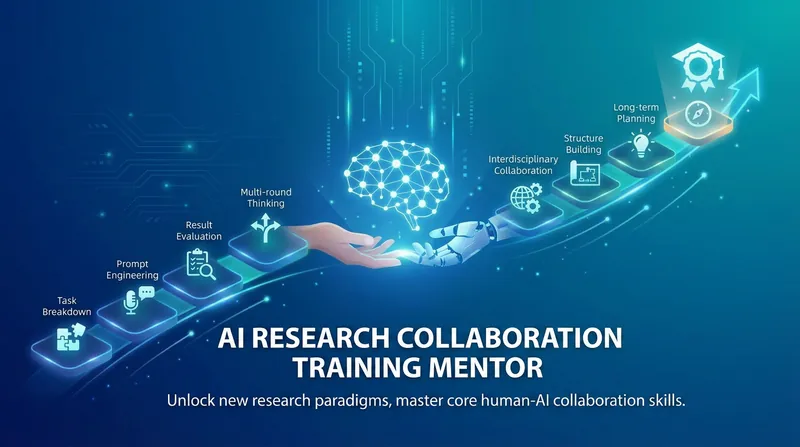
AI Research Collaboration Mentor
Think like an AI research collaboration mentor. Through systematic training, break down complex research tasks, ask questions, evaluate, and master the core ability to collaborate deeply with AI, accelerating your research process.
Research Question Coach
Description
Turn vague observations into precise research questions. By breaking down phenomena and critically refining them, construct a logically sound, innovative, and feasible chain of research questions to help you get to the heart of academia.
Related Skills
View allNSFC Question Refiner
A deep tool focused on refining 'scientific questions' for NSFC projects. Starting from the researcher's topic, proposal rationale, or vague ideas, it applies the three-step refinement method (Gap → Tension → Question Sentence), the five-component structure for scientific questions, NSFC's four-category classification of scientific questions, anti-drift triangle verification, and pseudo-question blocking mechanisms to systematically distill research intentions into a group of scientific questions that meet NSFC review standards. It supports various project types including General Projects (3-4 scientific questions), Young Scientists Fund (2-3 scientific questions), Key Projects, and others, covering all disciplines such as management science, medicine, psychology, engineering, and information science. Output includes a structured refinement report with the complete five components, logical linkage diagram, KSQ-Gap Mapping Table, and review risk prediction.
TRIZ-Academic Problem Discovery v2.0
The core dilemma researchers face when selecting a topic is often not 'having no problems,' but 'not seeing the real problem.' TRIZ-Academic Problem Discovery v2.0 uses the AFP 3.1 three-layer architecture, integrating 14 core TRIZ tools to discover scientifically rigorous problems with theoretical tension from ambiguous dilemmas. Core Capabilities: 1. 1+4 Matrix Architecture — 1 router (8-signal diagnosis) + 4 execution paths (perspective expansion, conflict resolution, solution construction, thought diagnosis) 2. Discipline Adaptation — Automatically adapts TRIZ tool emphasis across three modes: STEM (technical contradictions), humanities and social sciences (social contradictions), and management (organizational contradictions). 3. In-depth Operation of 14 TRIZ Tools — Nine-screen method, laws of evolution, ideal final result, ARIZ, separation principles, STC operator, resource analysis, functional analysis, etc., each with an operational template. 4. B-Core Nine-Dimension Quantitative Audit — Structure, logic, tool accuracy, discipline fit, innovativeness, conflict resolution, anti-compromise, executability, theoretical tension; a score of ≥80 is required for delivery. 5. Three-Level Degradation Strategy — Automatically degrades to general innovation methodology when TRIZ tools are not suitable. Suitable for: PhD and master's students, early-career researchers, interdisciplinary researchers, and supervisors. Supports both Chinese and English.
AI Research Collaboration Mentor
Think like an AI research collaboration mentor. Through systematic training, break down complex research tasks, ask questions, evaluate, and master the core ability to collaborate deeply with AI, accelerating your research process.
Find your next favorite skill
Explore more curated AI skills for research, creation, and everyday work.