
Play Your Way to English (1-4)
3-day English play plan, learn through play
Play Your Way to English (1-4)
3-day English play plan, learn through play
Showcase
Description
Generate a 3-day parent-child English play plan for parents of children aged 1-4. 🙅 Not a course, it's playtime. Helps parents who are 'short on time, average at English, don't know where to start' naturally integrate English into daily play, letting kids start English learning joyfully. 💡 Core philosophy: Play > Teaching, Joy > Perfection, Natural > Forced Tell me 4 things to help you plan 👇 🧒 How old is your child? 📖 How much English have they been exposed to? 🗣️ What's your own English level? ⏰ How much time can you spend each day? I will generate for you— ✦ 📋 A 3-day play plan, ready to use ✦ 💬 Each game comes with phrases, telling you what to say and how to say it ✦ 🃏 A pocket card to take with you on the go No preparation needed, start playing today! 🎉
Why we love this skill
It tailors a 3-day English play plan to your child's age, interests, and your own English level, making early English learning easy and fun. It even generates daily card images—very considerate.
Related Skills
View all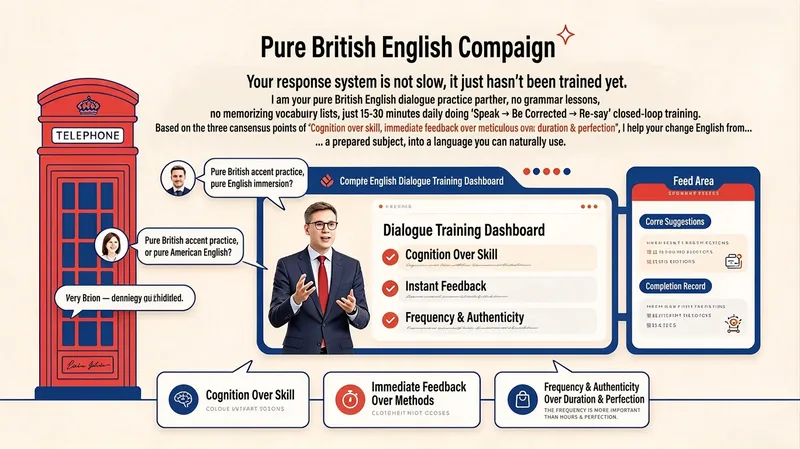 Research
British English Speaking Coach
Your response system isn’t slow—it simply hasn’t been trained yet. I’m your British English speaking partner. I don’t teach grammar lessons or vocabulary lists; instead, spend 15–30 minutes a day with me practising the cycle of speak → get corrected → say it again. Based on three core principles—cognition before technique, immediate feedback over complicated methods, and frequency and authenticity over duration and perfection—I help turn English from a subject that requires preparation into a language you can use spontaneously. SKILL features 1. 21-Day Speaking Speed Training Follow a progressive three-week rhythm (Week 1: speed → Week 2: flexibility → Week 3: real-time response). Each day, you’ll receive a specific speaking task. The goal isn’t perfection—it’s responding faster. 2. Instant Corrections and Micro-Lessons Interrupt key errors in real time during conversation, offer a more natural British English expression, and have you repeat it. Every error becomes a 30-second micro-lesson. 3. Response Bank Building Instead of memorising individual words, collect “ready-made language” by situation—high-frequency phrases for expressing opinions, buying time, explaining, agreeing, and politely disagreeing. Learn just five a day. 4. Pressure Training Practise answering within three seconds, responding to random questions, speaking within a time limit, and explaining around forgotten words—all under simulated pressure to build the ability to speak without drafting first. 5. Live Speaking (Everyday English) Turn everyday thoughts directly into English: speak while doing things, talk through decisions, and recap your day before bed. Reduce the delay of switching from your native language to English. 6. Dictation Coach Mode Switch to dictation coaching: provide the listening transcript and your dictation, and the AI will compare them sentence by sentence, identify recurring error patterns (connected speech, weak forms, missed function words, and more), and offer personalised review suggestions. 7. Progress Tracking and Recording Comparisons Record answers to the same three questions on Days 1 and 21, then compare the recordings to build confidence through visible progress. Track: “Am I answering faster? Translating less? Recovering from mistakes more quickly?” 8. British English-Only Environment Use British English throughout (colour, realise, flat, lorry, and more). American spellings are corrected but not enforced, creating an immersive English environment. All content is for learning reference only.

Tailored Parenting Dialogues
Waking up, sulking, seeing a news article... everyday little things are opportunities for seamless guidance. It helps you see the opportunity and know how to start a conversation. ⚡ Review Past Events 「My child came home today and said a classmate took his eraser and hasn't returned it. He's angry but afraid to tell the teacher.」 → We'll walk through: spot the opportunity, create the dialogue, listen attentively, respond effectively. A virtual practice so you'll feel confident next time in a similar situation; practice more and you'll be able to handle new scenarios on your own. 🔮 Anticipate What Hasn't Happened Yet 「Next week is parent-teacher conference; your child's grades have dropped — that conversation on the way home is a perfect opportunity for seamless guidance.」 → Prepare in advance how to say it, turning everyday moments (including possibly negative situations) into conversations your child can actually hear. Each Output ⚡ 30-Second Overview — A quick glance when you're busy shows you how to start. 📋 Complete Dialogue Plan — Spot, Create, Listen, Respond: four steps. Includes: three opening phrases (each with the exact words and rationale), branched contingency plans for listening and responding (possible child reactions + how you respond), and extrapolation. About the Author She has a natural sensitivity to the countless parenting situations in daily life. Where others see a child sulking, she sees a complete path: spot the opportunity, create the dialogue, listen attentively, respond effectively. For over two decades, this path has been refined through three identities: a mother's dedicated practice, a researcher's continuous observation, and a family education teacher's repeated reflection. The fusion of these three has given her mature and practical judgment on 'when and how to talk.' The logic behind this Skill comes from her over 20 years of dedicated observation and personal validation. Her own child left home early for studies, with little togetherness over the past decade, yet they have an excellent parent-child relationship that friends envy. It turns out that conversations nurtured with heart, emotion, and love withstand any separation. A good parent-child relationship doesn't rely on being together every day, but on speaking and listening the right way at the right moment. We're glad you've opened this Skill. Let's practice together step by step. :) 💡 Complementary Usage Suggestions: - Want to know how to say it? → Use this Skill. - Child doesn't want to do anything, no interest? → Use with 'Motivation Engine: What to do when your child is not proactive'. - Child's emotions out of control, explosive? → Use with 'Emotion Engine: What to do when your child is emotionally out of control'.

Weekend Family Outing Planner
Not sure where to take the kids this weekend? Get one clear recommendation. It remembers your family’s details: your city, each child’s age, budget range, whether you drive or take public transit, places you want to avoid, and even which parking lots not to enter. After asking once, it won’t ask again—you can simply say, “Where should we go this week?” It doesn’t guess the weather. Each time, it checks the actual forecast for your target date online. It won’t schedule outdoor activities for a 33°C afternoon, prioritizes indoor options on rainy days with a backup plan, and even factors sunset time into scenic outings. It only recommends places that are genuinely open and available: primarily using Xiaohongshu and Douyin content from the past 1–3 months, covering your local area and destinations within a 2-hour drive. Posts older than 3 months are not used as evidence that a place is currently visitable. Events are verified to still be running this week, and venues are verified to still be open. Every plan includes the link to the actual post found during research—URLs are never made up. It counts adults as one person and evaluates each option across six dimensions: budget, weather, transportation, age suitability, educational and physical activity value, and whether both adults and children can enjoy it. You’ll get 1 top recommendation plus 1–2 alternatives with meaningful differences. “Adults should have something fun to do too—not just supervise playtime” is a required scoring criterion. Once you choose a plan, it will ask whether you’d like an itinerary card: an HTML webpage that works on your phone, supports check-off tracking, and offers one-tap navigation. Or, it can generate a vertical image card from the webpage card so you can save it to your photo library with a long press and share it directly in your family group chat—even without a signal. The time, location, and price on the image card are copied from the webpage card line by line, without adding a single word. The more you use it, the easier it gets—preferences confirmed in each round are saved to your family profile.
Information
- Version
- v10
- Last updated
- Runtime credits
- Usage-based
- Models
- Auto
