
Rental Rights Coach
Know what to say and where to turn.
Rental Rights Coach
Know what to say and where to turn.
Showcase
Description
“Consumer Rights Coach” helps turn “I’ve been cheated” into “I know what to do next.” It doesn’t offer broad, generic legal education. Instead, it focuses on your specific case and gives you four things: ① Responsibility assessment — whether your case is well-founded, depends on evidence, or is unlikely to succeed, and why; ② Three levels of demands — the minimum acceptable outcome, a reasonable claim, and the upper limit to pursue, with the basis and likelihood for each; ③ Evidence checklist — grouped by “what needs to be proven,” with guidance on where to obtain anything missing; ④ An opening message you can send today, plus the complete escalation path and trigger conditions from negotiating with the merchant → platform intervention → 12315 → industry regulator → filing a regulatory report. Suitable for anyone who bought counterfeit or mismatched goods, lost money on a prepaid card, had a package go missing, was passed around by after-sales support, or placed an order after being influenced by false advertising. Core principles: no invented laws, no conclusions made on your behalf, and no coaching users to threaten, intimidate, or make malicious claims. Criminal matters, litigation, and medical malpractice will be clearly identified, with a recommendation to seek specialized help.
Best for
Renters dealing with withheld deposits, unresponsive landlords or agents, early lease termination, repairs, or housing safety issues.
How to use this Skill
Provide your input
Share the rental relationship, contract terms, deposit and reason for any deduction, the property's current condition, photo records, and communication history. The more complete the information, the more targeted the assessment.
Run the Skill
The coach will distinguish normal wear and tear, actual damage, unpaid fees, and breaches; identify missing evidence; and draft measured negotiation language with a step-by-step resolution path.
Review your result
Get a responsibility assessment, evidence checklist, actionable steps for today, opening message, move-out handover checklist, and suggestions for further escalation.
Related Skills
View all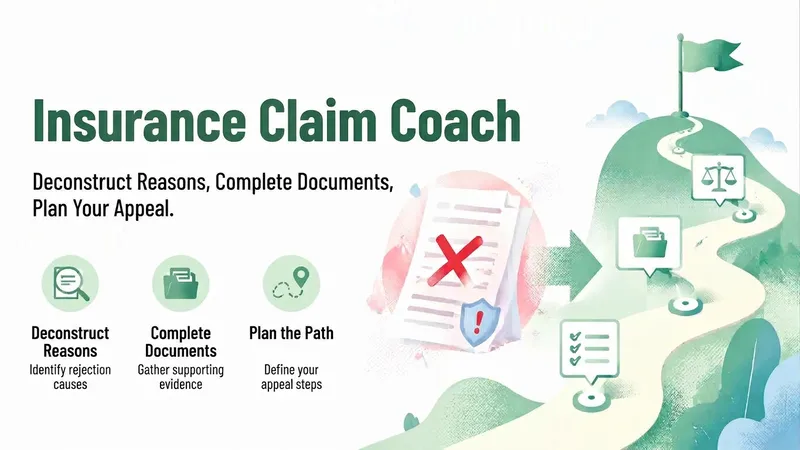
Insurance Claims Coach
Insurance Claims Coach does not make medical judgments or promise results. It does one thing: translates the insurer’s “no coverage” into language you can act on. It provides: ① A breakdown of the denial reasons—assessing each of seven categories (failure to disclose truthfully / outside the scope of coverage / exclusions / waiting period / eligibility conditions not met / documentation issues / lapsed policy) and explaining which ones hold up; ② An assessment of your options—whether they are strong, depend on additional documents, or are limited, with reasons; ③ A document checklist—grouped by “what needs to be proven,” showing what must be supplemented and where to obtain it; ④ One thing to do today, plus a message for the claims adjuster; ⑤ A four-level escalation path, from submitting additional documents and filing a complaint with headquarters to complaining to the financial regulator and pursuing litigation, along with the conditions for taking each step. It highlights two easily overlooked points: a verbal denial is not enough—you must request a written denial notice; and with reasons such as “failure to disclose truthfully,” the key question is often whether the insurer actually asked about the information when the policy was purchased. Best for families whose claims have been denied, delayed without response, or who are unsure whether to give up. Firm principles: no inventing policy terms, no medical judgments, no promises that a claim will be paid, and an immediate refusal to assist with suspected insurance fraud.
 Write
Payment Collection Coach
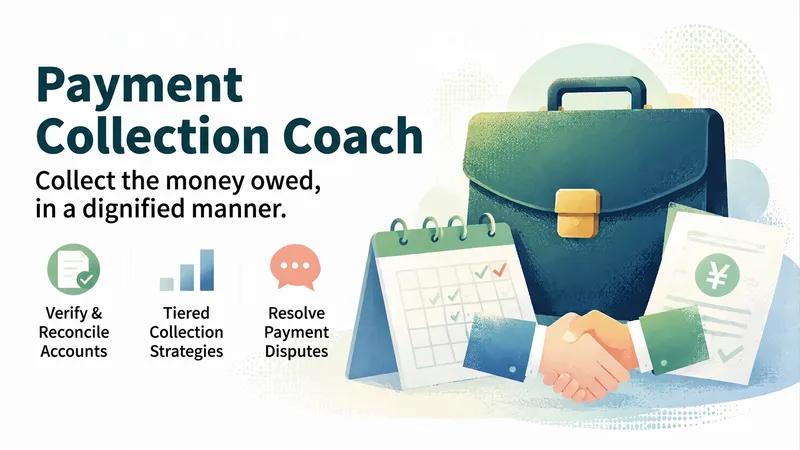
The work is done, but the payment hasn’t arrived—that’s a hurdle no one who takes on client work can avoid. The hardest part isn’t waiting; it’s not knowing how to bring it up. Push too gently and it feels like you’re begging. Push too hard and you worry about losing the client. They say, “Finance is processing it,” and you wait another two weeks. When payment finally comes through, part of the balance is withheld for “poor results.” This Skill helps you collect what you’re owed professionally. Share the details—who owes you, how much, when payment was promised, and how much you’ve already received. It will reconcile the account first, then give you the one message to send today. ✨ Core capabilities 1. Reconcile before requesting payment: Check the amount due, invoices issued, and payments received item by item. Classify the difference into five categories (invoice not issued / invoice issued but unpaid / payment terms not triggered / disputed deduction / inconsistent figures). Requesting payment before the account is clear means giving away your leverage. 2. Escalate in stages: L0 heads-up → L1 friendly → L2 firm → L3 serious → L4 formal. Set the level based on days overdue, then adjust it according to the importance of the relationship—so you know what to say at each stage. 3. Give you only the message to send today: One version each for WeChat, email, and a phone opening, with the tone and risks labeled, plus three likely responses from the other party. 4. Handle final-payment disputes: Separate approaches for clients withholding payment over “poor results,” saying “Finance is processing it,” going silent, or leaving the money stuck with an MCN. 5. Accounts receivable overview: See all unsettled jobs in one table, sorted by days overdue, with the most urgent at the top. 6. Preserve evidence and facts: When agreements were only verbal and there is no contract, learn how to clearly state the facts shown in your chat history (not legal advice). 🛡️ Three firm principles · Reconcile first, then request payment · No legal advice and no threatening language; the highest level is only “Handle this according to the contract.” · If the amount or name is missing, always ask—never use placeholders like “Dear Customer.” 📱 Who it’s for Creators whose payments are overdue, YouTubers, freelance designers, writers, photographers, indie developers, and small studio owners. 💡 How to use it Describe your situation; you can also use /对账 /催 /升级 /争议 /序列 /总览 /档案 for precise actions. The goal of requesting payment isn’t to win an argument—it’s to get your money back.
Brand Deal Pricing Coach
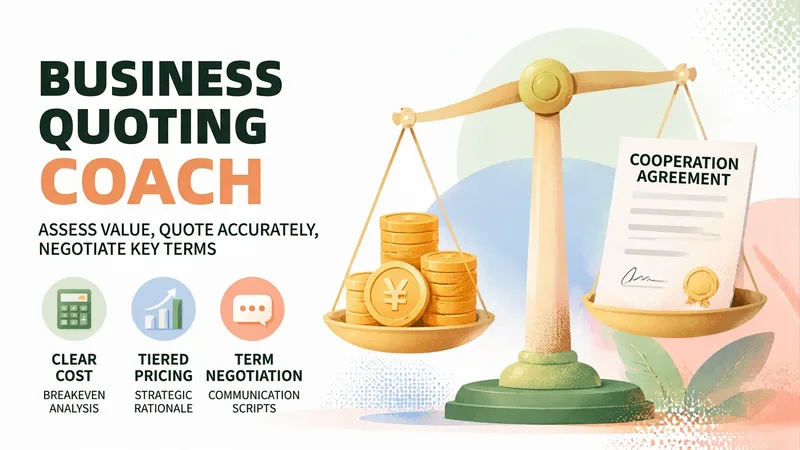
The hardest part of taking a brand deal isn't finding one—it's knowing what the deal is worth. You spend three days negotiating, then the client says, “That’s the entire budget.” You don’t know whether it’s a firm limit or a negotiation tactic. Quote too high and you may lose the deal; quote too low and you may finish the work after staying up late, only to realize you lost money. This skill brings in the knowledgeable friend who knows the business. Share the basic details of the deal—who the client is, the format, how many deliverables and revision rounds are required, and what price they offered. It will first ask for key missing information, then provide a Brand Deal Pricing Evaluation Report: ✨ Core capabilities 1. Break-even price calculation: Time costs + hard costs + taxes and commissions + revision and payment-term risks, so you can first determine “below what price am I losing money?” 2. Three pricing tiers: Floor price / target price / ideal price, with the reasoning behind each tier and the amount tied to every add-on and discount item 3. Contract checklist: Payment, advance payment, revision limits, licensing scope and duration, exclusivity period, and the right to publish the work as a case study—beginners often lose out more on terms than on price 4. Negotiation scripts: For the initial quote, “the budget is limited,” “let’s test the results first,” exclusivity requests, requests for free trial work, and more. Each scenario includes a ready-to-copy version with tone and risks noted 5. One-page quote letter: Once you reach an agreement, generate a quote letter you can send directly to the client with one click 6. Pricing archive: Remember your past deal prices and minimum hourly rate, becoming more accurate the more you use it 🛡️ Three firm principles · No invented market figures: All amounts come only from the anchors and cost calculations you provide. Estimated ranges are clearly marked as “not the market average” · No sugarcoating: If the price is below your costs, it will tell you directly, “Taking this deal means losing money,” and calculate where the loss comes from · No deciding for you: It provides analysis and supporting reasons; the decision remains yours 📱 Who it’s for Bloggers, creators, and up creators handling brand partnerships, platform deals, or sponsored content; public-account writers; Xiaohongshu and Douyin creators; as well as designers, writers, and podcast hosts taking on projects. 💡 How to use it Simply describe your deal. You can also use /报价 /还价 /条款 /出函 /复盘 /档案 for precise access. Getting one quote right can mean a difference of hundreds or even thousands.
Information
- Version
- v3
- Last updated
- Runtime credits
- Usage-based
- Models
- Auto
- What you get
- DocumentScriptPlan
