Podcast Insights Extractor
Podcast Insights Extractor
Showcase
Description
Decompose the analysis of a podcast episode into seven progressive layers: from basic information identification and topic module division, to in-depth analysis of each module, to global perspective knowledge integration, and finally to actionable summaries. It not only helps you extract 'what the guest said', but also guides you to ask 'why did they say that', 'what else was not said', and 'what can I do from this'.
Recommended by
Nico@YouMind
Why we love this skill
This skill, from the perspective of a professional knowledge extractor, deeply analyzes podcast content, from topic division to action outline, progressing layer by layer to help you systematically absorb the essence of podcasts.
Related Skills
View all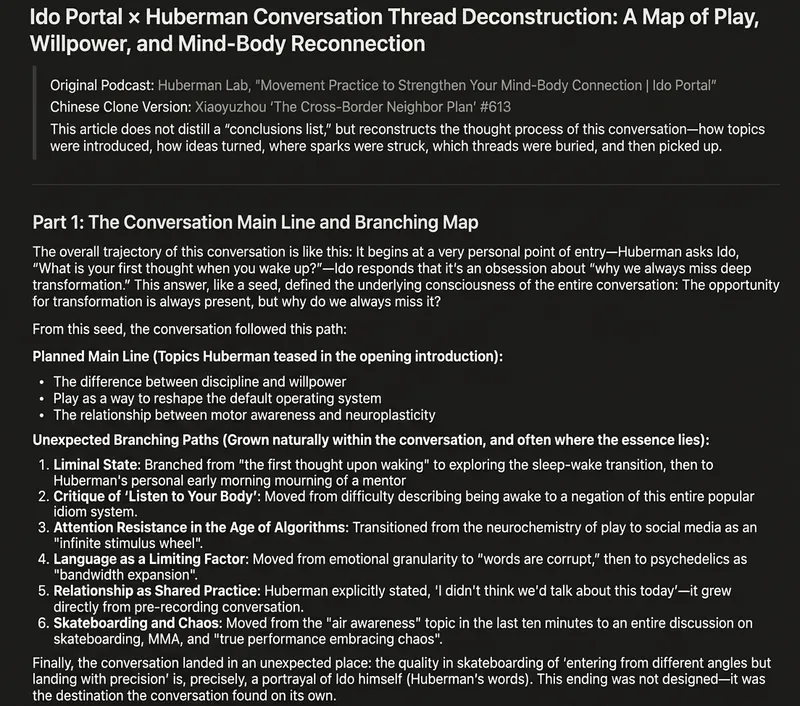
Conversation Podcast: Thinking
7/14 Update: Added content extraction and integration sections 1. Key information summary (Module 5) 2. Opinion integration and comparative analysis (Module 6): Groups scattered opinions by topic, distinguishes genuine divergence / surface divergence / consensus, and adds argument strength assessment. 3. Topic area tags (Module 7): Two-tier system of domain tags and concept tags, up to 15 tags, for future retrieval and cross-episode linking. 4. Key questions for further exploration (Module 8): Unresolved threads / logical extensions / assumptions to challenge. ———————————————— Deep analysis of conversational podcasts. This skill helps you capture the most compelling thought trajectories in conversations. It does not merely extract conclusions, but meticulously recreates collisions, generation, divergence, and extension of ideas, allowing you to see how podcast guests build their arguments step by step. You will receive a structurally clear podcast interpretation, including the main thread and unexpected "detour maps," accurately depicting the overall flow of the conversation. The skill presents the reasoning process in segments, from the origin of the topic, intermediate steps of argumentation, to the disagreements between guests and their fascinating chemistry, letting you understand the formation context of each viewpoint. Additionally, this skill highlights "sparkling moments" in the conversation, such as unexpected quotes, brilliant analogies, or 'aha' moments, along with the specific context in which they appear. You can also track the network of clues that are "laid earlier and echoed later," understanding how concepts evolve and how details mentioned early become key to later arguments. Finally, the skill lists unfinished topics and unresolved thoughts, providing inspiration for further exploration.
 Research
Goal Review & Blind Spots v1.0
Why do you need this skill? Have you ever encountered these confusions: 📝 Written many journals and notes, but don't know what they are telling you? 🤔 Always feel a gap between life and ideals, but can't pinpoint the problem? 💭 Want to plan for the future, but don't know what you truly want? 🔍 Feel like you have blind spots, but no outside perspective to help you see clearly? This skill is designed to solve these problems. It is not a cold data analysis tool, but a gentle, insightful coach that, through three core scenarios, helps you: ✨ Discover - Uncover hidden themes and emotional patterns from fragmented records ✨ Align - See the match between behaviors and values, find the root of deviations ✨ Open - Clarify 'the life I want' through carefully designed questions
Short-Form Content Extractor
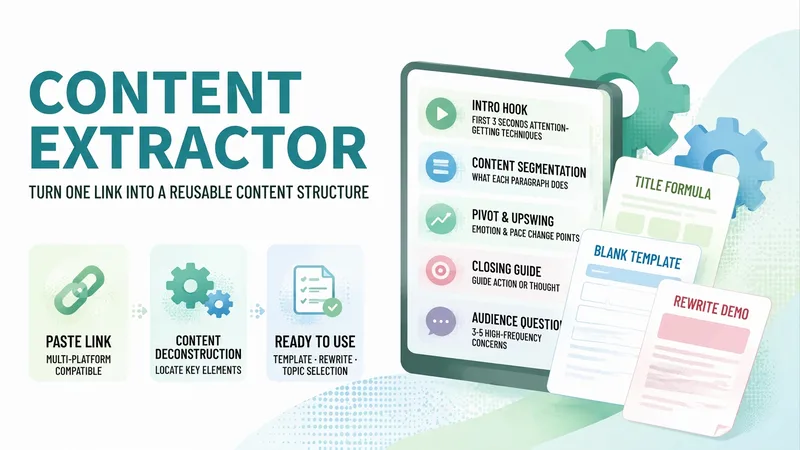
You come across a particularly well-made piece of content and want to learn its structure, but don’t know where to start. **Content Extraction Sheet** breaks down a link from Douyin, Xiaohongshu, WeChat Official Accounts, Bilibili, Weibo, or Zhihu into a practical structure you can use right away: what technique the first three-second hook uses, how many sections the content has and what each one does, where the transitions and emotional build-ups appear, and what the ending calls viewers to do. It then gives you three highly practical resources: an abstracted headline formula, with three examples adapted to your field; a blank structure template with fill-in fields; and a rewritten example based on a topic you choose. It also finds 3–5 questions viewers genuinely care about in public comments, which can become topics for your next piece of content. The honest boundary comes first: when the link content is accessible, it will clearly say “based on the original.” When it isn’t, it will say so plainly and give you a three-step method for obtaining the material—never inventing content from a link alone. Strict rules: no downloading videos, removing watermarks, bypassing login or paywalls, reposting original content, rewriting to disguise plagiarism, or extracting other people’s personal information.
Information
- Version
- v3
- Last updated
- Runtime credits
- Usage-based
- Models
- Auto
- Capabilities
- Web research
