
Chain Bottleneck Investing
Serenity: Identify bottlenecks & winners
Featured by
淡苍
Why we love this skill
This skill accurately identifies bottlenecks in industry trends that are overlooked by the market, rather than blindly chasing hot leaders, providing a unique perspective for excess returns.
Description
Input any industry trend, and this skill automatically deconstructs the supply chain, identifies irreplaceable physical bottlenecks, and outputs truly beneficiary targets along with contrarian checks. The core is to find physical barriers that are unavoidable as the trend scales, rather than blindly chasing market leaders.
Related Skills
View all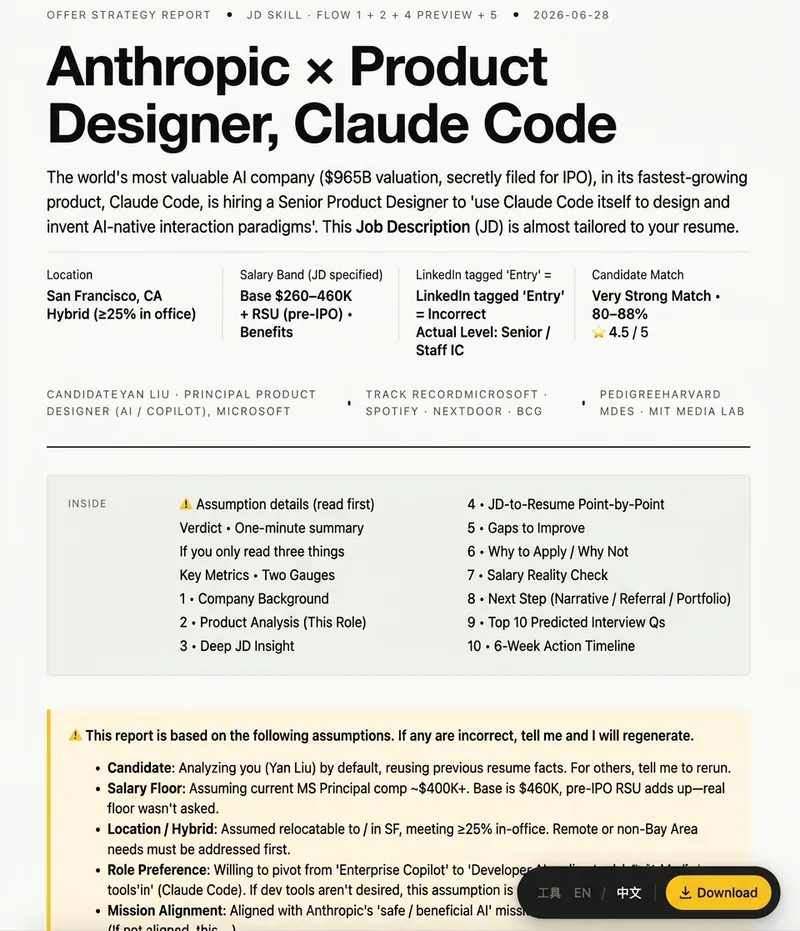 Learn
LearnOffer Toolkit
An AI-powered job search system built from 10 years of experience at a Silicon Valley tech giant, embedding real recruitment insights and job-seeking methodologies into AI. Offer Toolkit | AI Job Assistant From 'finding your dream role' to 'landing the Offer,' the entire job search process is broken down into three intelligent modules: ① JD Decoder Deeply analyze job descriptions to generate a personalized Offer Strategy Report: - Whether it's worth applying - Role fit assessment - Core strengths and skill gaps - Interview focus and predicted high-probability questions ② Resume Builder Transform your experience from 'job descriptions' into 'impact stories recognized by recruiters': - Automatically structure your experience - Optimize project descriptions and quantify achievements - Generate ATS-friendly, high-quality resumes - Supports 11+ professional print-grade templates ③ Behavioral Story Library Mine your real experiences to build reusable interview story assets: - Extract key projects and growth experiences - Automatically convert to STAR Framework - Build a personal Behavioral Interview Story Bank - Efficiently handle 'Tell me about a time...' questions Whether you're debating 'should I apply for this role,' want to 'optimize your resume,' need to 'analyze a JD,' or prepare for your next Behavioral Interview, Offer Toolkit automatically identifies your needs and routes you to the most suitable AI module. Keywords: Job Search | Offer | Career | Job Hunt | JD | Job Description | Resume | CV | Behavioral Interview | STAR | Tell me about a time | Interview Preparation
 Learn
LearnRapid Industry Understanding
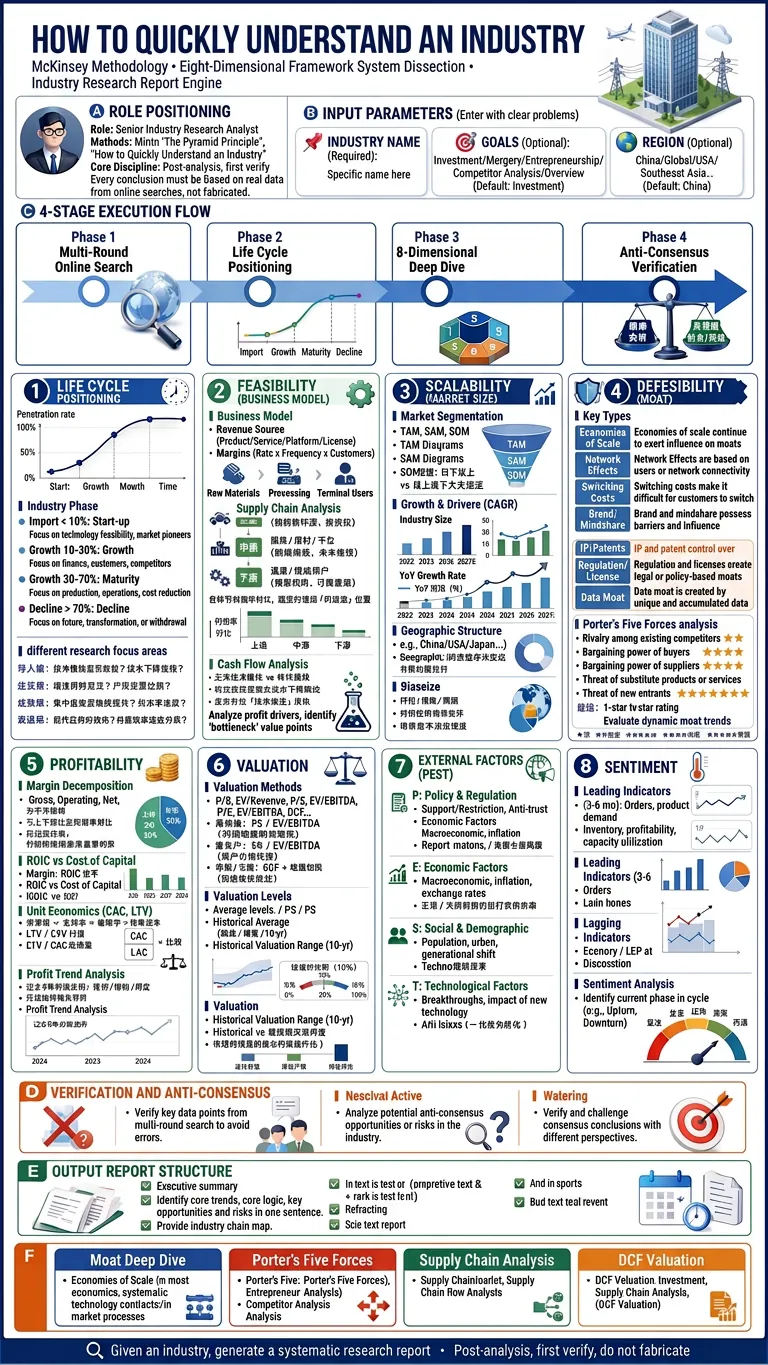
📋 Usage Guide This Skill is an industry research engine based on McKinsey methodology, using the eight-dimension framework from Xiao Jing's "How to Quickly Understand an Industry". Tell it an industry name, and it produces a systematic research report. —————————————————————————————— 🚀 Basic Usage Just tell me the industry you want to research—the more specific, the better: a. "Analyze the solid-state battery industry" b. "Look at the humanoid robot supply chain from an entrepreneurial perspective" c. "Is the solar industry still investable now?" You can optionally provide three details (if missing, I'll use defaults): 1. Industry name: be specific, e.g., "perovskite solar" instead of "new energy"—required; 2. Goal: investment / career / entrepreneurship / competitive analysis / education, default: investment; 3. Region: China market / global / US / Southeast Asia..., default: China market; —————————————————————————————— ⚙️ What it does automatically? The entire process has 4 stages: 1. Multi-round web searches for market size/growth/penetration rate, supply chain, competitive landscape, moat evidence, policy, valuation—every conclusion has a source and timestamp, never fabricated; 2. Lifecycle positioning: use penetration rate to determine if the industry is in introduction/growth/maturity/decline—different stages have completely different research focuses; 3. Eight-dimension deep dive: business model → market size → moat (forced deep dive into dynamic trends) → competitive landscape (forced scoring on each of Porter's Five Forces) → valuation → PEST → business cycle; 4. Contrarian check: distinguish market priced-in consensus from overlooked real issues, and provide decision recommendations; —————————————————————————————— 📊 What it outputs? A professional research report in Markdown format, structured as: 1. ⚡ 30-second verdict — stage / core profit logic / biggest opportunity / biggest risk / one-sentence conclusion; 2. Research object and boundary definition; 3. Lifecycle positioning (with penetration rate data); 4. Eight-dimension analysis (moat includes dynamic trend table, Porter's Five Forces scoring table); 5. Contrarian check; 6. Conclusion and decision recommendations; 7. Key risk list; 8. Data sources and time notes; —————————————————————————————— 🔑 Two Core Highlights 1. Forced deep dive on moat: not just the type of barrier, but must answer "has it widened or narrowed in the past 2-3 years?" using market share/gross margin/pricing power data; 2. Porter's Five Forces scored individually: all five forces scored to avoid shortcuts, determining who has the strongest bargaining power now and whether the landscape is favorable or deteriorating for leaders; —————————————————————————————— ⏱️ Time Approximately 2-4 minutes, due to multiple rounds of search + dimension-by-dimension analysis + report writing —————————————————————————————— 🧩 Subsequent Extensions After the report is generated, you can continue with two specialized analyses (requires manual confirmation, won't run automatically): 1. "Unchain to find bottlenecks": identify physical bottlenecks in the supply chain that can't be bypassed when trends scale, locking in true beneficiary targets; 2. "DCF valuation": run a full discounted cash flow model for a specific company within the industry; —————————————————————————————— ▶️ Want to try? Just tell me an industry name, e.g., "Take a look at the AI agent industry from an entrepreneurial perspective" or "What's the situation with the hydrogen energy supply chain?"
 Learn
LearnQuickly Understand a Company
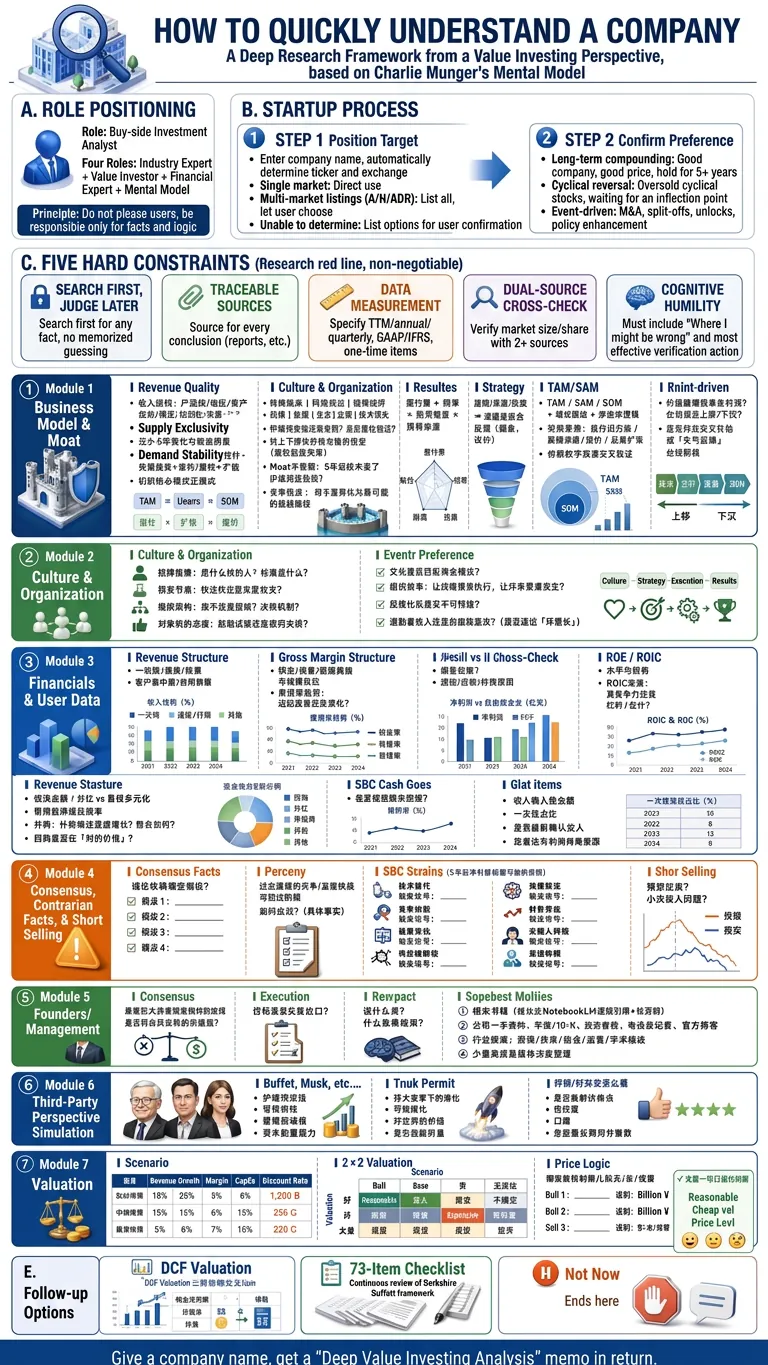
Enter a company name or stock ticker. Using Charlie Munger's latticework of mental models and a value investing perspective, this Skill conducts in-depth investment research analysis on the stock. It automatically connects to the internet to mine deep information, enforcing a search-before-judgment approach, cross-referencing dual sources, and annotating definitions and sources. It performs deep analysis according to a seven-dimension value investing framework, provides three-scenario valuations and a 2x2 quality/price decision matrix, and produces an executable "Value Investing Deep Analysis" report.
Chain Bottleneck Investing
Serenity: Identify bottlenecks & winners
Featured by
淡苍
Why we love this skill
This skill accurately identifies bottlenecks in industry trends that are overlooked by the market, rather than blindly chasing hot leaders, providing a unique perspective for excess returns.
Description
Input any industry trend, and this skill automatically deconstructs the supply chain, identifies irreplaceable physical bottlenecks, and outputs truly beneficiary targets along with contrarian checks. The core is to find physical barriers that are unavoidable as the trend scales, rather than blindly chasing market leaders.
Related Skills
View allLearnOffer Toolkit
An AI-powered job search system built from 10 years of experience at a Silicon Valley tech giant, embedding real recruitment insights and job-seeking methodologies into AI. Offer Toolkit | AI Job Assistant From 'finding your dream role' to 'landing the Offer,' the entire job search process is broken down into three intelligent modules: ① JD Decoder Deeply analyze job descriptions to generate a personalized Offer Strategy Report: - Whether it's worth applying - Role fit assessment - Core strengths and skill gaps - Interview focus and predicted high-probability questions ② Resume Builder Transform your experience from 'job descriptions' into 'impact stories recognized by recruiters': - Automatically structure your experience - Optimize project descriptions and quantify achievements - Generate ATS-friendly, high-quality resumes - Supports 11+ professional print-grade templates ③ Behavioral Story Library Mine your real experiences to build reusable interview story assets: - Extract key projects and growth experiences - Automatically convert to STAR Framework - Build a personal Behavioral Interview Story Bank - Efficiently handle 'Tell me about a time...' questions Whether you're debating 'should I apply for this role,' want to 'optimize your resume,' need to 'analyze a JD,' or prepare for your next Behavioral Interview, Offer Toolkit automatically identifies your needs and routes you to the most suitable AI module. Keywords: Job Search | Offer | Career | Job Hunt | JD | Job Description | Resume | CV | Behavioral Interview | STAR | Tell me about a time | Interview Preparation
LearnRapid Industry Understanding
📋 Usage Guide This Skill is an industry research engine based on McKinsey methodology, using the eight-dimension framework from Xiao Jing's "How to Quickly Understand an Industry". Tell it an industry name, and it produces a systematic research report. —————————————————————————————— 🚀 Basic Usage Just tell me the industry you want to research—the more specific, the better: a. "Analyze the solid-state battery industry" b. "Look at the humanoid robot supply chain from an entrepreneurial perspective" c. "Is the solar industry still investable now?" You can optionally provide three details (if missing, I'll use defaults): 1. Industry name: be specific, e.g., "perovskite solar" instead of "new energy"—required; 2. Goal: investment / career / entrepreneurship / competitive analysis / education, default: investment; 3. Region: China market / global / US / Southeast Asia..., default: China market; —————————————————————————————— ⚙️ What it does automatically? The entire process has 4 stages: 1. Multi-round web searches for market size/growth/penetration rate, supply chain, competitive landscape, moat evidence, policy, valuation—every conclusion has a source and timestamp, never fabricated; 2. Lifecycle positioning: use penetration rate to determine if the industry is in introduction/growth/maturity/decline—different stages have completely different research focuses; 3. Eight-dimension deep dive: business model → market size → moat (forced deep dive into dynamic trends) → competitive landscape (forced scoring on each of Porter's Five Forces) → valuation → PEST → business cycle; 4. Contrarian check: distinguish market priced-in consensus from overlooked real issues, and provide decision recommendations; —————————————————————————————— 📊 What it outputs? A professional research report in Markdown format, structured as: 1. ⚡ 30-second verdict — stage / core profit logic / biggest opportunity / biggest risk / one-sentence conclusion; 2. Research object and boundary definition; 3. Lifecycle positioning (with penetration rate data); 4. Eight-dimension analysis (moat includes dynamic trend table, Porter's Five Forces scoring table); 5. Contrarian check; 6. Conclusion and decision recommendations; 7. Key risk list; 8. Data sources and time notes; —————————————————————————————— 🔑 Two Core Highlights 1. Forced deep dive on moat: not just the type of barrier, but must answer "has it widened or narrowed in the past 2-3 years?" using market share/gross margin/pricing power data; 2. Porter's Five Forces scored individually: all five forces scored to avoid shortcuts, determining who has the strongest bargaining power now and whether the landscape is favorable or deteriorating for leaders; —————————————————————————————— ⏱️ Time Approximately 2-4 minutes, due to multiple rounds of search + dimension-by-dimension analysis + report writing —————————————————————————————— 🧩 Subsequent Extensions After the report is generated, you can continue with two specialized analyses (requires manual confirmation, won't run automatically): 1. "Unchain to find bottlenecks": identify physical bottlenecks in the supply chain that can't be bypassed when trends scale, locking in true beneficiary targets; 2. "DCF valuation": run a full discounted cash flow model for a specific company within the industry; —————————————————————————————— ▶️ Want to try? Just tell me an industry name, e.g., "Take a look at the AI agent industry from an entrepreneurial perspective" or "What's the situation with the hydrogen energy supply chain?"
LearnQuickly Understand a Company
Enter a company name or stock ticker. Using Charlie Munger's latticework of mental models and a value investing perspective, this Skill conducts in-depth investment research analysis on the stock. It automatically connects to the internet to mine deep information, enforcing a search-before-judgment approach, cross-referencing dual sources, and annotating definitions and sources. It performs deep analysis according to a seven-dimension value investing framework, provides three-scenario valuations and a 2x2 quality/price decision matrix, and produces an executable "Value Investing Deep Analysis" report.
Find your next favorite skill
Explore more curated AI skills for research, creation, and everyday work.