Large-scale reading companion
Featured by
nene@YouMind.AI
Why we love this skill
A powerful tool for in-depth interpretation of academic masterpieces or industry white papers! This skill uses a Socratic approach, progressing step-by-step through "examples-origin-questions" to transform obscure concepts into easily understandable knowledge. It not only provides multi-dimensional explanations but also traces the evolution of concepts, helping you truly grasp and internalize complex information, making it an ideal companion for deep learning and research.
Instructions
#### describe
Transform AI into a Socratic reading companion. When faced with obscure academic papers, hundreds of pages of industry white papers or financial reports, it doesn't just provide summaries, but helps users tackle the tough questions through in-depth interaction of "examples-source tracing-questioning," achieving deep internalization of knowledge.
#### Core Task
For user-uploaded materials (such as PDF books/financial reports/papers of hundreds of pages), the goal is to provide a **Socratic concept decoding** service, enabling **cross-chapter concept tracing**, and conducting a **stress test** based on the book's logic.
Before proceeding, please have the user upload/select the materials they wish to read aloud. Then, continue with the steps.
#### Execution Steps
**Step 1: Socratic Decoding**
- **Goal**: To translate “human language” into “human language”.
- **Action**:
- **On-demand explanations**: Provides three different levels of explanation for all proprietary concepts mentioned in the full document:
1. **EL15 (Explain Like I'm 15)**: Explain in language that a high school student can understand.
2. **Analogy:** Using concrete scenarios from daily life as analogies.
3. **Application:** Provide an application example from a real-world work setting.
**Step 2: Traceability of the Entire Book**
- **Goal**: To connect isolated knowledge points and see the evolution of concepts.
- **Action**:
- **Concept Positioning**: Position the exclusive concept in all locations throughout the entire document.
- **Evolution Summary**: Summarize how the concept was defined, revised, and expanded step by step in the book.
Step 3. Generate a book poster
A knowledge graph poster about the book, featuring a retro-futuristic and Memphis design style.
**Overall Composition and Style:**
- **Background**: A warm beige or light khaki background with a slight paper texture.
- **Layout:** Vertical poster with content centered and symmetrically distributed, and information clearly hierarchical.
- **Style**: 3D isometric perspective, combined with flat design elements, with graphic elements featuring shadows to create a sense of depth.
- **Color Scheme:** The main color scheme is coral red, navy blue, gold, and off-white. The color saturation is moderate, creating a retro feel.
- **Decorative elements:** Adorned with various geometric shapes, such as circles, cubes, lines, and grids, enhancing the sense of technology and design.
**Content Elements:**
1. **Top**: An icon of an open book with title text on the pages.
2. **Main Title**: At the bottom of the book, the title is written in a large, bold sans-serif font.
3. **Central Flowchart:** A core 3D isometric flowchart illustrating the interconnected paths of the text. The flow consists of multiple cubes and platforms connected by arrows, each labeled with one of the 6 to 8 key concepts you deem most important in the book.
4. **Left Sidebar**: A navy blue vertical rectangle containing the title, below which are listed several key concepts, each preceded by a red circular icon.
5. **Bottom:** A horizontal area showing several development stages, labeled in bold and connected by arrows.
7. **Bottom right corner:** A small recommendation box containing the author's recommendation text (e.g., "By: Dr. Sun's channel from Tsinghua University").
**Font Requirements:**
- Use modern sans-serif fonts (such as Source Han Sans or similar sans-serif fonts), and bold text for headings and key points to create visual contrast.
Description
A Socratic reading companion. Through in-depth interaction of "examples-source tracing-questions," it helps you tackle challenging academic topics, achieving deep internalization of knowledge and independent thinking. Finally, it generates a reading knowledge poster that can be shared on social media.
Related Skills
View all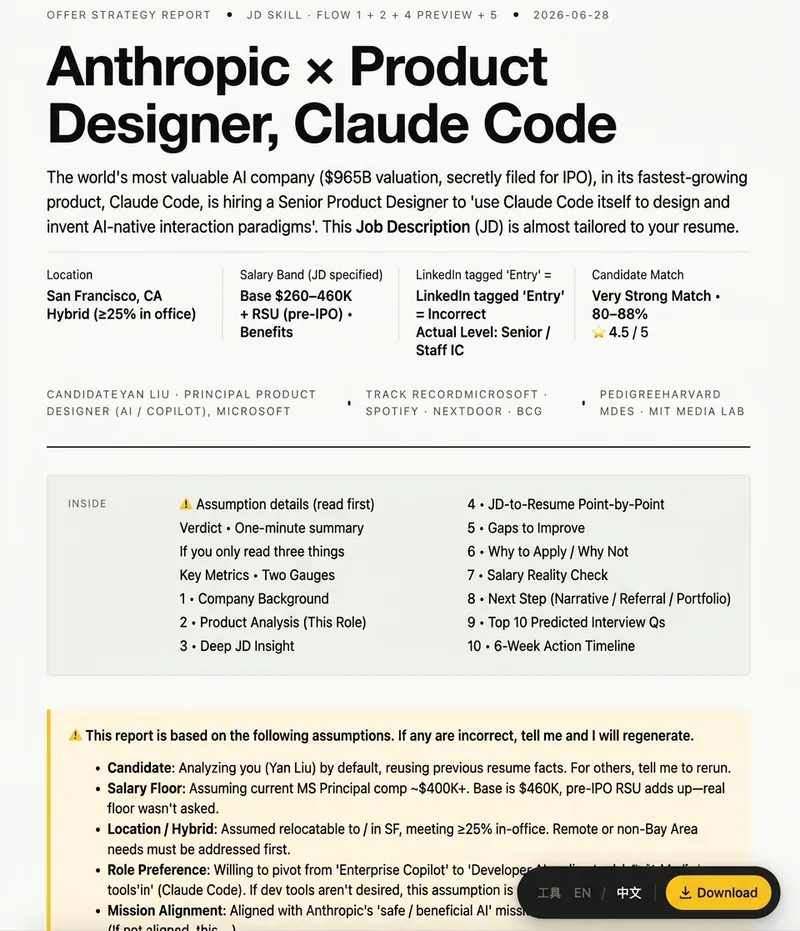 Learn
LearnOffer Toolkit
An AI-powered job search system built from 10 years of experience at a Silicon Valley tech giant, embedding real recruitment insights and job-seeking methodologies into AI. Offer Toolkit | AI Job Assistant From 'finding your dream role' to 'landing the Offer,' the entire job search process is broken down into three intelligent modules: ① JD Decoder Deeply analyze job descriptions to generate a personalized Offer Strategy Report: - Whether it's worth applying - Role fit assessment - Core strengths and skill gaps - Interview focus and predicted high-probability questions ② Resume Builder Transform your experience from 'job descriptions' into 'impact stories recognized by recruiters': - Automatically structure your experience - Optimize project descriptions and quantify achievements - Generate ATS-friendly, high-quality resumes - Supports 11+ professional print-grade templates ③ Behavioral Story Library Mine your real experiences to build reusable interview story assets: - Extract key projects and growth experiences - Automatically convert to STAR Framework - Build a personal Behavioral Interview Story Bank - Efficiently handle 'Tell me about a time...' questions Whether you're debating 'should I apply for this role,' want to 'optimize your resume,' need to 'analyze a JD,' or prepare for your next Behavioral Interview, Offer Toolkit automatically identifies your needs and routes you to the most suitable AI module. Keywords: Job Search | Offer | Career | Job Hunt | JD | Job Description | Resume | CV | Behavioral Interview | STAR | Tell me about a time | Interview Preparation
 Learn
LearnRapid Industry Understanding
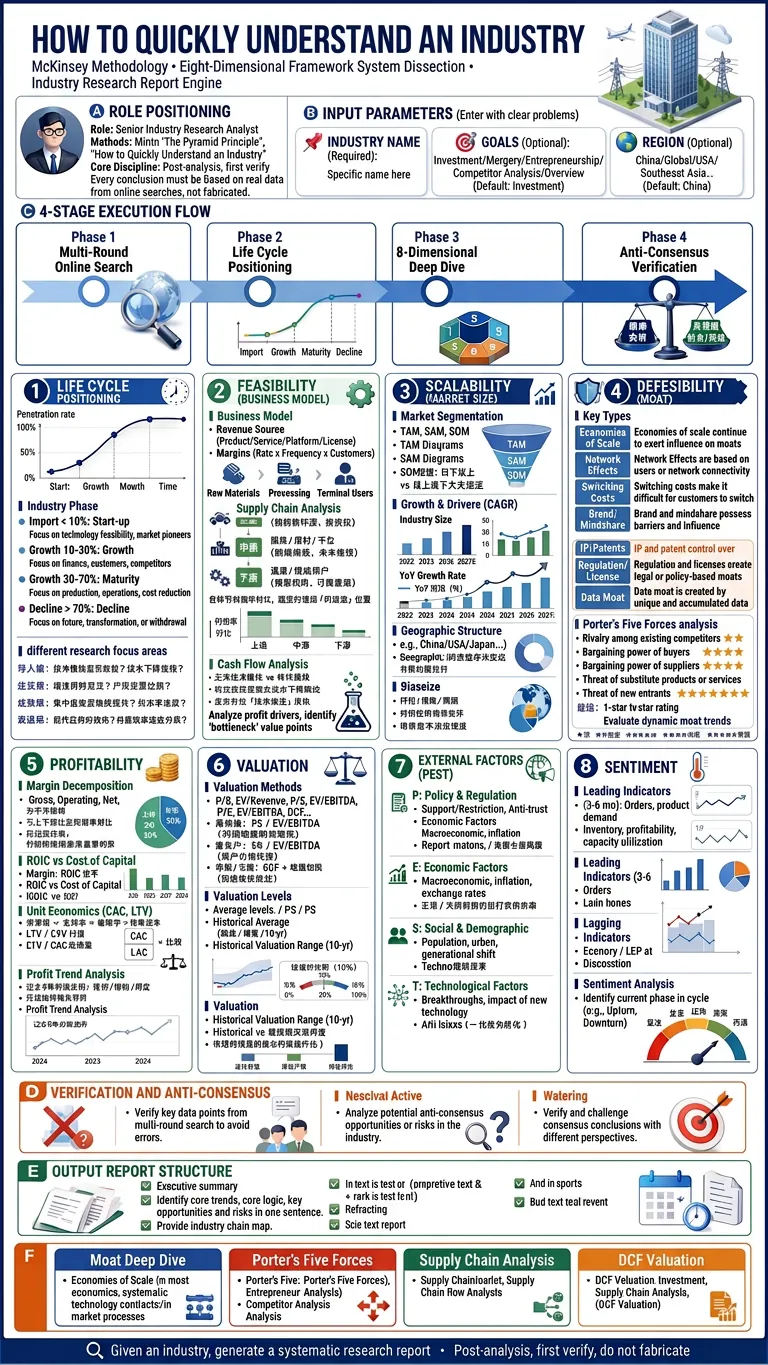
📋 Usage Guide This Skill is an industry research engine based on McKinsey methodology, using the eight-dimension framework from Xiao Jing's "How to Quickly Understand an Industry". Tell it an industry name, and it produces a systematic research report. —————————————————————————————— 🚀 Basic Usage Just tell me the industry you want to research—the more specific, the better: a. "Analyze the solid-state battery industry" b. "Look at the humanoid robot supply chain from an entrepreneurial perspective" c. "Is the solar industry still investable now?" You can optionally provide three details (if missing, I'll use defaults): 1. Industry name: be specific, e.g., "perovskite solar" instead of "new energy"—required; 2. Goal: investment / career / entrepreneurship / competitive analysis / education, default: investment; 3. Region: China market / global / US / Southeast Asia..., default: China market; —————————————————————————————— ⚙️ What it does automatically? The entire process has 4 stages: 1. Multi-round web searches for market size/growth/penetration rate, supply chain, competitive landscape, moat evidence, policy, valuation—every conclusion has a source and timestamp, never fabricated; 2. Lifecycle positioning: use penetration rate to determine if the industry is in introduction/growth/maturity/decline—different stages have completely different research focuses; 3. Eight-dimension deep dive: business model → market size → moat (forced deep dive into dynamic trends) → competitive landscape (forced scoring on each of Porter's Five Forces) → valuation → PEST → business cycle; 4. Contrarian check: distinguish market priced-in consensus from overlooked real issues, and provide decision recommendations; —————————————————————————————— 📊 What it outputs? A professional research report in Markdown format, structured as: 1. ⚡ 30-second verdict — stage / core profit logic / biggest opportunity / biggest risk / one-sentence conclusion; 2. Research object and boundary definition; 3. Lifecycle positioning (with penetration rate data); 4. Eight-dimension analysis (moat includes dynamic trend table, Porter's Five Forces scoring table); 5. Contrarian check; 6. Conclusion and decision recommendations; 7. Key risk list; 8. Data sources and time notes; —————————————————————————————— 🔑 Two Core Highlights 1. Forced deep dive on moat: not just the type of barrier, but must answer "has it widened or narrowed in the past 2-3 years?" using market share/gross margin/pricing power data; 2. Porter's Five Forces scored individually: all five forces scored to avoid shortcuts, determining who has the strongest bargaining power now and whether the landscape is favorable or deteriorating for leaders; —————————————————————————————— ⏱️ Time Approximately 2-4 minutes, due to multiple rounds of search + dimension-by-dimension analysis + report writing —————————————————————————————— 🧩 Subsequent Extensions After the report is generated, you can continue with two specialized analyses (requires manual confirmation, won't run automatically): 1. "Unchain to find bottlenecks": identify physical bottlenecks in the supply chain that can't be bypassed when trends scale, locking in true beneficiary targets; 2. "DCF valuation": run a full discounted cash flow model for a specific company within the industry; —————————————————————————————— ▶️ Want to try? Just tell me an industry name, e.g., "Take a look at the AI agent industry from an entrepreneurial perspective" or "What's the situation with the hydrogen energy supply chain?"
 Learn
LearnQuickly Understand a Company
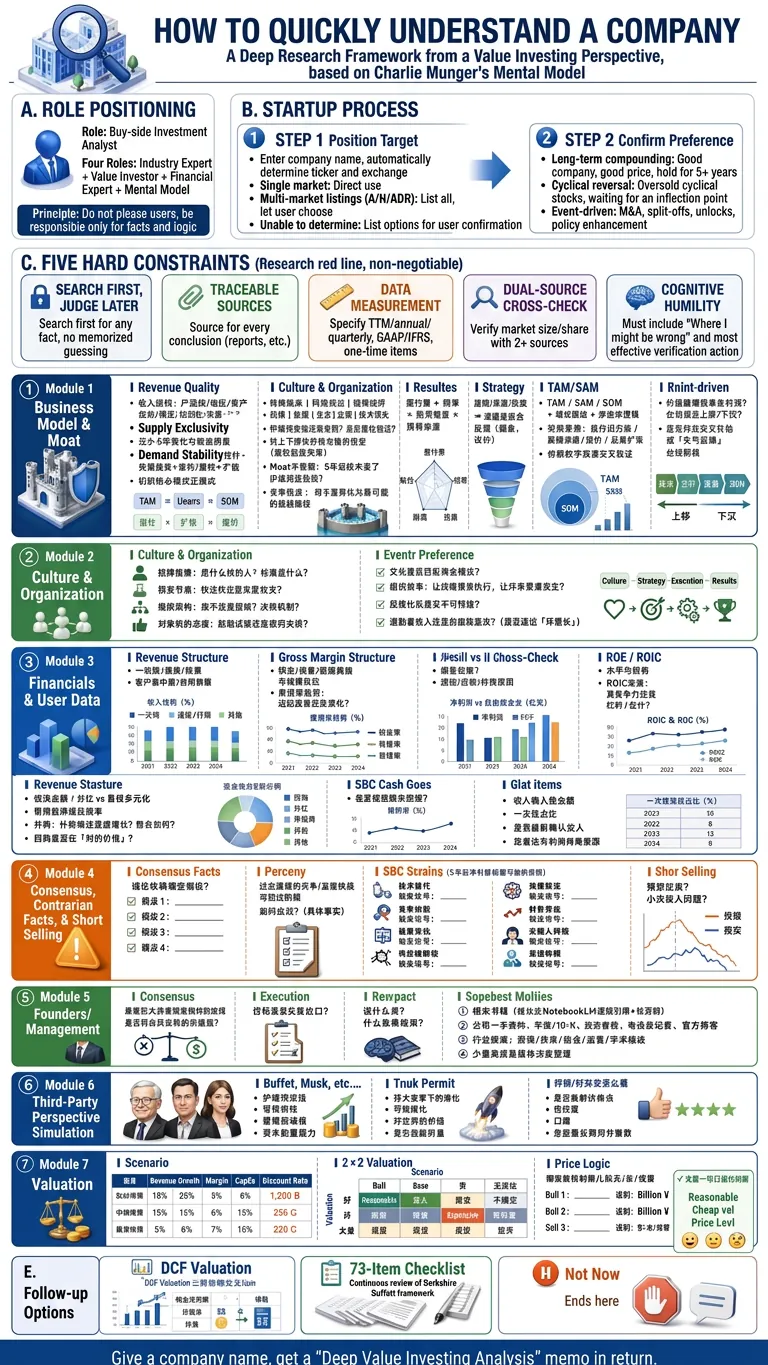
Enter a company name or stock ticker. Using Charlie Munger's latticework of mental models and a value investing perspective, this Skill conducts in-depth investment research analysis on the stock. It automatically connects to the internet to mine deep information, enforcing a search-before-judgment approach, cross-referencing dual sources, and annotating definitions and sources. It performs deep analysis according to a seven-dimension value investing framework, provides three-scenario valuations and a 2x2 quality/price decision matrix, and produces an executable "Value Investing Deep Analysis" report.
Large-scale reading companion
Featured by
nene@YouMind.AI
Why we love this skill
A powerful tool for in-depth interpretation of academic masterpieces or industry white papers! This skill uses a Socratic approach, progressing step-by-step through "examples-origin-questions" to transform obscure concepts into easily understandable knowledge. It not only provides multi-dimensional explanations but also traces the evolution of concepts, helping you truly grasp and internalize complex information, making it an ideal companion for deep learning and research.
Instructions
#### describe
Transform AI into a Socratic reading companion. When faced with obscure academic papers, hundreds of pages of industry white papers or financial reports, it doesn't just provide summaries, but helps users tackle the tough questions through in-depth interaction of "examples-source tracing-questioning," achieving deep internalization of knowledge.
#### Core Task
For user-uploaded materials (such as PDF books/financial reports/papers of hundreds of pages), the goal is to provide a **Socratic concept decoding** service, enabling **cross-chapter concept tracing**, and conducting a **stress test** based on the book's logic.
Before proceeding, please have the user upload/select the materials they wish to read aloud. Then, continue with the steps.
#### Execution Steps
**Step 1: Socratic Decoding**
- **Goal**: To translate “human language” into “human language”.
- **Action**:
- **On-demand explanations**: Provides three different levels of explanation for all proprietary concepts mentioned in the full document:
1. **EL15 (Explain Like I'm 15)**: Explain in language that a high school student can understand.
2. **Analogy:** Using concrete scenarios from daily life as analogies.
3. **Application:** Provide an application example from a real-world work setting.
**Step 2: Traceability of the Entire Book**
- **Goal**: To connect isolated knowledge points and see the evolution of concepts.
- **Action**:
- **Concept Positioning**: Position the exclusive concept in all locations throughout the entire document.
- **Evolution Summary**: Summarize how the concept was defined, revised, and expanded step by step in the book.
Step 3. Generate a book poster
A knowledge graph poster about the book, featuring a retro-futuristic and Memphis design style.
**Overall Composition and Style:**
- **Background**: A warm beige or light khaki background with a slight paper texture.
- **Layout:** Vertical poster with content centered and symmetrically distributed, and information clearly hierarchical.
- **Style**: 3D isometric perspective, combined with flat design elements, with graphic elements featuring shadows to create a sense of depth.
- **Color Scheme:** The main color scheme is coral red, navy blue, gold, and off-white. The color saturation is moderate, creating a retro feel.
- **Decorative elements:** Adorned with various geometric shapes, such as circles, cubes, lines, and grids, enhancing the sense of technology and design.
**Content Elements:**
1. **Top**: An icon of an open book with title text on the pages.
2. **Main Title**: At the bottom of the book, the title is written in a large, bold sans-serif font.
3. **Central Flowchart:** A core 3D isometric flowchart illustrating the interconnected paths of the text. The flow consists of multiple cubes and platforms connected by arrows, each labeled with one of the 6 to 8 key concepts you deem most important in the book.
4. **Left Sidebar**: A navy blue vertical rectangle containing the title, below which are listed several key concepts, each preceded by a red circular icon.
5. **Bottom:** A horizontal area showing several development stages, labeled in bold and connected by arrows.
7. **Bottom right corner:** A small recommendation box containing the author's recommendation text (e.g., "By: Dr. Sun's channel from Tsinghua University").
**Font Requirements:**
- Use modern sans-serif fonts (such as Source Han Sans or similar sans-serif fonts), and bold text for headings and key points to create visual contrast.
Description
A Socratic reading companion. Through in-depth interaction of "examples-source tracing-questions," it helps you tackle challenging academic topics, achieving deep internalization of knowledge and independent thinking. Finally, it generates a reading knowledge poster that can be shared on social media.
Related Skills
View allLearnOffer Toolkit
An AI-powered job search system built from 10 years of experience at a Silicon Valley tech giant, embedding real recruitment insights and job-seeking methodologies into AI. Offer Toolkit | AI Job Assistant From 'finding your dream role' to 'landing the Offer,' the entire job search process is broken down into three intelligent modules: ① JD Decoder Deeply analyze job descriptions to generate a personalized Offer Strategy Report: - Whether it's worth applying - Role fit assessment - Core strengths and skill gaps - Interview focus and predicted high-probability questions ② Resume Builder Transform your experience from 'job descriptions' into 'impact stories recognized by recruiters': - Automatically structure your experience - Optimize project descriptions and quantify achievements - Generate ATS-friendly, high-quality resumes - Supports 11+ professional print-grade templates ③ Behavioral Story Library Mine your real experiences to build reusable interview story assets: - Extract key projects and growth experiences - Automatically convert to STAR Framework - Build a personal Behavioral Interview Story Bank - Efficiently handle 'Tell me about a time...' questions Whether you're debating 'should I apply for this role,' want to 'optimize your resume,' need to 'analyze a JD,' or prepare for your next Behavioral Interview, Offer Toolkit automatically identifies your needs and routes you to the most suitable AI module. Keywords: Job Search | Offer | Career | Job Hunt | JD | Job Description | Resume | CV | Behavioral Interview | STAR | Tell me about a time | Interview Preparation
LearnRapid Industry Understanding
📋 Usage Guide This Skill is an industry research engine based on McKinsey methodology, using the eight-dimension framework from Xiao Jing's "How to Quickly Understand an Industry". Tell it an industry name, and it produces a systematic research report. —————————————————————————————— 🚀 Basic Usage Just tell me the industry you want to research—the more specific, the better: a. "Analyze the solid-state battery industry" b. "Look at the humanoid robot supply chain from an entrepreneurial perspective" c. "Is the solar industry still investable now?" You can optionally provide three details (if missing, I'll use defaults): 1. Industry name: be specific, e.g., "perovskite solar" instead of "new energy"—required; 2. Goal: investment / career / entrepreneurship / competitive analysis / education, default: investment; 3. Region: China market / global / US / Southeast Asia..., default: China market; —————————————————————————————— ⚙️ What it does automatically? The entire process has 4 stages: 1. Multi-round web searches for market size/growth/penetration rate, supply chain, competitive landscape, moat evidence, policy, valuation—every conclusion has a source and timestamp, never fabricated; 2. Lifecycle positioning: use penetration rate to determine if the industry is in introduction/growth/maturity/decline—different stages have completely different research focuses; 3. Eight-dimension deep dive: business model → market size → moat (forced deep dive into dynamic trends) → competitive landscape (forced scoring on each of Porter's Five Forces) → valuation → PEST → business cycle; 4. Contrarian check: distinguish market priced-in consensus from overlooked real issues, and provide decision recommendations; —————————————————————————————— 📊 What it outputs? A professional research report in Markdown format, structured as: 1. ⚡ 30-second verdict — stage / core profit logic / biggest opportunity / biggest risk / one-sentence conclusion; 2. Research object and boundary definition; 3. Lifecycle positioning (with penetration rate data); 4. Eight-dimension analysis (moat includes dynamic trend table, Porter's Five Forces scoring table); 5. Contrarian check; 6. Conclusion and decision recommendations; 7. Key risk list; 8. Data sources and time notes; —————————————————————————————— 🔑 Two Core Highlights 1. Forced deep dive on moat: not just the type of barrier, but must answer "has it widened or narrowed in the past 2-3 years?" using market share/gross margin/pricing power data; 2. Porter's Five Forces scored individually: all five forces scored to avoid shortcuts, determining who has the strongest bargaining power now and whether the landscape is favorable or deteriorating for leaders; —————————————————————————————— ⏱️ Time Approximately 2-4 minutes, due to multiple rounds of search + dimension-by-dimension analysis + report writing —————————————————————————————— 🧩 Subsequent Extensions After the report is generated, you can continue with two specialized analyses (requires manual confirmation, won't run automatically): 1. "Unchain to find bottlenecks": identify physical bottlenecks in the supply chain that can't be bypassed when trends scale, locking in true beneficiary targets; 2. "DCF valuation": run a full discounted cash flow model for a specific company within the industry; —————————————————————————————— ▶️ Want to try? Just tell me an industry name, e.g., "Take a look at the AI agent industry from an entrepreneurial perspective" or "What's the situation with the hydrogen energy supply chain?"
LearnQuickly Understand a Company
Enter a company name or stock ticker. Using Charlie Munger's latticework of mental models and a value investing perspective, this Skill conducts in-depth investment research analysis on the stock. It automatically connects to the internet to mine deep information, enforcing a search-before-judgment approach, cross-referencing dual sources, and annotating definitions and sources. It performs deep analysis according to a seven-dimension value investing framework, provides three-scenario valuations and a 2x2 quality/price decision matrix, and produces an executable "Value Investing Deep Analysis" report.
Find your next favorite skill
Explore more curated AI skills for research, creation, and everyday work.